Balochistan's Breakaway: The Reckoning Pakistan Never Saw Coming
For nearly eight decades, Pakistan has sought to project itself as the global champion of oppressed Muslims. It has spoken passionately about the rights of Palestinians, Rohingyas and Kashmiris, urging the international community to support their aspirations and condemn injustice. Yet, within its own borders lies Balochistan, a land whose people have long alleged that they have been denied the very rights Pakistan claims to champion elsewhere. The declaration by Baloch nationalist leaders proclaiming an independent Republic of Balochistan is, for them, not merely a political announcement. It is the culmination of decades of accumulated anger over political exclusion, economic neglect and alleged state repression

Balochistan's Breakaway: The Reckoning Pakistan Never Saw Coming
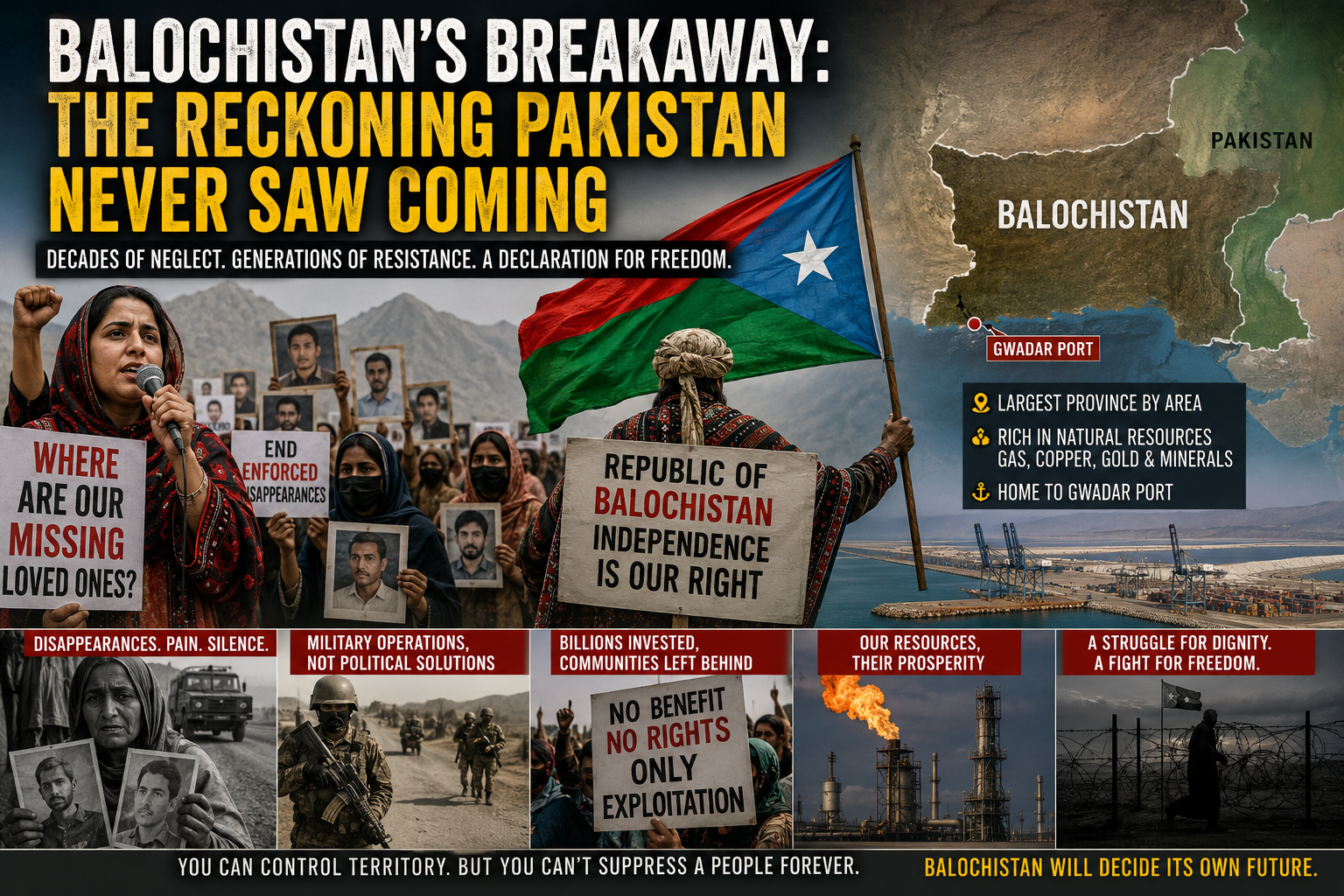
For nearly eight decades, Pakistan has sought to project itself as the global champion of oppressed Muslims. It has spoken passionately about the rights of Palestinians, Rohingyas and Kashmiris, urging the international community to support their aspirations and condemn injustice. Yet, within its own borders lies Balochistan, a land whose people have long alleged that they have been denied the very rights Pakistan claims to champion elsewhere. The declaration by Baloch nationalist leaders proclaiming an independent Republic of Balochistan is, for them, not merely a political announcement. It is the culmination of decades of accumulated anger over political exclusion, economic neglect and alleged state repression.
For India, this moment carries significance beyond the immediate political headlines. It shines a spotlight on what many in New Delhi have long viewed as Pakistan's greatest contradiction. A country that repeatedly invokes the language of self determination on the international stage has consistently resisted scrutiny over allegations of human rights abuses and political alienation within its own borders. Whether this declaration ultimately reshapes the geopolitical landscape or not, it has reignited a debate Pakistan can no longer afford to ignore.
The Colony Within Pakistan
Balochistan is Pakistan's largest province by area, accounting for nearly 44 percent of the country's landmass. It is home to vast reserves of natural gas, copper, gold and other valuable minerals. Its coastline hosts Gwadar Port, the centrepiece of the China Pakistan Economic Corridor and one of Beijing's most strategically important overseas infrastructure investments. On paper, Balochistan should have been Pakistan's greatest strategic asset.
Instead, it remains one of Pakistan's least developed regions across almost every social and economic indicator. For generations, Baloch leaders and activists have argued that Islamabad viewed their homeland as a colony to be exploited rather than a province to be empowered. Natural gas extracted from Sui fuelled industries and homes elsewhere in Pakistan long before many communities near the gas fields enjoyed basic infrastructure. Billions of dollars flowed into strategic projects that strengthened Pakistan's economy and China's regional ambitions, while many Baloch communities continued to struggle for clean drinking water, healthcare, education and employment. To many Baloch, this was never development. It was extraction without inclusion.
Decades of Repression, Generations of Resistance
The roots of Baloch discontent stretch back to 1948, when the princely State of Kalat was incorporated into Pakistan, a move that remains deeply contested by many Baloch nationalists. What followed was not reconciliation but recurring cycles of insurgency and military operations. Every decade has witnessed renewed unrest, reflecting unresolved political, constitutional and economic grievances.
Pakistan has consistently maintained that these operations are necessary to combat separatist militancy and preserve national unity. However, human rights organisations, including Amnesty International, Human Rights Watch and United Nations experts, have repeatedly raised concerns over allegations of enforced disappearances, arbitrary detentions, custodial abuses and restrictions on civil liberties in Balochistan. For thousands of Baloch families, these are not abstract political issues. They are deeply personal stories of missing fathers, brothers, sons and husbands whose whereabouts remain unknown. The pain of those families has become one of the defining symbols of the Baloch struggle.
When Dissent Became a Crime
One of the defining characteristics of the Baloch movement has been the emergence of peaceful activists demanding justice and accountability. Figures such as Dr. Mahrang Baloch have gained international attention for campaigning on issues relating to missing persons and civil rights. Their supporters argue that they represent ordinary families seeking answers through peaceful democratic means rather than violence.
The response from the Pakistani state has drawn criticism from international human rights bodies and UN experts, who have questioned the use of counterterrorism laws against civil rights activists and highlighted concerns about due process. To many observers, this reflects a larger pattern in which political dissent is increasingly treated as a national security threat instead of being addressed through democratic dialogue. Every protest becomes a law and order issue. Every demand for accountability is viewed through the prism of security.
Gwadar: The Port That Left the Baloch Behind
Few projects illustrate the Baloch sense of alienation more than Gwadar Port. Celebrated internationally as Pakistan's gateway to economic transformation, Gwadar has become one of the most strategically significant ports in the Indian Ocean. For Islamabad and Beijing, it represents commerce, connectivity and geopolitical influence.
For many local residents, however, Gwadar has become a symbol of exclusion. Activists and community leaders have argued that local communities have benefited little from the billions invested in the region. Concerns over displacement, restricted access to traditional fishing grounds and limited participation in decision making have fuelled resentment. Gleaming infrastructure may have transformed the skyline, but for many Baloch families, everyday life changed very little. They watched prosperity arrive on their shores without ever reaching their homes.
Pakistan's Greatest Hypocrisy
From an Indian perspective, Balochistan exposes a contradiction that Pakistan has struggled to explain for decades. Islamabad has consistently championed the principle of self determination when discussing Kashmir before international forums. Yet when sections of the Baloch population speak of political rights, greater autonomy or dignity, the response has overwhelmingly centred on military deployments, security operations and criminal prosecutions.
This contrast has become increasingly difficult to ignore. A state cannot endlessly demand justice abroad while resisting scrutiny over allegations of injustice within its own borders. Credibility in international affairs begins with credibility at home. Balochistan has become a stark reminder that the treatment of one's own citizens ultimately shapes the moral authority with which a nation speaks to the world.
A Declaration Forged in Decades of Betrayal
The declaration by Baloch nationalist leaders is significant not because it emerged overnight, but because it represents the accumulated frustration of generations. Political movements of this scale are not born in a day. They are forged through decades of perceived injustice, broken promises and the belief that peaceful demands have repeatedly gone unanswered.
For many Baloch nationalists, this declaration represents something far greater than politics. It is an assertion of identity, dignity and the right to decide their own future after decades in which they believe their voices were ignored. Whether history ultimately views it as the beginning of a new chapter or a powerful act of political defiance, it has succeeded in drawing unprecedented international attention to a conflict that Pakistan has long struggled to keep out of the global spotlight.
The Reckoning Islamabad Can No Longer Ignore
Pakistan can continue to describe Balochistan primarily as a security challenge. It can strengthen military deployments, tighten laws and intensify operations. But history offers a simple lesson. Political crises rooted in decades of accumulated grievances are rarely resolved through force alone. Stability ultimately depends on trust, legitimacy and the willingness of citizens to believe that they are equal stakeholders in the nation.
For India, the developments in Balochistan reaffirm a reality that has become increasingly difficult to dismiss. Pakistan's greatest challenge to its unity has not come from across its borders. It has emerged from within, fuelled by unresolved political disputes, economic disparities and longstanding allegations of human rights abuses. Nations seldom weaken because of external pressure alone. More often, they weaken when sections of their own people lose faith in the promise of the state.
The declaration by Baloch nationalist leaders is therefore far more than another headline in South Asian politics. It is a reminder that military power can enforce control, but it cannot manufacture legitimacy. Governments may command territory through force, but they earn loyalty only through justice, inclusion and trust.
Pakistan now faces a defining question that decades of military operations and political rhetoric have failed to answer. If Balochistan was truly treated as an equal partner in the federation, why have so many Baloch come to believe that their future lies outside it?
That question, more than any official statement or military operation, may well define the next chapter of Pakistan's history.
Source: Special correspondent, Delhi, CSB News USA