Ankara's Fingerprints on Dhaka's Blood
Was Bangladesh’s July 2024 uprising driven exclusively by genuine public grievances, or were broader geopolitical interests also at play? In this analysis, M. Rayhan Kabir explores what he describes as evidence of Turkish influence, intelligence networks, and strategic objectives shaping the country’s post-August political landscape.
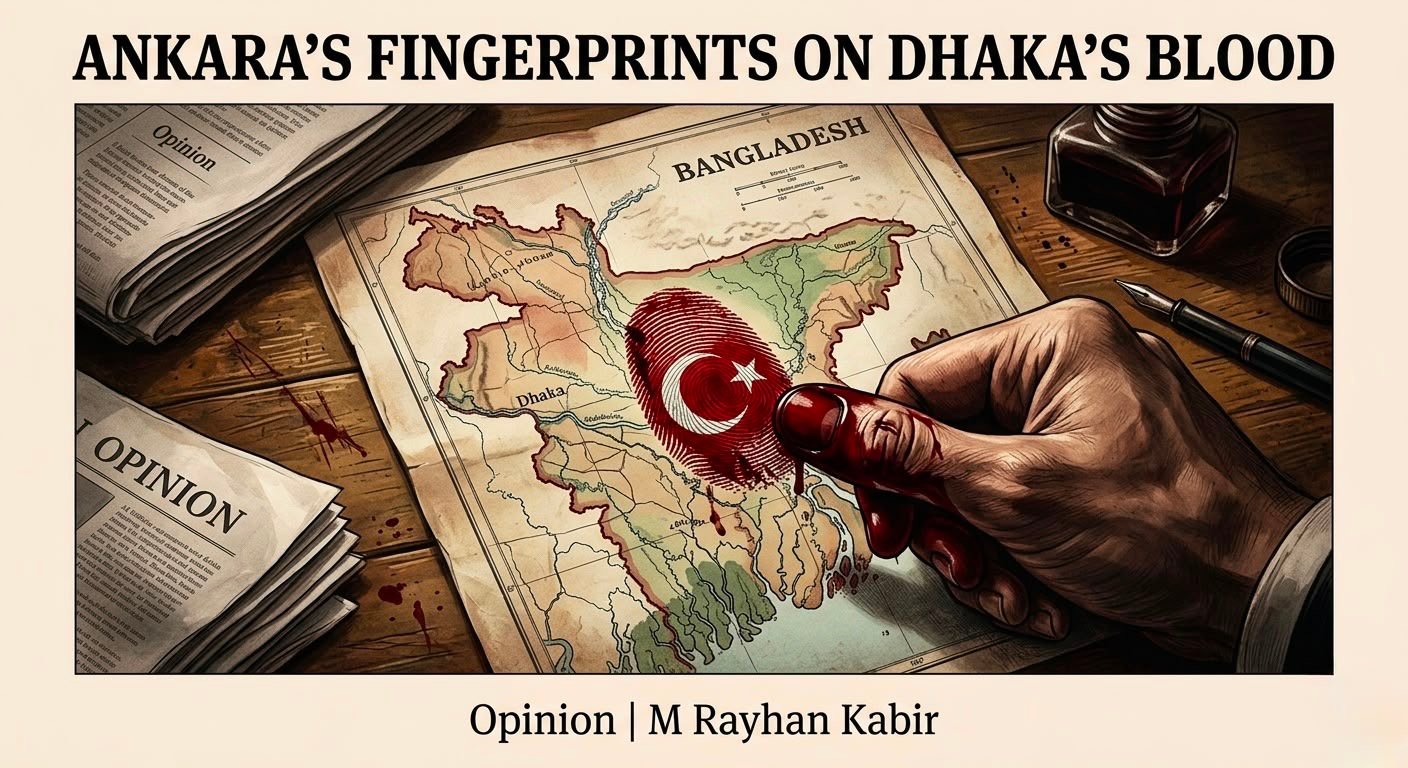
Ankara's Fingerprints on Dhaka's Blood
Bangladesh's political establishment is dodging a question that demands brutal honesty. A fifteen-year regime collapses in weeks, driven to the edge by a genuine student movement. But we are obligated to look past our own borders. Who had spent years building the infrastructure to make this exact outcome happen?
The answer the evidence points toward is not Washington alone. One actor has been systematically overlooked in the post-August accounting: Turkey. And that oversight is precisely how influence architecture of this sophistication is designed to work, invisibly, until the work is done.
A Relationship Built on Refusal
To understand why Turkey had every strategic reason to see Sheikh Hasina's government removed, look back five years before July 2024. In September 2019, on the sidelines of the 74th United Nations General Assembly, Turkish Foreign Minister Mevlüt Çavuşoğlu reiterated Ankara's proposal to establish new shelters for Rohingya refugees on allocated land in Cox's Bazar. Hasina implicitly denied the plan and outlined Bangladesh's own four-point strategy on the crisis instead.
According to investigative reports by Nordic Monitor, Bangladesh's rejection was rooted in a direct fear that Turkey would use any humanitarian camp as an incubator for Jamaat-e-Islami and radical Islamist groups, a fear that Bangladeshi officials made explicit in their internal assessments.
This was not a minor diplomatic exchange. Cox's Bazar hosts approximately one million Rohingya, the largest refugee population on earth, sitting at the mouth of the Bay of Bengal. Turkish agencies including Diyanet, TIKA, and the Turkish Red Crescent had already established a significant operational presence in the camps since 2017, as documented by the Middle East Institute. Hasina's persistent refusal to formalise that presence into permanent camp structures denied Turkey a strategic foothold it had been pursuing for years.
The bilateral relationship had already fractured in 2016 when Turkey withdrew its ambassador following the execution of Jamaat leader Motiur Rahman Nizami, and Erdoğan publicly rebuked Hasina at election rallies inside Turkey to appeal to his Islamist voter base, as reported by Nordic Monitor. Geopolitical actors operating on multi-decade timelines do not forget such systematic containment. They simply wait for a structural vulnerability to exploit.
Ideological Brothers in the Gallows
The institutional bond between Turkey's ruling Justice and Development Party and Jamaat-e-Islami Bangladesh goes back to at least 2010, according to multiple security analysts and reporting by India Tribune. Ideologically, Jamaat is the South Asian cousin of the Muslim Brotherhood model on which Erdoğan's own movement was constructed.
When Hasina's government executed Jamaat's senior leadership for 1971 war crimes, a process that ran from 2013 through 2016, Turkey issued open condemnation at each stage. Erdoğan treated each execution as an attack on a political family to which Ankara belonged. By the time the quota protests of July 2024 began, Turkey had watched its ideological partners imprisoned, hanged, their party banned, and their student wing Islami Chhatra Shibirdesignated a terrorist organisation. The July uprising did not create Turkey's motivation, it activated what had been accumulating for over a decade.
The Architecture Built Before the Crisis
Foreign influence rarely begins with street protests. It begins with relationships constructed quietly over years through religious institutions, educational exchanges, development funding, and intelligence networks. Turkey's Directorate of Religious Affairs, Diyanet, and its development agency TIKA had been expanding their presence across Bangladesh's madrasa networks and Islamic charities long before 2024, as documented by both the Middle East Institute and Manara Magazine.
Following Hasina's removal, multiple security publications including BLiTZ and MyIndMakers reported that Turkish intelligence networks funded the renovation of Jamaat's central office in Dhaka's Moghbazar, citing active intelligence sources. NGOs connected to Diyanet and TIKA also began channelling funds into Islamic charities and madrasa outreach programmes.
The open patronage was confirmed in July 2025 when Yasin Aktay, a former Turkish parliamentarian and senior personal aide to Erdoğan, paid a formal visit to Jamaat's Dhaka headquarters and met directly with Jamaat Ameer Shafiqur Rahman, as reported by India Tribune in August 2025.
The Forensic Reality of July
The quota protests were genuine in their origins. Students had a real grievance. But genuine grievances, when they coincide with pre-existing foreign operational infrastructure, do not always unfold according to their own internal logic alone. They are accelerated and directed toward outcomes that serve interests far beyond the original demands of the protesters.
The forensic evidence of the July violence raises questions that Bangladesh's current government has actively suppressed. According to analysis published by the Middle East Forum in December 2025, the majority of student fatalities were caused by 7.62mm ammunition, the calibre fired by AK-47 and sniper rifles. Bangladesh's police used rubber bullets and did not possess sniper weapons or 7.62mm calibre bullets, as confirmed by reporting in NE News in April 2026. The army deployed minimally and by documented accounts many officers resisted orders to fire on civilians. Neither force accounts for the lethal rounds that killed students in the streets.
The most significant public testimony on this question came from Former Home Affairs Adviser Brigadier General (Retd.) Sakhawat Hossain. Speaking in a televised interview reported by the Daily Sun in February 2026, Hossain stated that he had personally seen videos of men in civilian dress carrying police rifles and firing 7.62mm Chinese Type-39 weapons, which he described as a very lethal weapon, generally used as a military firearm. He added that he had seen individuals whose physical features are not like ours, people he described as outsiders, being transported by helicopter during the events.
Hossain stated he intended to launch a formal inquiry into the matter. He was subsequently relieved of the Home Affairs portfolio and reassigned to the Ministry of Textiles and Jute, as documented in the publicly available account of the July Uprising. The inquiry was never conducted. A senior government official identified the right question and was removed from the position that would have allowed him to pursue it. That sequence speaks for itself.
The Rehabilitation of a Banned Organisation
Islami Chhatra Shibir's role in the uprising moved well beyond street participation. It provided the organisedlogistical backbone that sustained the movement through its most critical weeks. The deaths Shibir sustained became the foundational currency of its own political rehabilitation. Within a year of August 2024, Shibir won 24 out of 26 posts in Chittagong University student elections.
The Jamaat ban was lifted within weeks of Hasina's departure. The Awami League, the party that led Bangladesh's liberation war, was itself banned. High-risk, death-row Islamists from Hizb-ut-Tahrir, Ansarullah Bangla Team, Jamaat-ul-Mujahideen Bangladesh, and Harkat-ul-Jihad were released from prison, as documented by the Middle East Forum. This is not the natural outcome of a student quota protest. It is the outcome of a precisely engineered political transition whose beneficiaries were determined long before the first demonstration began.
What Bangladesh Has Traded Away
Since August 2024, Bangladesh has become Turkey's fourth-largest defence customer. In January 2025, Dhaka finalised the procurement of 26 Turkish-made Tulpar light tanks suited specifically for marshy and riverine terrain, as reported by BLiTZ in October 2025. Turkish firm CANiKsigned agreements to supply Bangladesh with heavy machine guns, counter-drone systems, and precision rifles.
Bangladesh's defence investment authority visited Turkish state arms manufacturer MKE in mid-2025 to discuss dedicated defence industrial clusters in Chittagong and Narayanganj, with negotiations covering Bayraktar drone procurement and local production of artillery shells, according to India Tribune.
In February 2026, Erdoğan's own son Bilal Erdoğan visited Dhaka and then proceeded directly to the Rohingya refugee camps in Cox's Bazar, as reported by The Week. This trip effectively completed the strategic access to the camps that Hasina had denied his father for years.
The Question Bangladesh Must Now Ask
There is a particular cruelty in what unfolded in July 2024. The students who poured into the streets had real grievances. The quota system was genuinely unjust. The desire for change was authentic and rooted in legitimate anger. Those young people deserved a political future that honoured their sacrifice.
What the forensic evidence, the documented intelligence relationships, the weapons procurement trail, and the speed of Jamaat's rehabilitation collectively suggest is that their courage was channelled through pre-existing foreign infrastructure and pre-positioned weapons into a transition whose outcome was not determined by the students who bled for it.
Brigadier General Sakhawat Hossain saw suspicious outsiders carrying weapons that did not belong in civilian hands and asked who they were. He was silenced. The 7.62mm rounds that killed Bangladesh's children in the streets remain unaccounted for. No investigation has been permitted.
When a foreign power spends years funding religious institutions, renovating a political party's offices through intelligence-linked entities, and then moves immediately after a political transition to lock in defence contracts, a permanent humanitarian foothold, and open patronage of the newly rehabilitated Islamist forces, that is a strategic operation, not a coincidence.
Turkey's hand reached into Bangladesh long before July 2024. It tightened its grip during the uprising. It is consolidating its position today. Until Bangladesh develops the institutional will to examine that evidence clearly, name it accurately, and demand answers about who fired those bullets, the sovereignty supposedly reclaimed in August 2024 will remain entirely hollow.