The Teesta Gamble: Why Bangladesh's China Turn Is Not the Victory It Looks Like
There is a version of the Teesta story that writes itself easily. India dithered, Bangladesh lost patience, China showed up. It is a clean narrative, and like most clean narratives about complicated places, it leaves out the part that matters most

The Teesta Gamble: Why Bangladesh's China Turn Is Not the Victory It Looks Like
There is a version of the Teesta story that writes itself easily. India dithered, Bangladesh lost patience, China showed up. It is a clean narrative, and like most clean narratives about complicated places, it leaves out the part that matters most.
The timeline is worth sitting with. As recently as June 2024, Bangladesh's then-Prime Minister Sheikh Hasina publicly and explicitly stated her preference for India to execute the Teesta project, arguing that since India controls the upstream flow of the river, it was better placed to address long-term water management. She said it plainly: "China is ready, but I want India to do it." That was not the language of a leader who had given up on New Delhi. It was the language of a leader who understood the hydrology.
Twenty-two days later, she was removed from power in a student-led uprising, fled to India, and the calculus changed entirely. The Teesta pivot to China did not happen because India failed Bangladesh. It happened because the government that preferred India is gone, and the government that replaced it has different strategic instincts and different political incentives. Framing this as India's failure is convenient. It is not accurate.
The Hydrology That Cannot Be Wished Away
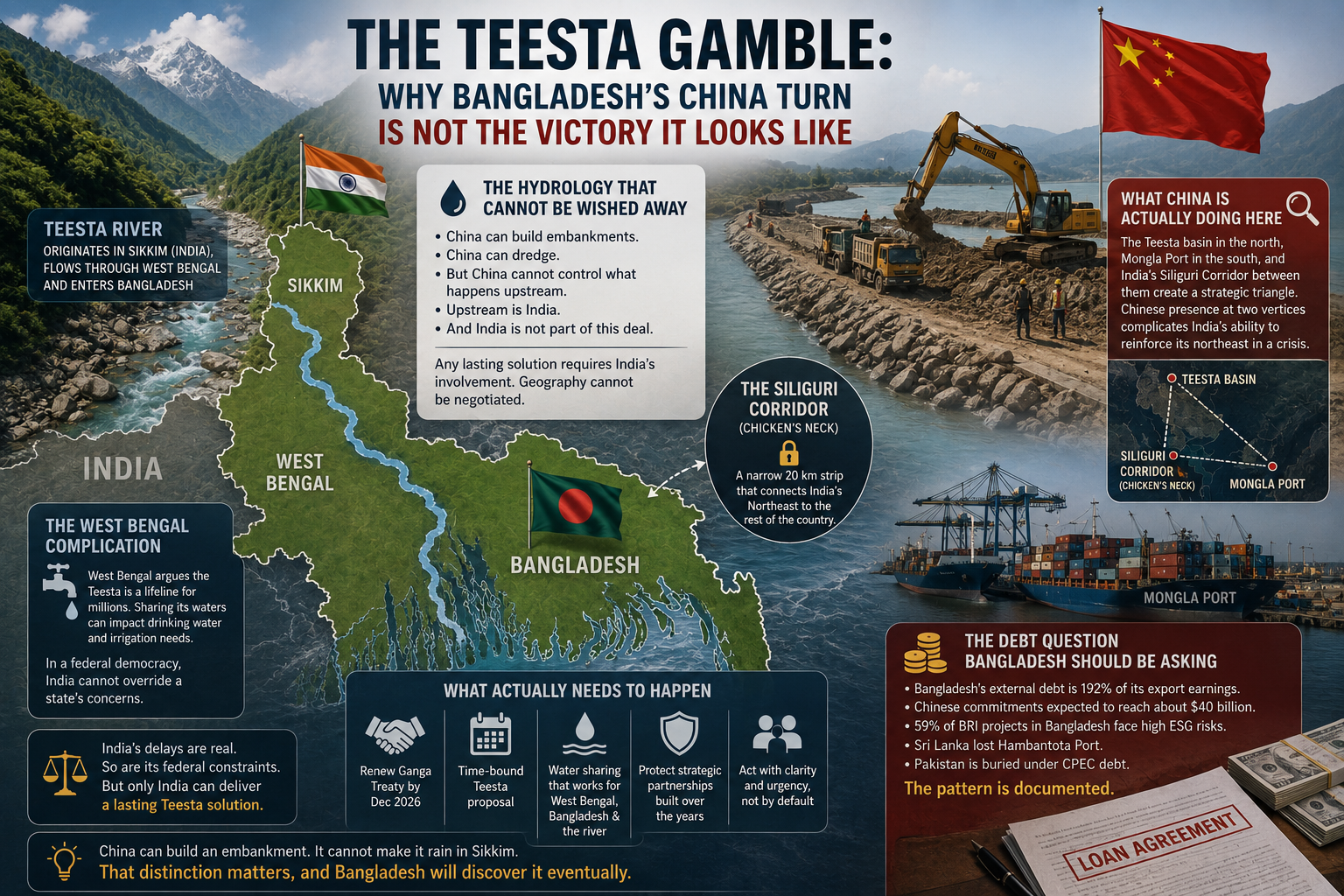
Here is the part of the Teesta argument that no amount of Chinese financing can resolve. The river originates in the eastern Himalayas, flows through the Indian states of Sikkim and West Bengal, and enters Bangladesh downstream. Any lasting solution to the Teesta's water challenges requires India's involvement because the river flows into Bangladesh from Indian territory. China can build embankments. China can dredge. China can construct flood control infrastructure and sign as many memoranda of understanding as it likes. What China cannot do is control what happens upstream, because upstream is India, and India is not part of this deal.
The Teesta project is meant to control flooding in the monsoon, reduce riverbank erosion, and increase water flow in the dry season. All of these objectives depend, fundamentally, on the volume and timing of water flowing from Indian territory into Bangladesh. A project that manages the river's behaviour in Bangladesh without addressing what happens to it in Sikkim and West Bengal is treating symptoms while ignoring the disease. For all its readiness with financing and engineering, China cannot solve a problem that begins in Indian territory. That is not a political point. It is a geographical one.
The West Bengal Complication
India's critics are not entirely wrong that the Teesta water-sharing agreement has stalled. It has, and for too long. Negotiations have faltered repeatedly due to West Bengal's objections, with Chief Minister Mamata Banerjee arguing that the Teesta is a lifeline for northern West Bengal and that sharing its waters would harm drinking water and irrigation needs in the state. This is a genuine domestic political complication in a federal democracy, not a sign of bad faith toward Bangladesh. India cannot simply override a state government's position on a matter that directly affects its own population's water access. No federal democracy can.
This is the part of the conversation that tends to get lost when India is cast as the villain of the Teesta story. The delay is real. The reason for it is also real. And the solution, a comprehensive water-sharing arrangement that works for West Bengal, for Bangladesh, and for the river itself, remains something only India can ultimately deliver, regardless of who builds embankments downstream.
What China Is Actually Doing Here
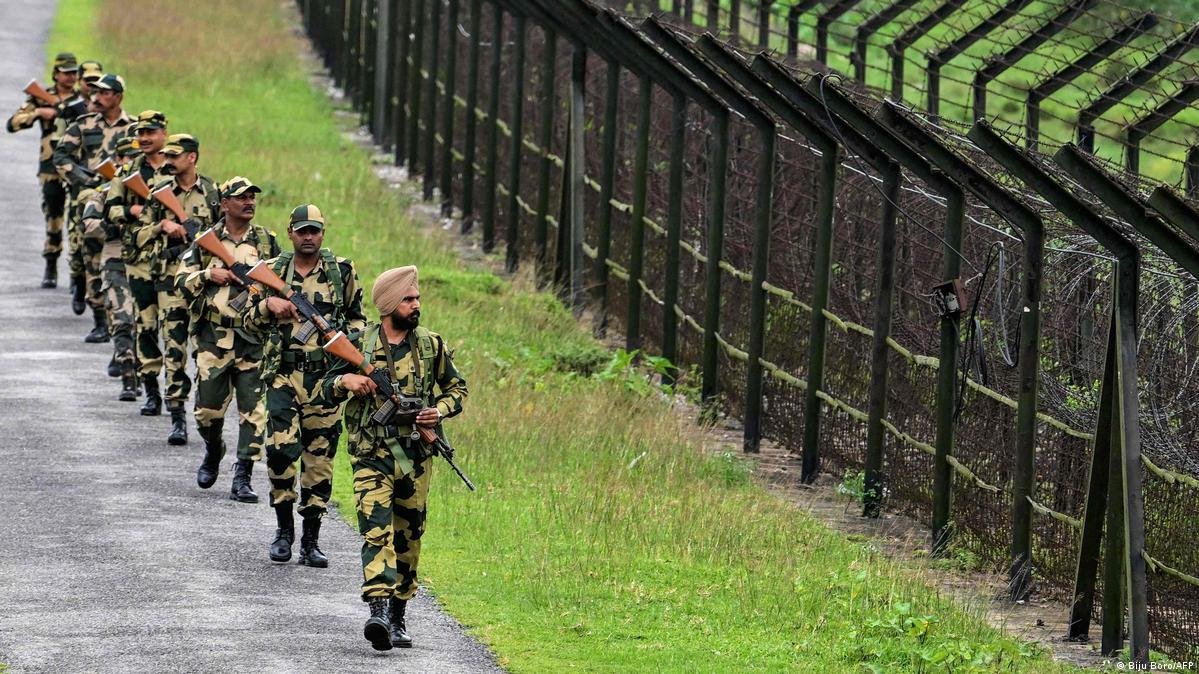
It would be naive to look at China's enthusiasm for the Teesta project and see only development assistance. The lower Teesta basin in Bangladesh lies in close proximity to India's strategically vital Siliguri Corridor, often referred to as the Chicken's Neck, a narrow stretch of land barely 20 kilometres wide at its narrowest point that connects India's seven northeastern states to the rest of the mainland. This is not a corridor India can afford to have compromised. It is the only land link to a vast and strategically sensitive region.
Large river management projects involve extensive hydrographic mapping, satellite imagery, terrain surveys, hydrological modelling, and communications infrastructure. Indian security agencies are concerned that such activities could indirectly provide China with valuable information regarding terrain and transport infrastructure in northern Bangladesh and adjoining Indian areas, including bridges, roads, military logistics routes near the Siliguri Corridor, and patterns of troop movement during emergencies.
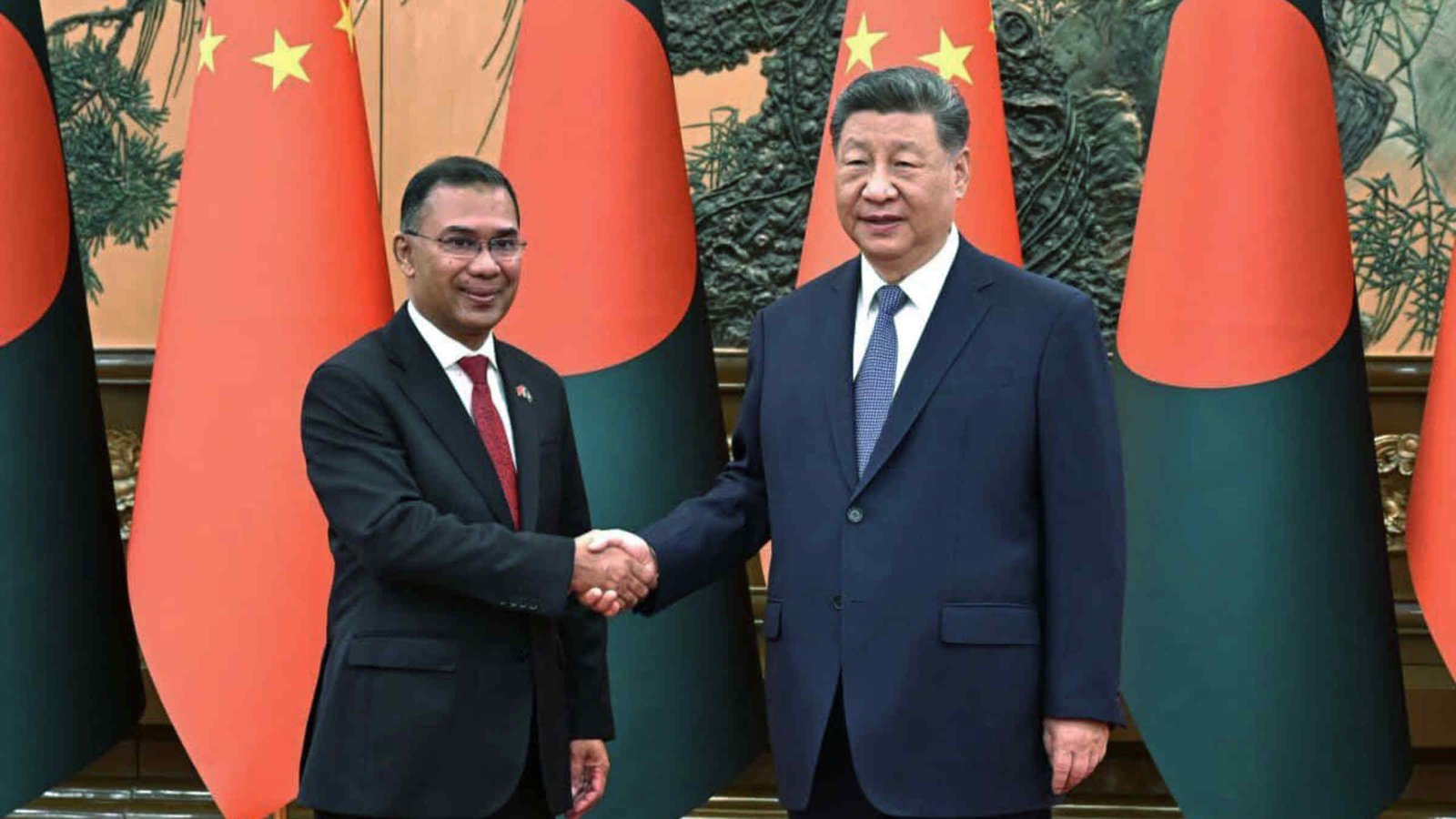
China's deepening footprint in Bangladesh, funding the Teesta project and expanding Mongla Port, is not mere development aid. It creates a strategic geometry: the Teesta basin in the north, Mongla Port in the south, and the Siliguri Corridor sitting between them. Chinese presence at two vertices of that triangle, with the Chicken's Neck at the third, creates a surveillance and logistics architecture that could, in a crisis scenario, complicate India's ability to reinforce its northeast through its sole land corridor.
When Beijing insists that its cooperation "does not target any third party," it is saying what every power says about its strategic infrastructure investments.
The Debt Question Bangladesh Should Be Asking
Bangladesh's new enthusiasm for Chinese partnership deserves a closer look beyond the headline agreements. Since joining China's Belt and Road Initiative in 2016, Bangladesh has steadily expanded its exposure to Chinese financing, with Dhaka now expecting total Chinese commitments to reach about $40 billion, including $14 billion in joint ventures. The World Bank's International Debt Report 2025 highlighted that Bangladesh's external debt has jumped by 42 per cent over the past five years. Senior Bangladeshi officials now openly acknowledge that the country has fallen into a debt trap, with rising repayment obligations squeezing public finances and limiting policy choices.
According to an analysis by the Associated Press, countries borrowing from China tended to spend that money to pay off foreign debt. The lack of transparency in Chinese loans and their use in projects with high environmental, social, and governance risks have prompted serious questions, with 59 per cent of BRI projects in Bangladesh facing such risks.
Sri Lanka handed over Hambantota Port. Pakistan is buried under CPEC debt it cannot service. The pattern is not a conspiracy theory. It is a documented strategic approach. Bangladesh is a sovereign nation capable of making its own choices. But sovereignty and vulnerability are not mutually exclusive, and a country whose external debt now stands at 192 per cent of its export earnings is in a delicate position to be signing $750 million infrastructure agreements with a creditor who has strategic motivations as well as developmental ones.
Hasina and the Asylum Question
India hosting Sheikh Hasina has been framed as a provocation, evidence that New Delhi prefers pliable allies over respecting Bangladeshi sovereignty. Extending protection to a leader who fled a volatile political transition is not interference in Bangladesh's judicial process. It is what democratic states do. India has not declared her innocent of anything. It has simply ensured her physical safety while due process runs its course. That is not a provocation. It is standard practice.
What Actually Needs to Happen
The Teesta Gamble: Why Bangladesh's China Turn Is Not the Victory It Looks Like knows it. The Ganga Water Sharing Treaty signed in 1996 is due for renewal by December 2026, and Dhaka's domestic politics may increasingly link both rivers under a single headline: India must deliver water fairness. That linkage, combined with China offering an alternative framework through river basin infrastructure assistance, could sharpen bargaining pressure on New Delhi in the coming months.
New Delhi needs to treat this deadline with the urgency it deserves. A renewed Ganga treaty, combined with a credible and time-bound proposal on Teesta, would do more for India's standing in Bangladesh than any number of bilateral meetings. The relationship built over the Hasina years, the pipelines, the rail links, the security cooperation, is still worth protecting. But it will not protect itself.
India did not lose the Teesta to China because it was indifferent. It lost the opening because its domestic political constraints are real, its federal structure is genuinely complicated, and the government in Dhaka that understood all of this is gone. The question now is whether the next chapter of this relationship is written in New Delhi with clarity and urgency, or ceded by default to a power that has no river upstream and no genuine stake in Bangladesh's long-term water security.
China can build an embankment. It cannot make it rain in Sikkim. That distinction matters, and Bangladesh will discover it eventually.
The author Rashi Randev is a geopolitical analyst based in Canada and holds a PhD in International Relations from the Centre for the Study of the Americas at Jawaharlal Nehru University.