When Political Exclusion Replaces Democratic Competition: The Case of Bangladesh
Bangladesh’s current Home Minister, Salahuddin Ahmed, said recently that the Awami League had been politically destroyed and would never again take part in Bangladesh’s political process. This is a major development in the country’s fast-changing political landscape. His remarks, coupled with the declaration that the Awami League will be put on trial as a political party, mark a clear shift in the post-July political narrative and herald an attempt to re-define the political order of Bangladesh

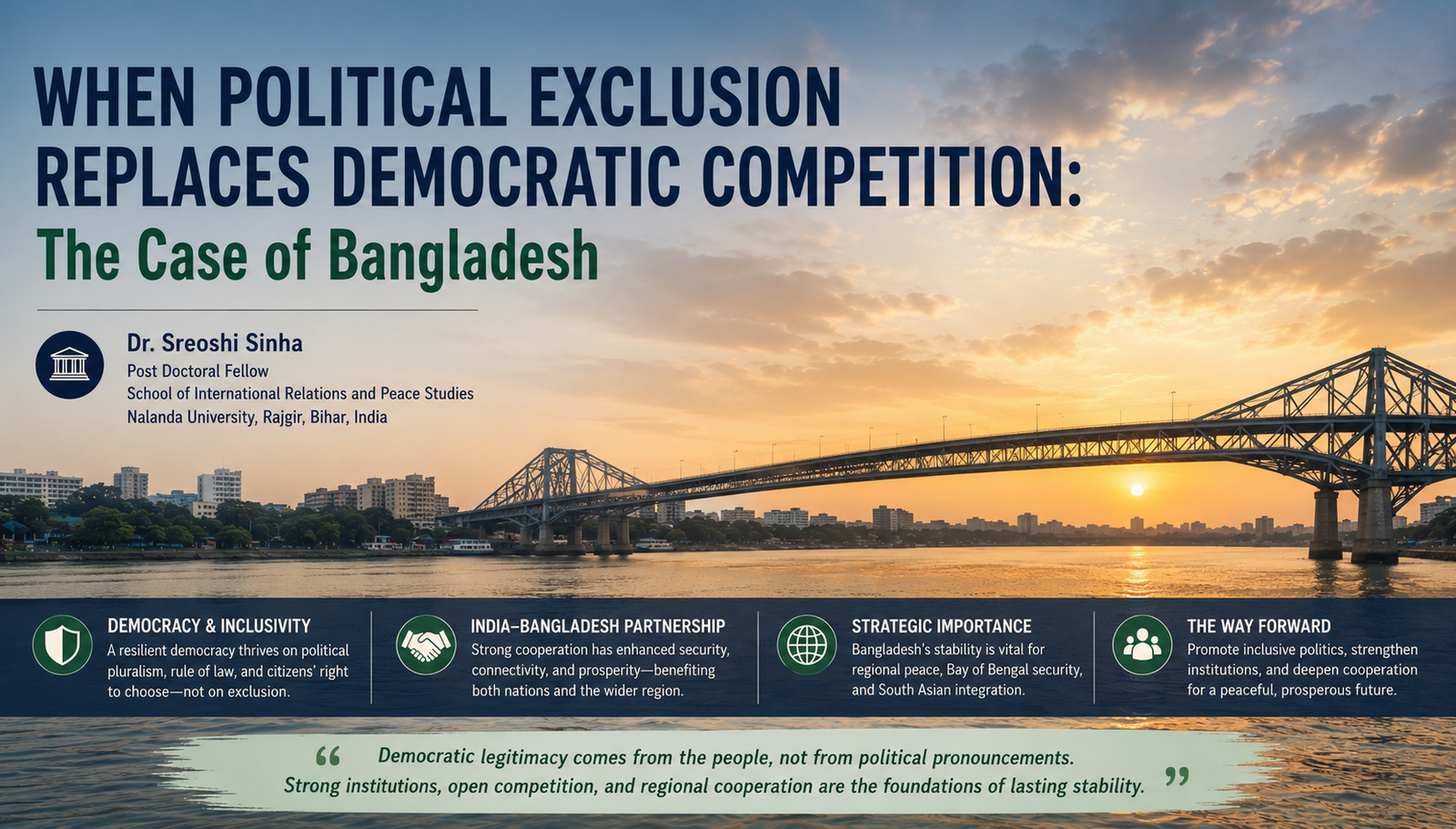
When Political Exclusion Replaces Democratic Competition: The Case of Bangladesh
Dr. Sreoshi Sinha, Post Doctoral Fellow School of International Relations and Peace Studies, Nalanda University, Rajgir, Bihar, India
Bangladesh’s current Home Minister, Salahuddin Ahmed, said recently that the Awami League had been politically destroyed and would never again take part in Bangladesh’s political process. This is a major development in the country’s fast-changing political landscape. His remarks, coupled with the declaration that the Awami League will be put on trial as a political party, mark a clear shift in the post-July political narrative and herald an attempt to re-define the political order of Bangladesh.
Whether one favours the Awami League or not, the prospect of permanently barring one of Bangladesh’s oldest and most influential political parties from the democratic process raises important constitutional, democratic, and strategic questions. Political parties are not simply electoral organisations; they are constituencies and political traditions and competing visions for the future of a nation. Ultimately, their legitimacy comes from the electorate and not from political pronouncements. The long-term stability of any democracy depends on the preservation of institutional credibility, the maintenance of political pluralism and the ability of citizens to decide the fate of political parties through constitutional and electoral processes.
These developments also go well beyond the domestic politics of Bangladesh. Bangladesh today occupies a pivotal position in the strategic scenario of South Asia. It has the longest international land frontier with India and overlooks the Bay of Bengal. It is at the centre of regional connectivity, maritime security, counter-terrorism and economic integration. Hence political developments in Dhaka are bound to impact New Delhi’s security calculus. Thus, any fundamental restructuring of Bangladesh’s political landscape must be analysed not only in terms of domestic politics but also in terms of its implications for regional stability, cross-border security and the future trajectory of India–Bangladesh relations.
Political Exclusion Does Not Imply Democratic Consolidation
Democracy’s legitimacy depends on political competition, constitutional institutions, the rule of law, and the ability of citizens to choose who is in government through free and fair elections. It is not about getting rid of political opponents, but about ensuring that contesting political forces operate within a constitutional and democratic framework. A resilient democracy is not one that has no opposition, but one whose institutions can accommodate dissent, permit peaceful political competition, and uphold the rule of law without bias.
History suggests that durable political stability rarely results from systematically excluding major political actors. Governments certainly have the power to investigate alleged violations of the law and prosecute those found guilty through independent judicial processes, but the permanent political marginalisation of an entire political movement has often bred unintended and destabilising consequences.
One very important example is the 1992 Algerian coup d'état. When the Islamic Salvation Front seemed poised to win the national elections, the electoral process was cancelled and the party was prevented from taking power. The exclusion of a major political force did not restore stability but rather led to a decade-long civil conflict in which an estimated 100,000–200,000 people lost their lives. The Algerian case is of course quite different from Bangladesh today, but the episode illustrates how the refusal to grant a major political constituency a constitutional outlet for political activity worsens social divisions rather than healing them.
Another, but equally instructive, example is Zimbabwe under Robert Mugabe. The imposition of restrictions on opposition parties, manipulation of elections and the concentration of political power over time weakened democratic institutions and eroded public confidence in constitutional government. Political dominance did not ensure stability. Rather it contributed to a long-term economic decline, international isolation and recurrent political crises.
Similarly, in Russia the slow narrowing of the political space through restrictions on the opposition leadership, registration of parties and electoral competition has often been used by scholars as an example of democratic backsliding. Elections are still held, but the lack of real political competition has led to continued international concern for institutional independence, political pluralism and democratic accountability.
In recent times, major political parties in Thailand have been repeatedly dissolved through judicial and constitutional means. These measures, though taken within the country's legal system, did not solve the underlying political disagreements. Instead, they were followed by recurring protests and political instability and repeated cycles of constitutional and governmental crises. The Thai experience demonstrates that legal action against political parties, however lawful, cannot substitute for broad political consensus or democratic legitimacy.
These comparative experiences do not imply that Bangladesh will follow a similar path. The political development of each country is conditioned by its own historical, constitutional and social context. Yet they highlight a shared lesson: democracies are more resilient when accountability and political participation go hand-in-hand rather than against one another. Judicial proceedings are legitimate not only when they are based on law but also to the extent that they are perceived as fair, open and free from political influence.
Recent assertions that the Awami League has been “politically annihilated” and “will never be able to do politics again” and declarations that the party itself will be prosecuted inevitably pose questions about the future of political pluralism in Bangladesh. The Awami League is not just another political party, it is one of the founding political parties of the country and has been in power in Bangladesh for significant periods since independence. At the end of the day, it is for the Bangladeshi people to decide through democratic elections whether it continues to enjoy public support, not for politicians to declare.
For Bangladesh, a South Asian fast-growing economy and a strategically important state in the Bay of Bengal, the quest for democratic legitimacy is inseparable from the quest for political stability. The political environment that is seen to exclude major competitors runs the risk of increasing polarisation at home, undermining institutional credibility and creating uncertainty for regional partners. For neighbouring India, whose security is so closely tied to developments in Bangladesh through counterterrorism cooperation, border management, connectivity and maritime security, preserving a stable and politically inclusive Bangladesh is not just a diplomatic preference but a strategic imperative.
India-Bangladesh Security Nexus under Sheikh Hasina: A Strategic Partnership and Its Importance for Regional Stability
Political rhetoric is not contained within national borders. The statements about the future of key political actors, actually influence international perceptions of a country’s democratic future, institutional stability, and policy continuity. Delhi, closely watches developments in Dhaka, as these have a direct bearing on border security, regional connectivity, counterterrorism cooperation and stability of the Bay of Bengal.
The relationship between India and Bangladesh saw a dramatic turn during the tenure of ex-Prime Minister Sheikh Hasina. Bilateral relations have had their ups and downs since Bangladesh’s independence, but between 2009 and 2024 there was an unprecedented expansion of strategic engagement. What had emerged was a fine relationship that had been defined more by historical and cultural ties rather than by converging security, economic, and geopolitical interests.
One of the most important aspects of this transformation was security cooperation. Prior to 2009, insurgent groups operating in India’s Northeast such as the United Liberation Front of Asom (ULFA), the National Democratic Front of Bodoland (NDFB) and other armed groups had steady logistical networks and operational sanctuaries within Bangladesh. Their activities complicated the internal security environment of India and were a regular concern in bilateral relations.
Bangladesh, under the leadership of Sheikh Hasina, charted a very different course. Dhaka bolstered counterterrorism cooperation with New Delhi by taking action against militant infrastructures, facilitating action against several insurgent leaders, strengthening intelligence-sharing mechanisms, improving border coordination, and increasing cooperation against organised crime and transnational terrorist networks. These steps have reduced to a great extent the operating space of the insurgent groups targeting India’s Northeast and have helped improve the security conditions along the eastern border.
But it was not just limited to that. The two countries increased cooperation on maritime security in the Bay of Bengal, coordinated coastal surveillance, strengthened border management, enhanced energy connectivity and improved transport and transit links. The peaceful implementation of the maritime boundary award further illustrated the ability of both governments to resolve complex problems through institutional and legal mechanisms.
Thus, Bangladesh emerged as one of the key strategic partners of India in the Bay of Bengal and the broader Indo-Pacific. The bilateral relationship was increasingly viewed as one of the most successful examples of regional security cooperation in South Asia.
However, despite all these, with the ousting of Prime Minister Sheikh Hasina from power in 2024, observers have debated the future direction of bilateral relations. While institutional cooperation between the two countries has continued in several sectors, political uncertainty and domestic polarisation have inevitably attracted attention in New Delhi because of the strategic importance of Bangladesh to India's national security.
Why is India important for Bangladesh
From the kitchen to the ballot, Bangladesh and India have always remained intertwined. Thus, the importance of India to Bangladesh extends beyond diplomacy. Geography alone makes the relationship unique. The two countries share more than 4,000 kilometres of international border, making India Bangladesh's largest immediate neighbour. Such geography creates what can be described in International Relations as asymmetric interdependence: although the two countries differ considerably in size and capabilities, each has important interests in maintaining a stable and cooperative relationship with the other.
India is one of Bangladesh's largest trading partners and an important source of energy connectivity, transport access, and regional market integration. Cooperation also extends to river-water management, border infrastructure, disaster management, power trade, and regional connectivity initiatives through road, rail, inland waterways, and coastal shipping.
People-to-people ties remain equally significant. India continues to be an important destination for Bangladeshi citizens seeking higher education, business opportunities, religious travel, and specialised medical treatment. This was evident when India resumed broader visa processing, after which visa application centres in Bangladesh witnessed exceptionally high demand, with reports of long queues and large numbers of applicants seeking medical visas. The episode illustrated the practical importance of cross-border mobility for thousands of Bangladeshi families who rely on access to Indian healthcare services. Thus, for Bangladesh, maintaining a stable, constructive, and forward-looking relationship with India is not merely a diplomatic choice, but a strategic imperative shaped by geography, economics, and shared security interests, one founded on cooperation rather than confrontation.
Why Bangladesh Is Important for India
The relationship is also important to India. Bangladesh holds an important position in India’s eastern strategic neighbourhood. Cooperation with Dhaka has led to enhanced security in India’s Northeast, strengthened efforts against cross-border terrorism and organised crime, improved maritime security in the Bay of Bengal, facilitated regional connectivity with the Northeast and supported wider initiatives in the Indo-Pacific.
Bangladesh also plays an important role in sub-regional groupings such as BIMSTEC and connectivity initiatives linking South Asia with South East Asia. Thus, stability in Bangladesh has implications not only for bilateral relations but also for regional economic integration and maritime security.
Within this context, the importance of continued institutional continuity, constructive political engagement and bilateral cooperation, regardless of changes in government cannot be overstated. Strong India-Bangladesh relations have historically served the interests of both the countries. They have helped in regional stability, economic growth and in cooperating to tackle shared security challenges.
Thus, a politically stable Bangladesh with functioning democratic institutions serves India's national security interests far better than a deeply polarized political environment marked by prolonged institutional confrontation.
Recent remarks by Bangladesh’s Home Minister Salahuddin Ahmed, asserting that the Awami League has been “politically destroyed” and will not engage in the political process of Bangladesh again, along with the declaration of impending prosecution for the party, prompt significant enquiries regarding democratic inclusiveness and political pluralism in the country. However, for now it will be the people of Bangladesh who will decide whether to either support the Awami League or reject it and that too constitutionally and democratically. The political destiny of a party which has made history of Bangladesh for decades should be decided at the voting box and not by political speeches. In democracies, legitimacy does not mean exclusion of opposing political parties but citizens’ right to determine their electoral fate.
Such remarks that seem to exclude the political future of a major political party may also provide an appearance of institutional intolerance and democratic uncertainty. The greater the involvement of Bangladesh in the geopolitical map of South Asia, the greater will be the influence of exclusionary political discourse on regional confidence, investor sentiment, and in the perception of foreign partners. Hence, in addition to the responsibility of governing, especially in moments of transition, political leadership must also promote trust in democratic institutions via balanced public debate.
However, such events should not be seen as signalling the end of the India-Bangladesh cooperation. "There have been moments of political conflict but the relationship between the two nations has always been robust as its foundations go well beyond the politics of any one government. Geography, history, security cooperation, economic integration, connectedness, common rivers and vast people to people interactions generate structural realities that transient political conflicts or changes of administration cannot readily alter.
In many respects, India and Bangladesh are like two siblings, sometimes with differences in political views, but bound by links deeper than the controversies of any particular moment. For India, a secure, peaceful, democratic and wealthy Bangladesh remains strategically important. Likewise, Bangladesh’s long-term interests are best served by maintaining good ties with its closest neighbour with whom it has strong economic, security, cultural and humanitarian links.
Thus, the challenge for both nations is to ensure that periodic political disagreement does not determine the future of a partnership that has made such an important contribution to regional stability over the previous decade and a half. Consolidating democratic inclusivity, deepening institutional engagement and continuing collaboration on common security problems would be vital to guarantee that India-Bangladesh ties remain a foundation of peace, stability and prosperity in South Asia.