The Diplomacy of Balance: Reading Tarique Rahman's China Visit
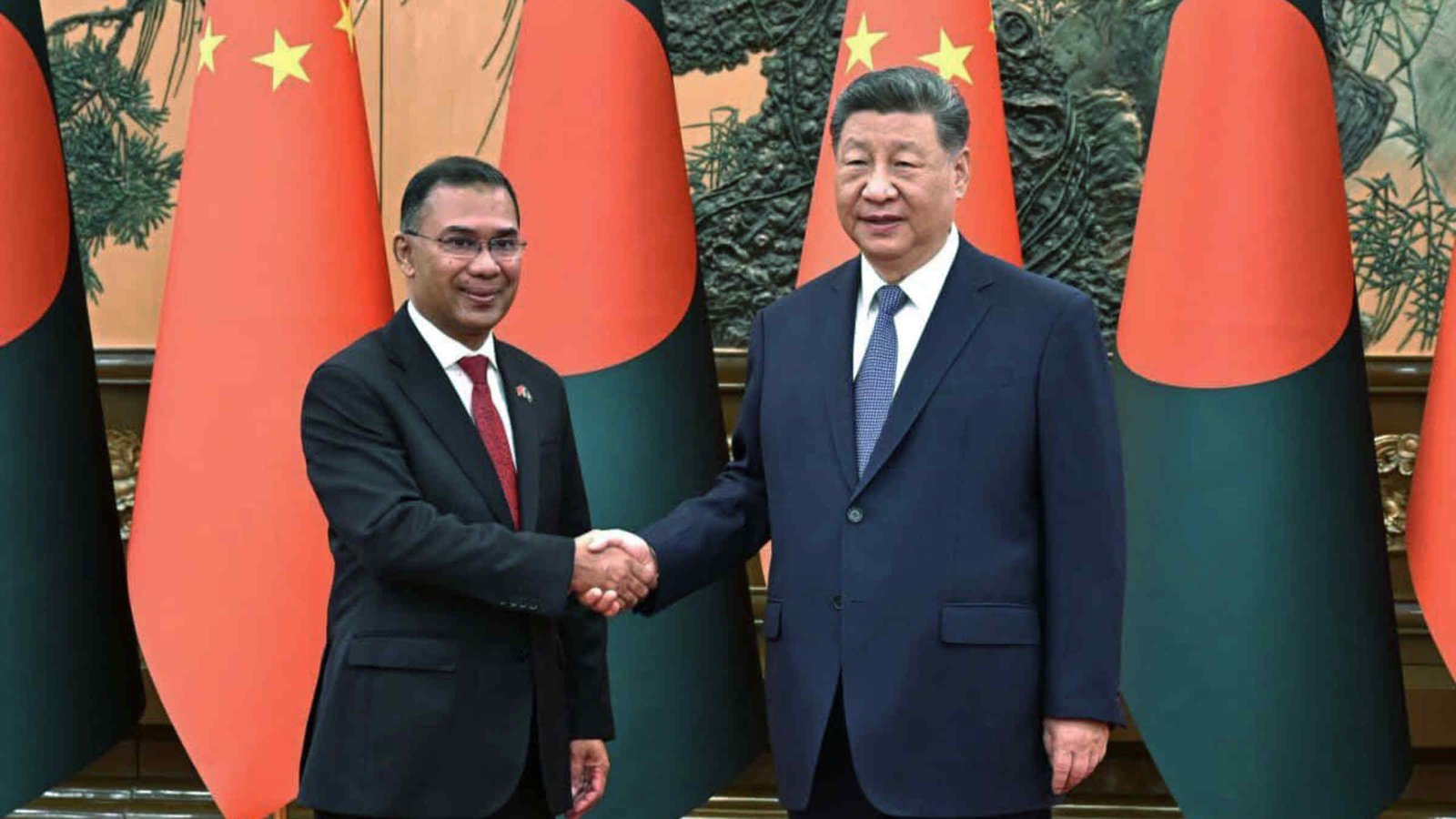
Tarique Rahman's China visit was not merely about economic cooperation. It marked the return of Bangladesh's traditional BNP foreign policy—using China as strategic leverage against India while attempting to maximize diplomatic autonomy. Whether Dhaka can sustain this balancing act without becoming caught in Sino-Indian rivalry remains the central question

The Diplomacy of Balance: Reading Tarique Rahman's China Visit
Tarique Rahman's China visit was not merely about economic cooperation. It marked the return of Bangladesh's traditional BNP foreign policy—using China as strategic leverage against India while attempting to maximize diplomatic autonomy. Whether Dhaka can sustain this balancing act without becoming caught in Sino-Indian rivalry remains the central question.
When Bangladesh Nationalist Party (BNP) leader Tarique Rahman chose Malaysia and China for his first overseas visits after his electoral victory, speculation was inevitable. Prime Minister Narendra Modi had been among the first world leaders to congratulate Rahman and had extended an invitation for him and his wife to visit India. Against that backdrop, the decision to defer New Delhi inevitably attracted diplomatic attention.
Rahman's advisers were quick to dismiss suggestions of an anti-India signal. They described the visits as part of Bangladesh's effort to maintain a “balanced” foreign policy.
Yet history suggests that the “balance” is incumbent to traditional preferences.
Whenever the BNP has been in power under former Prime Minister and Rahman’s mother Khaleda Zia, Bangladesh has traditionally drawn closer to China while using that relationship as strategic leverage in dealing with India. Tarique Rahman's visit to Beijing indicates that this long-standing template may once again be taking shape.
Unlike symbolic diplomatic gestures, this visit produced tangible outcomes. Bangladesh and China concluded a series of agreements aimed at expanding industrial cooperation and Chinese investment. Among the most significant announcements was the decision of Chinese manufacturer Handa Industries' to invest US$220 million in a new manufacturing facility in Keraniganj. The project is expected to generate more than 10,000 jobs.
However, the most consequential agreements went far beyond industrial investment.
China and Bangladesh signed a Memorandum of Understanding to develop the China-Bangladesh Mongla Port Economic Zone adjacent to the strategically located Mongla Port in southern Bangladesh. The project assumes added significance because the same land had originally been earmarked for an India-Bangladesh economic zone. For New Delhi, it may be a strategic set back as Mongla Port occupies a strategically sensitive location on the Bay of Bengal, close to India's eastern coastline.
The visit also deepened cooperation in another area of particular concern to India—water resources, especially the Teesta project which carries immense significance well beyond river management.
The Teesta water-sharing agreement between India and Bangladesh has remained unresolved for nearly twenty-five years and continues to be one of the principal irritants in bilateral relations. China's entry into a project located close to India's strategically sensitive Siliguri Corridor linking mainland India with the Northeast—adds an entirely new strategic dimension.
However, China's growing role in Bangladesh is hardly unprecedented. The Awami League government under Sheikh Hasina formally joined the Belt and Road Initiative (BRI) in 2013, demonstrating that Dhaka's engagement with Beijing transcends partisan politics.
The joint statement, among other things, reiterated China's support for Bangladesh's sovereignty, territorial integrity and independence—a standard diplomatic formulation that nevertheless acquires significance amid intensifying strategic competition in the Indo-Pacific.
The proposal intersects with another unresolved regional issue—the debate over humanitarian access to Myanmar. Only last year, Bangladesh witnessed intense domestic controversy over proposals for a United Nations-backed humanitarian corridor into Myanmar's Rakhine State. The interim government appeared to shift positions repeatedly under pressure from domestic political parties, including the BNP itself, which warned that Bangladesh risked becoming entangled in great-power rivalry.
That concern has hardly disappeared.
Myanmar today remains an arena where Chinese and American strategic interests increasingly intersect. While Washington has expanded engagement with pro-democracy and ethnic armed groups, Beijing has simultaneously consolidated its influence with Myanmar's military establishment and secured critical infrastructure projects. This is precisely the strategic dilemma confronting a future BNP government.
China offers investment, infrastructure financing and expanded economic opportunities. India remains Bangladesh's immediate neighbor, largest regional trading partner and an indispensable geographic reality. Neither relationship can substitute for the other.
The temptation to leverage one against the other has historically shaped Bangladesh's foreign policy under the BNP. Whether that strategy remains sustainable in an era of sharpening Sino-Indian rivalry is another question altogether.
Rahman's visit may seem like a step in the direction of strengthening China's position in Bangladesh and signals the BNP's intention to diversify its external partnerships. But it does not necessarily herald a fundamental rupture in India-Bangladesh relations. Geography, economics, security and domestic compulsions ensure that New Delhi and Dhaka remain engaged on all aspects. The challenge for India is not to react defensively but to adapt to a Bangladesh that seeks greater strategic autonomy.
Bangladesh's outreach to Beijing should be viewed less as a binary strategic choice and more as an attempt to maximize diplomatic and economic space. Smaller states have increasingly adopted such multi-vector foreign policies amid intensifying great-power competition.
For New Delhi, the appropriate response lies not in viewing every Chinese investment through a zero-sum lens, but in demonstrating that India continues to offer tangible economic opportunities, faster project implementation, deeper connectivity and enduring strategic trust.
By Mohit Sharma, Forien Affairs researcher of South Asia.