Shadow War: How Iran, Israel and the US Are Fueling Middle East Instability Through Proxy Forces
As US Secretary of State Marco Rubio concluded his brief visit to the Middle East, he sought to present his meetings with Gulf leaders in a positive light. However, Gulf states remain deeply concerned that the recent US-Iran agreement fails to address Tehran’s continued efforts to project power across the region through its network of allied militias and proxy groups

Shadow War: How Iran, Israel and the US Are Fueling Middle East Instability Through Proxy Forces
As US Secretary of State Marco Rubio concluded his brief visit to the Middle East, he sought to present his meetings with Gulf leaders in a positive light. However, Gulf states remain deeply concerned that the recent US-Iran agreement fails to address Tehran’s continued efforts to project power across the region through its network of allied militias and proxy groups.
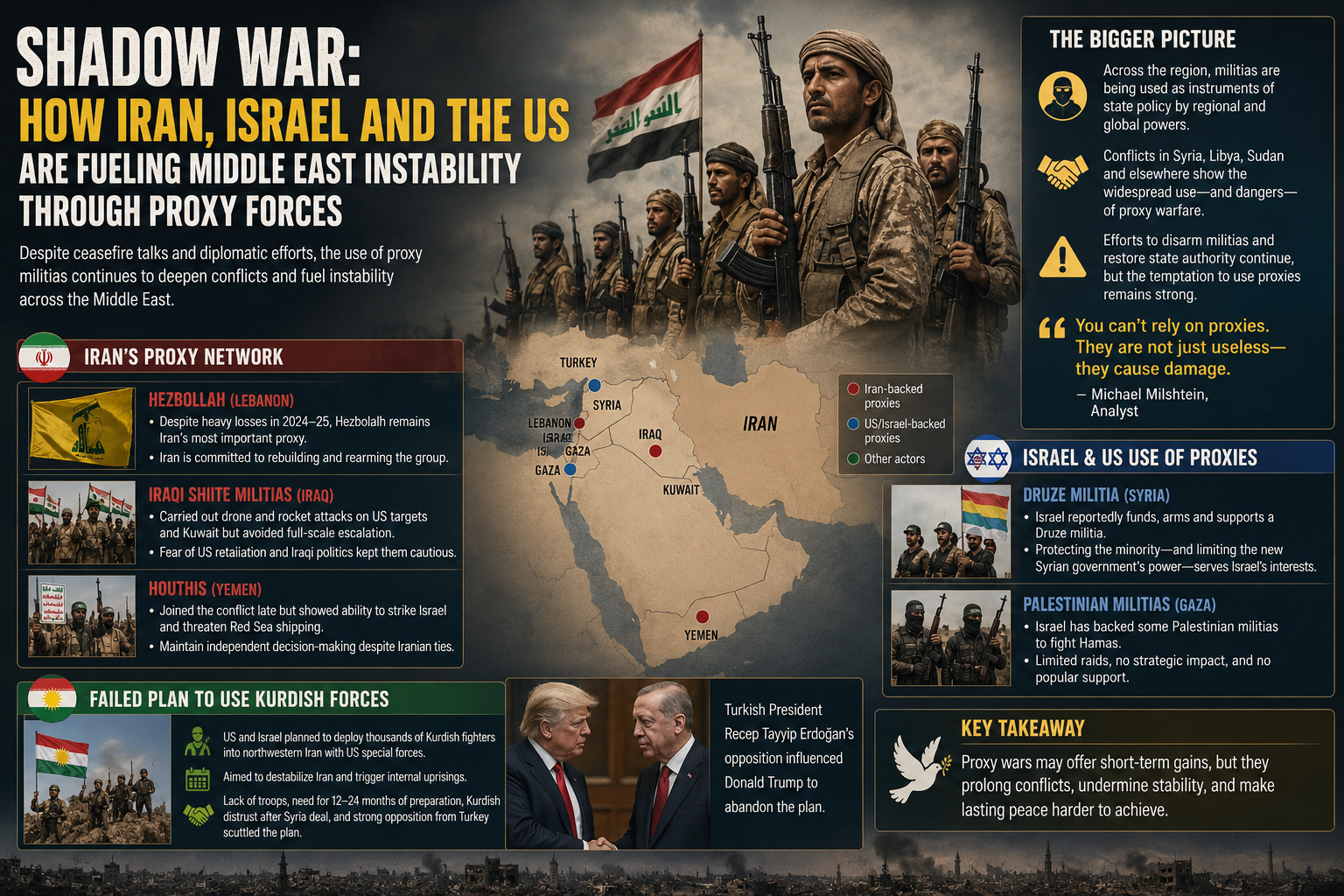
Rubio acknowledged that Gulf leaders had expressed “very concrete concerns,” insisting that any final agreement with Tehran must require Iran not only to limit its nuclear program but also to end its support for Hamas in Gaza, Hezbollah in Lebanon, Shiite militias in Iraq, and the Houthis in Yemen.
Despite these demands, analysts and Western security officials believe the recent conflict has reinforced Iran’s long-standing strategic doctrine. They argue Tehran is likely to increase support for its regional proxy forces in the aftermath of the war. At the same time, Israel—and to a lesser extent the United States—is also expected to expand its use of irregular armed groups to advance strategic interests.
Hezbollah Remains Iran’s Most Important Proxy
Although Hezbollah suffered significant losses during prolonged fighting with Israel in 2024 and 2025 and failed in its primary mission of deterring a direct Israeli strike on Iran, it remains the cornerstone of Tehran’s regional alliance network.
Founded more than four decades ago with support from Iran’s Islamic Revolutionary Guard Corps (IRGC), Hezbollah continues to receive strong backing from Tehran.
Hanin Ghaddar, a senior fellow at the Washington Institute for Near East Policy, said Iran views the organization’s current setbacks as temporary.
“The Iranians see this as a temporary bad phase and believe Hezbollah will regenerate. It is absolutely vital for the Revolutionary Guards to rebuild their proxies across the region and maintain control over their decision-making.”
Iran’s insistence on linking the Iran-US ceasefire to an end to fighting in Lebanon has also created tensions between Israel, which wants to continue military operations against Hezbollah, and Washington, which favors de-escalation.
Houthis Maintain Independent Decision-Making
The Houthis joined the recent conflict only in its final stages but demonstrated their ability to strike Israel and threaten international shipping in the Red Sea.
However, analysts say the Yemeni group remains more independent than many of Iran’s other allies.
According to Ghaddar:
“The Houthis are very hardcore and were useful during the war, but they have their own decision-making processes that don’t always involve the Iranians.”
Iraqi Militias Chose Caution Over Escalation
Iran-backed Shiite militias in Iraq launched dozens of drone and rocket attacks against US assets and also targeted Kuwait during the conflict. Nevertheless, they refrained from deploying their full military capabilities.
Experts say the threat of devastating US retaliatory airstrikes, combined with Iraq’s complicated domestic politics, made militia leaders reluctant to escalate the conflict further.
Michael Knights, an expert on Iraqi militias at Horizon Engage, said:
“They are more risk-averse than perhaps the Iranians would like.”
Iran also used Iraqi militias to pressure Kurdish groups into staying out of the conflict.
US-Israeli Plan to Use Kurdish Forces Failed
At the beginning of the war, the United States and Israel attempted to mobilize armed groups among Iran’s Arab and Baluch minorities, as well as Kurdish factions based in northern Iraq. Those efforts ultimately failed.
Former US and Kurdish officials revealed that a long-standing contingency plan envisioned several thousand Kurdish fighters entering northwestern Iran alongside US Special Forces. Backed by American and Israeli airpower, they would attempt to destabilize the Iranian government and trigger wider uprisings.
However, only a few hundred fighters were immediately available. Kurdish leaders also remained distrustful of Washington following what they viewed as the US “betrayal” of Kurdish authorities in Syria earlier this year.
Officials added that the operation would have required 12 to 24 months of preparation to train fighters, distribute weapons, and establish unified command structures, while the White House appeared to expect implementation within days.
The plan was also strongly opposed by Turkish President Recep Tayyip Erdoğan, whose objections reportedly influenced President Donald Trump to reconsider the proposal.
Israel Expands Proxy Networks in Syria and Gaza
According to reports, Israeli intelligence has supplied funding, weapons, and intelligence to a newly formed Druze militia in Syria. While Israeli officials describe the group as a force to protect the Druze minority, analysts argue it also serves Israel’s strategic objective of limiting the new Syrian government’s authority.
In Gaza, Israel has also supported several Palestinian militias to challenge Hamas. These groups have carried out limited raids and tactical operations but have failed to significantly alter the balance of power.
Analyst Michael Milshtein said:
“They will in no way change the strategic situation in Gaza. They have zero popular support and absolutely cannot become an alternative to Hamas.”
Proxy Warfare Continues to Destabilize the Region
Across the Middle East, governments are attempting to disarm militias and restore state authority. Yet the temptation to rely on proxy forces remains strong despite repeated evidence of the risks involved. Conflicts in Syria, Libya, Sudan, and elsewhere continue to demonstrate how proxy warfare prolongs instability.
As Milshtein concluded:
“You can’t rely on proxies. They are not just useless—they cause damage.”
Analyist: Jason Burke, Jerusalem
Source: The guardian