

North Korea Changes Flag Proportions for First Time Since Its 1948 Founding
North Korea has changed the official proportions of its national flag for the first time since the country was established in 1948. The constitutional revision under Kim Jong Un makes the flag shorter while retaining its traditional colors and star. Analysts believe the move reflects a broader effort to establish a distinct national identity.

Reporter · CSB News USA
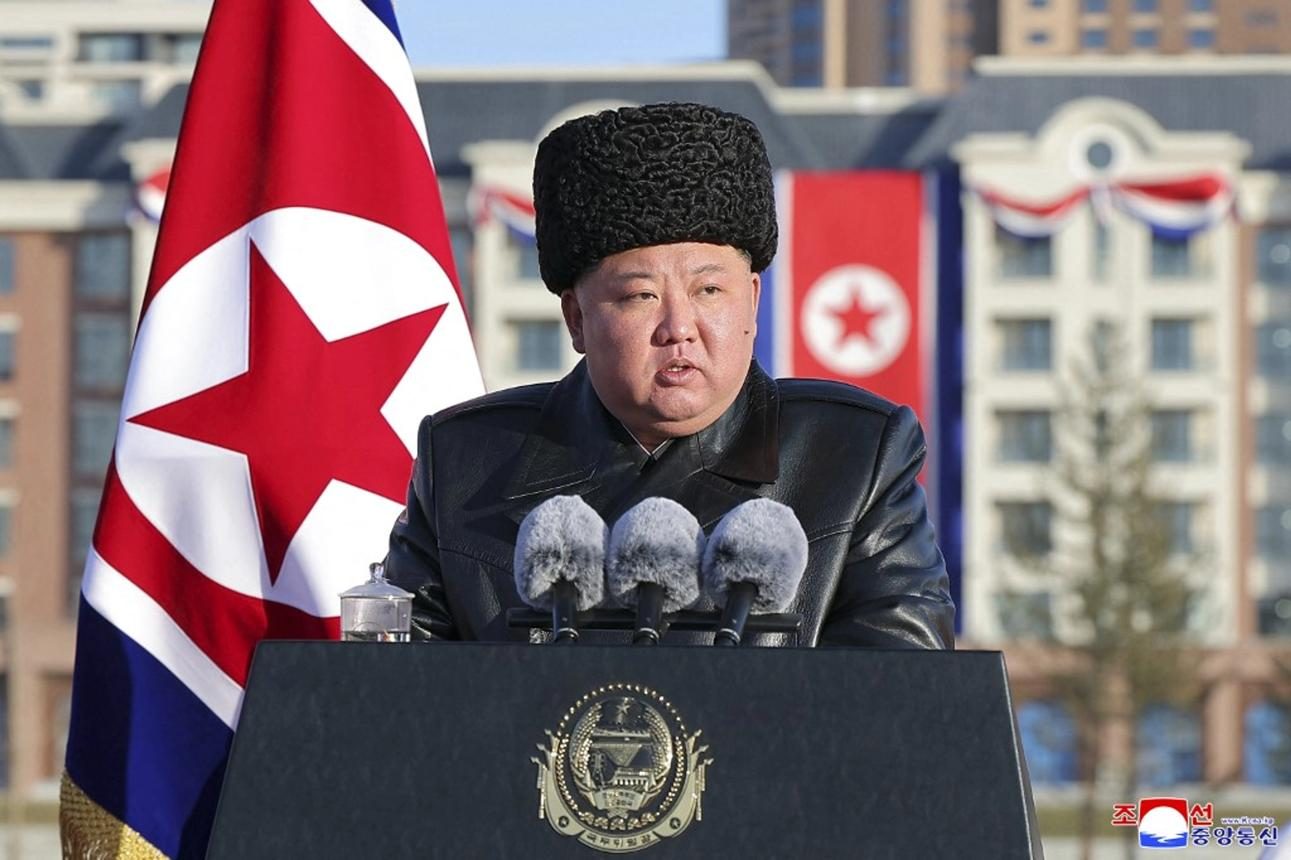
North Korea has changed the official proportions of its national flag for the first time since the country was established in 1948, marking a significant symbolic shift under leader Kim Jong Un. The change was revealed through the publication of the country’s revised constitution, which specifies a new height-to-width ratio for the national flag. Although the familiar red, white and blue colors and the five-pointed star remain, the flag will now appear noticeably shorter and less elongated than its previous version.
According to the revised constitution, published on November 13 through North Korea’s external propaganda website Naenara, Article 166 establishes the national flag’s height-to-width ratio at 1:1.65. This replaces the previous ratio of 1:2, which had remained part of the country’s constitutional framework for decades. The adjustment represents the first official change to the flag’s proportions since the Democratic People’s Republic of Korea was founded in September 1948.
The difference may appear small, but it represents an important development in a country where national symbols carry substantial political significance. Under the previous standard, the flag was twice as wide as it was tall. Under the new standard, its width is reduced relative to its height. In practical terms, the flag will look more compact, with its central star and red stripe occupying a slightly different visual position within the overall design.
Importantly, North Korea has not completely replaced its national flag with an entirely new design. The main visual elements remain the same. The flag continues to feature a broad red stripe running horizontally through the center, narrow white stripes above and below it, and blue stripes along the upper and lower edges. A red five-pointed star remains positioned inside a white circle near the side attached to the flagpole. The constitutional revision changes the official dimensions rather than eliminating the traditional symbols.
North Korea’s government has also provided explanations for the meaning of the flag’s colors and symbols. According to the description published alongside the revised constitutional provisions, the central red stripe represents the blood shed by revolutionary fighters who struggled against Japanese colonial rule and fought for the country’s freedom and independence. Japan ruled Korea from 1910 until 1945, making the colonial period a central part of North Korea’s official historical narrative.
The white circle and the two white stripes represent the loyalty of the North Korean people to the country’s leadership and the ruling Workers’ Party of Korea. The blue stripes symbolize the revolutionary spirit associated with anti-imperialism, independence, peace, friendship and unity, as well as the sovereignty of the republic. These explanations demonstrate how North Korea continues to use national symbols to communicate its political identity and official interpretation of history.
The timing of the revision has attracted attention from international observers because Kim Jong Un has been pursuing a broader effort to reshape North Korea’s political identity. Since taking power in 2011 following the death of his father, Kim Jong Il, he has gradually developed his own leadership image while maintaining the political system established by his grandfather, Kim Il Sung, who founded the North Korean state.
Analysts believe the flag adjustment could be part of an effort to distinguish the current leadership era from the political legacy of previous generations. However, North Korean authorities have not publicly provided a detailed explanation of why the proportions were changed. The interpretation that the move is intended to strengthen Kim’s personal political identity comes from outside observers rather than an officially confirmed government statement.
The development is particularly significant when considered alongside North Korea’s increasingly confrontational approach toward South Korea. For decades, both governments formally maintained the idea that the division of the Korean Peninsula was temporary and that reunification could eventually be achieved. Although relations were frequently tense, the shared Korean national identity remained an important part of political discussions.
That position has changed considerably under Kim Jong Un. In late 2023 and early 2024, Kim increasingly rejected the traditional reunification framework and described relations between North and South Korea as relations between two separate and hostile states. His government subsequently moved to remove references to peaceful reunification from the country’s constitutional framework.
The revised constitutional text published in November 2026 provides further evidence of this political direction. It defines North Korea’s territorial boundaries and removes earlier language connected with national reunification. The constitutional changes reinforce the government’s position that North Korea should be treated as a separate state rather than as one half of a divided nation awaiting reunification.
North Korea also made changes to its national anthem in 2024. The lyrics previously included the expression “Samcheolli,” a traditional reference to the Korean Peninsula as a whole. That wording was replaced with an expression meaning “this world.” The change attracted attention because the original wording carried historical and cultural associations with the entire Korean homeland, including both North and South Korea.
Taken together, the constitutional revisions, changes to the national anthem and adjustment to the flag’s proportions suggest a broader effort to redefine North Korea’s national identity. Rather than completely abandoning the symbols inherited from earlier leaders, Kim’s government appears to be retaining important traditional elements while modifying how the state officially presents itself.
The flag revision also raises questions about how North Korea will use the updated design at international events. National flags are displayed at diplomatic meetings, international sporting competitions, military ceremonies and official government functions. A constitutionally established change could eventually influence the specifications used for flags displayed at these events.
North Korea has previously used international sporting competitions to demonstrate its national identity. Its athletes and officials regularly display the national flag during international tournaments, while the country’s symbols also appear at diplomatic meetings and state ceremonies. The updated proportions could therefore become increasingly visible to international audiences as the new standard is adopted.
The change is also being viewed in the context of North Korea’s efforts to strengthen its image as an independent sovereign state. Analysts note that changing a national symbol does not necessarily mean the country’s political system or foreign policy will change immediately. However, national symbols can communicate long-term political priorities and help reinforce a government’s preferred historical narrative.
There is another important historical dimension. North Korea adopted its current flag in 1948, during the period following the end of Japanese colonial rule and the division of the Korean Peninsula into Soviet- and American-administered zones. The Soviet Union played an important role in the formation of North Korea’s early political institutions. The flag became one of the most recognizable symbols of the new state.
For nearly eight decades, the flag’s official proportions remained unchanged. Its continued use helped establish a sense of continuity between the founding generation and subsequent North Korean leadership. Changing its dimensions now, while preserving its main design, represents a balance between maintaining historical symbolism and introducing a modified national image.
Nevertheless, it is important not to overstate what the decision means. There is currently no verified evidence that North Korea has abandoned its traditional flag colors, removed the red star or introduced a completely different national emblem. The confirmed constitutional change concerns the flag’s official proportions. Reports suggesting a wider political motivation should be understood as expert interpretation, not as a declared explanation from Kim Jong Un’s government.
The development is likely to attract further attention from South Korea, international researchers and observers of East Asian security. North Korea’s decisions about national symbols are particularly important because they often reflect broader changes in the country’s official political messaging. The flag adjustment, therefore, is more than a technical change in design specifications.
For now, North Korea’s familiar red, white and blue flag remains in place, but its official shape has entered a new chapter. After 78 years without a change to its constitutional proportions, the country has adopted a narrower design under Kim Jong Un’s leadership. Whether this adjustment becomes a lasting symbol of a new political era will depend on how consistently the government incorporates it into national institutions, diplomatic activities and international representation.
Related News
10 Legal Ways to Get a U.S. Green Card: Employment, Investment, Family and More

COP31 Enters Decisive Final Week as Countries Face Major Divisions Over Climate Finance

UN Climate Chief Urges Compromise as COP31 Enters Decisive Second Week in Turkey

Comments 0
Log in or create a free account to join the conversation. You can comment anonymously.
No comments yet. Be the first.