

Trump Blames Old Equipment for Nationwide US Flight Shutdown
President Donald Trump has blamed outdated equipment for Friday’s unprecedented nationwide flight shutdown in the United States. The disruption lasted more than four hours, affecting thousands of flights and passengers. Trump insists flying remains safe, but the incident has renewed concerns about aging air traffic control technology and the need for modernization.

Reporter · CSB News USA
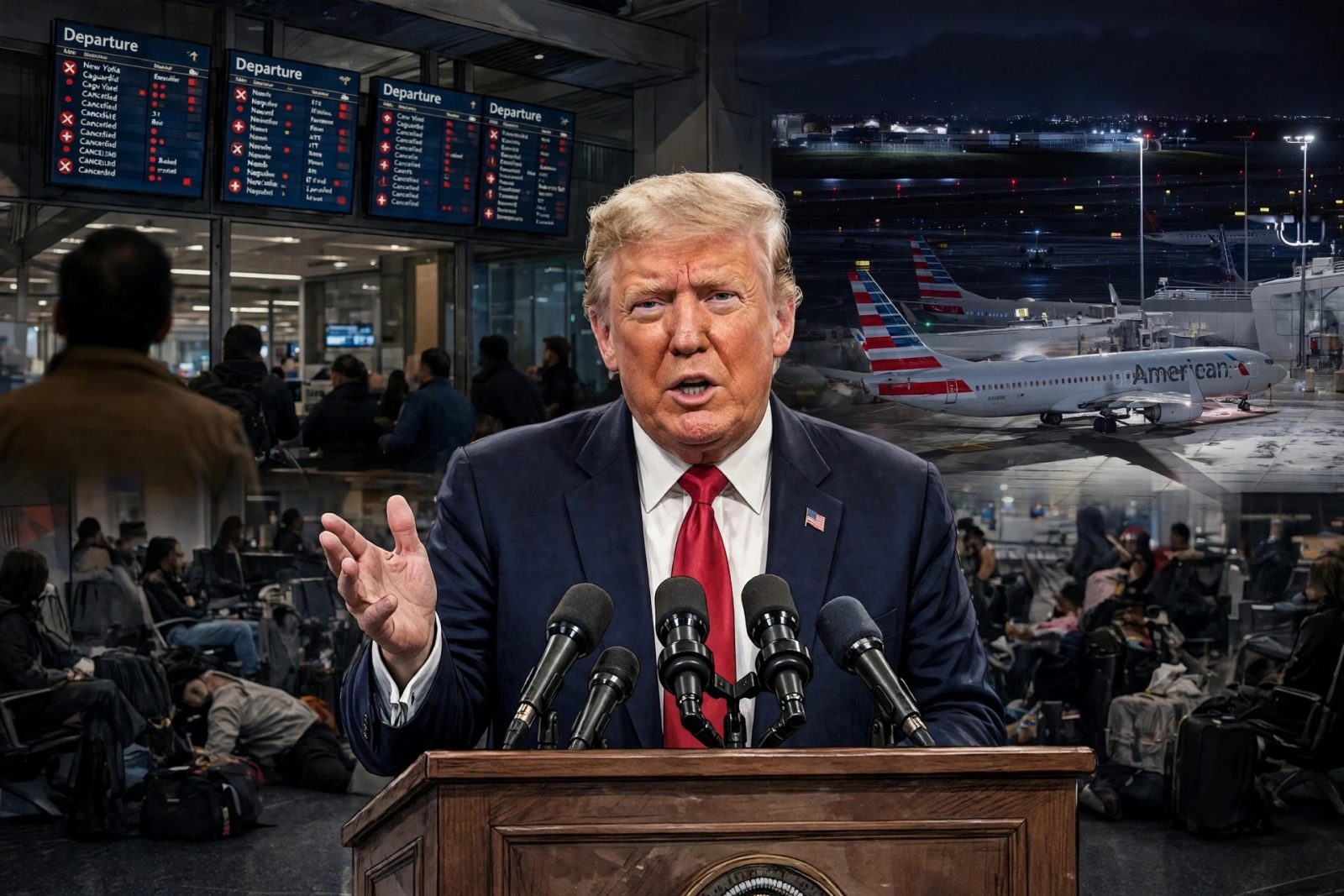
President Donald Trump has blamed outdated aviation technology for the nationwide disruption that brought commercial flight operations across the United States to a temporary standstill last Friday. Describing the technical failure in unusual terms, Trump said the country’s aging equipment had effectively suffered a “heart attack,” triggering one of the most significant interruptions to American air travel in recent years.
Trump made the remarks on Monday, November 16, while speaking to reporters outside the White House before departing for an official trip to Asia. His comments came three days after the Federal Aviation Administration (FAA) ordered a nationwide ground stop because of problems affecting the communications and radar systems used by air traffic controllers.
“Essentially what you saw on Friday was very, very old equipment that had a heart attack,” Trump told reporters.
Despite acknowledging the seriousness of the technical problems, the president insisted that commercial aviation in the United States remained safe. He said flying was “very safe” but emphasized that his administration wanted to make the country’s aviation system “beyond safe.”
The incident has renewed questions about the condition of America’s air traffic control infrastructure, particularly the technology responsible for maintaining communication between pilots and air traffic controllers. It has also raised concerns about whether the existing system can reliably manage the increasing demands of modern commercial aviation.
According to the FAA, the disruption began at approximately 3:30 p.m. Eastern Time on Friday, November 13. Technical instability affected the agency’s telecommunications network, creating problems with aircraft communications and radar information used by air traffic controllers.
The situation became serious enough that federal aviation officials decided to stop flights nationwide as a precautionary measure.
The ground stop remained in effect until approximately 8:15 p.m. Eastern Time, when the FAA confirmed that the system had become stable enough for normal flight operations to resume gradually.
Although the shutdown lasted approximately four hours and 45 minutes, its consequences continued long after the restrictions were lifted. Airlines struggled to reorganize their schedules, reposition aircraft and crews, and accommodate passengers whose journeys had been interrupted.
The FAA reported that approximately 12,462 flights were canceled on Friday following the telecommunications disruption. This figure included cancellations by major airlines, although not every cancellation was necessarily caused directly by the nationwide ground stop.
The incident affected airports throughout the country, leaving thousands of travelers waiting for information about their departures, connections and alternative travel arrangements.
The FAA’s preliminary explanation points to an unusual technical problem involving its aging telecommunications infrastructure.
Officials said excessive data traffic began flooding the FAA’s telecommunications network at a rate of approximately 1,000 connection attempts every four to five seconds. This created instability in the network and affected communications and radar feeds used to monitor aircraft.
The agency identified two potential locations associated with the unusual data activity: a radar facility in Amarillo, Texas, and a radio communications facility in El Dorado, Arkansas.
The investigation has focused particularly on work being performed by L3Harris, the contractor responsible for providing network services to the FAA.
According to Transportation Secretary Sean Duffy, a contractor had been carrying out routine maintenance at a remote facility. The work involved replacing aging copper telecommunications lines with newer fiber-optic connections.
The transition was intended to replace outdated technology that had become increasingly difficult to maintain.
However, during the process, a newly installed router became a potential source of excessive network traffic. The resulting data activity affected other parts of the aviation communications network.
Officials have not yet established whether the problem resulted from a defective router, an installation mistake or another technical failure associated with the maintenance work.
The FAA said the excessive traffic was isolated by blocking the two affected locations. The broadcasting function on the newly installed routers was also disabled as a precaution.
Furthermore, the agency disabled the same function on approximately 60 similar routers throughout its network to reduce the possibility of another disruption.
The FAA has emphasized that the nationwide ground stop was ordered to protect passengers and aircraft rather than because every communication system had completely failed.
In its November 15 explanation, the agency said that 17 of its 22 Air Route Traffic Control Centers experienced instability. Some radio frequencies and radar feeds remained operational throughout the incident.
Approximately 3,500 aircraft were already in the air when the disruption occurred. According to the FAA, all those aircraft landed safely, and every passenger arrived safely.
Officials also confirmed that established safety procedures remained in place during the incident. Pilots and air traffic controllers continued using available communication systems and alternative procedures to ensure aircraft could be managed safely.
The Department of Homeland Security also said there was no evidence indicating that the incident was caused by a cyberattack or an outside malicious actor.
These findings are important because the initial disruption raised concerns about whether a cyberattack or another form of deliberate interference could have affected the country’s aviation infrastructure.
However, investigators have continued examining the technical circumstances surrounding the incident.
The FAA has maintained that the system is stable and that commercial flights are safe to operate. Its November 15 statement specifically confirmed that the network had recovered and that airlines were working to restore normal schedules.
The incident has also intensified the debate over the need to modernize America’s air traffic control system.
For years, aviation officials and industry experts have warned that parts of the country’s air traffic infrastructure rely on outdated technology. Some equipment and facilities have been operating for decades, while the number of flights and the complexity of managing modern airspace have continued to increase.
Transportation Secretary Sean Duffy has repeatedly called for major federal investment to replace aging equipment and improve the reliability of the country’s aviation network.
Following Friday’s disruption, Duffy called for approximately $50 billion in funding to support a broader modernization effort.
He argued that the United States needs a more advanced telecommunications system capable of handling modern aviation demands without being vulnerable to failures involving older equipment.
The administration has also faced questions about the responsibility of federal officials for maintaining and upgrading the system.
Trump, however, rejected suggestions that he should personally accept responsibility for Friday’s shutdown. He pointed to decades of insufficient investment and criticized the previous administration for leaving behind outdated infrastructure.
The president also emphasized that his administration wanted to improve aviation safety rather than simply restore the existing system.
His comments have come amid growing political disagreement over federal spending priorities and the funding needed to modernize America’s transportation infrastructure.
Congress has already approved substantial funding for aviation improvements in recent years. A 2021 infrastructure law included approximately $25 billion over five years for airport and air traffic infrastructure projects. In 2025, Congress also approved $12.5 billion for FAA modernization.
Nevertheless, the latest incident has demonstrated that significant technical vulnerabilities remain.
The shutdown also highlighted how dependent the American aviation industry is on a network of interconnected communications systems. A problem at a relatively remote facility can potentially affect operations at airports and air traffic control centers across the country.
For passengers, the consequences can extend beyond a delayed flight. When aircraft cannot depart according to schedule, pilots and flight attendants may reach their legally permitted working hours. Aircraft can also end up at airports where they were not originally scheduled to be, creating additional difficulties for airlines.
These complications can affect thousands of subsequent flights, even after the original technical problem has been resolved.
The FAA has therefore warned that restoring the network does not automatically return the entire aviation industry to normal operations. Airlines must still reorganize their schedules and ensure that aircraft and personnel are available for scheduled departures.
For travelers, the disruption is a reminder that even a short technical failure can have consequences across a nationwide transportation network.
Trump’s latest remarks appear intended to reassure Americans that the immediate problem has been addressed and that flying remains safe. However, the larger question is whether the United States can modernize its aging aviation infrastructure quickly enough to prevent another nationwide disruption.
For now, federal officials say the system is stable, aircraft operations have resumed and investigations into the precise technical cause are continuing.
The incident has nevertheless placed America’s aging air traffic control technology under renewed scrutiny, with passengers, airlines and lawmakers waiting for answers about how such a widespread failure occurred and what steps will be taken to prevent it from happening again.
Related News
Trump Blames Outdated Equipment for Major U.S. Air Travel Disruption

Rising Living Costs and Iran War Anger Deal Major Midterm Blow to Trump Exactly

Trump Urges Congress to Approve Billions for Modern Air Traffic Control System

Comments 0
Log in or create a free account to join the conversation. You can comment anonymously.
No comments yet. Be the first.