Chinese Footprints in Bangladesh and India’s Challenge
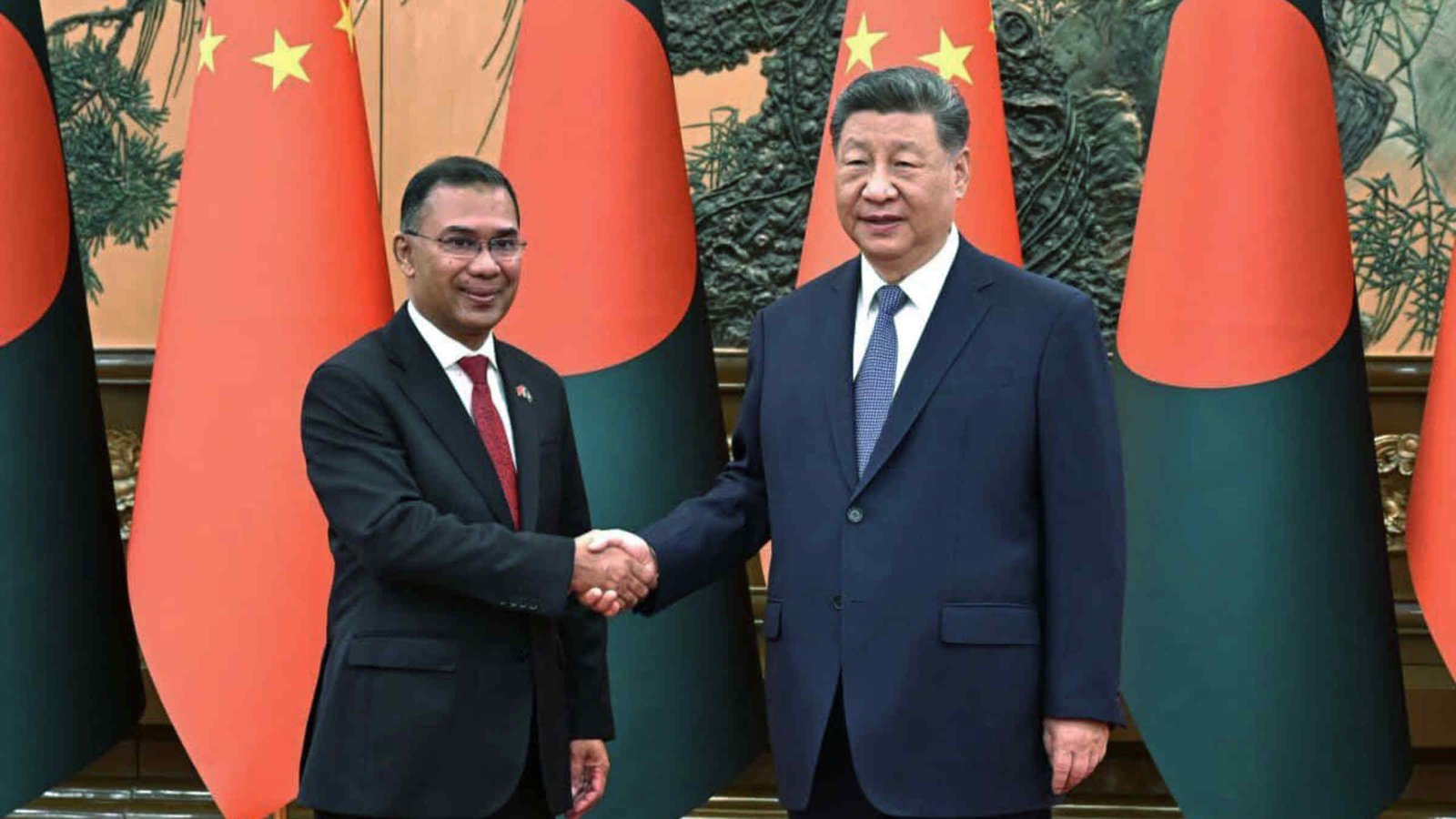
As Bangladesh’s Prime Minister commences a high-profile three-day visit to Beijing framed as the “Golden 50 Years,” New Delhi should view the trip as more than routine diplomacy. The potential formalization of Chinese participation in the Teesta Comprehensive Management and Restoration Project (TRCMRP) carries significant impact for India, as it directly impacts sensitive strategic areas, most notably the Siliguri Corridor—the strip of land connecting mainland India to the Northeast. Consequently, what may be perceived as a technical river engineering endeavor carries broader, deeper geopolitical and strategic implications for India


Chinese Footprints in Bangladesh and India’s Challenge
As Bangladesh’s Prime Minister commences a high-profile three-day visit to Beijing framed as the “Golden 50 Years,” New Delhi should view the trip as more than routine diplomacy. The potential formalization of Chinese participation in the Teesta Comprehensive Management and Restoration Project (TRCMRP) carries significant impact for India, as it directly impacts sensitive strategic areas, most notably the Siliguri Corridor—the strip of land connecting mainland India to the Northeast. Consequently, what may be perceived as a technical river engineering endeavor carries broader, deeper geopolitical and strategic implications for India.
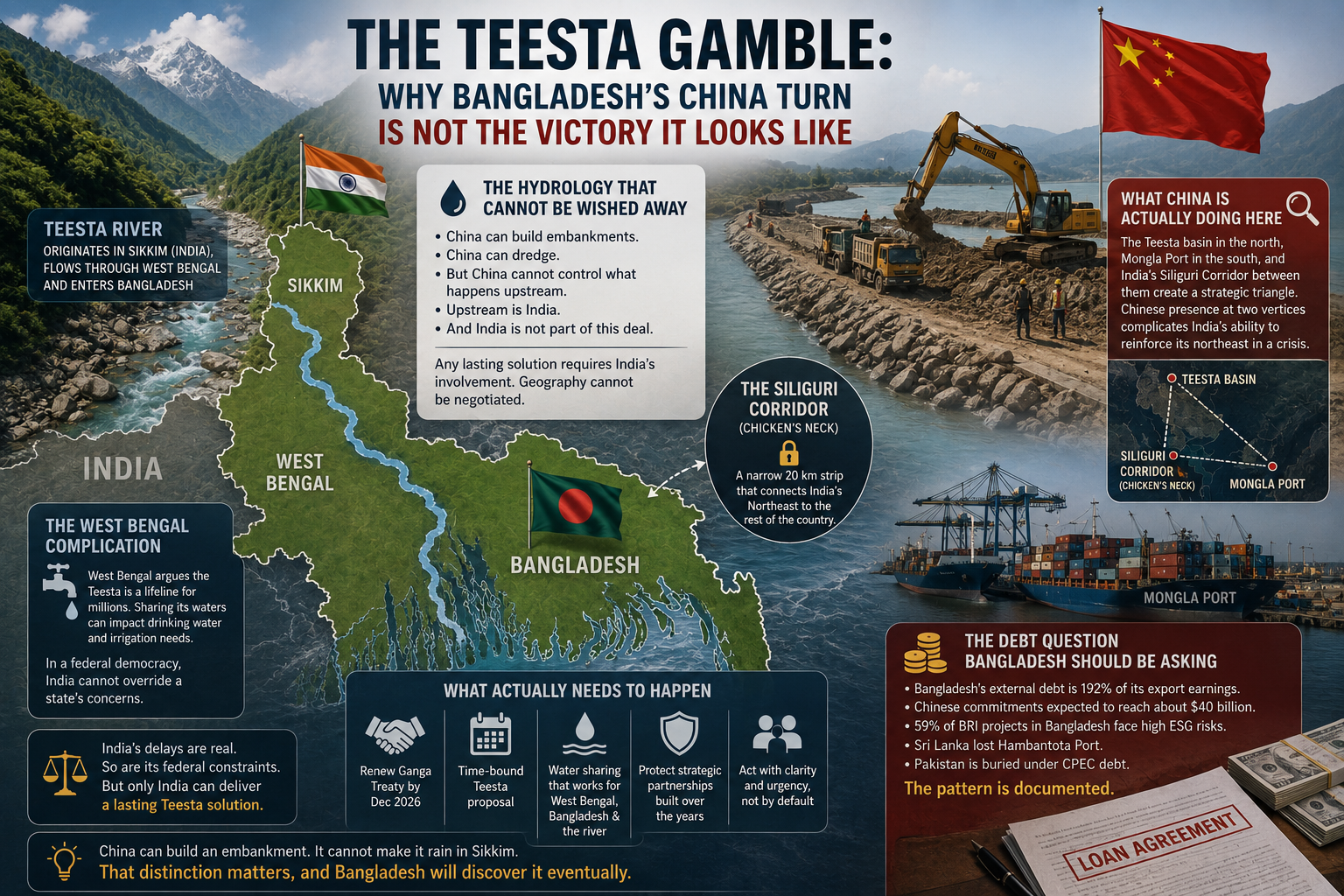
The TRCMRP’s stated objectives — river training, capital and maintenance dredging, construction and repair of embankments, land reclamation and dry-season storage — indicate flood-management needs in northern Bangladesh. For Dhaka, the Teesta is a lifeline for livelihood that has been prone to destructive floods and dry-season shortages. POWERCHINA’s engagement, confirmed through an MoU with the Bangladesh Water Development Board earlier this year, is therefore Dhaka addressing an acute domestic challenge.
But the choice of partner matters. For New Delhi, a sustained Chinese presence in the Teesta basin is not merely an economic arrangement; it is a strategic concern. The Teesta project’s northern reaches sit close to Siliguri Corridor, the roughly 22-kilometre-wide area that is India’s sole contiguous land link to the strategic Northeast. Any expansion of Chinese engineering teams, equipment footprints, communications infrastructure and logistics in adjacent areas could increase Beijing’s influence near this critical artery. That influence could be exercised in ways that affects India’s intelligence collection, surveillance, and rapid-response options around the corridor. Even if the likelihood of an overt military threat is low, the cumulative effect of infrastructure presence, data access and strengthened bilateral ties between Dhaka and Beijing can alter the strategic balance in the region.
Viewed in a wider context, the TRCMRP fits a now-familiar pattern of China converting economic assistance into strategic leverage across South Asia. Beijing’s investments — in ports, highways, power plants and now river management systems — can deliver tangible developmental benefits to recipient states like Bangladesh. They are, however, intrinsically intended to expand Chinese strategic reach and give it platforms for influence to counter India’s traditional neighborhood primacy. With domestic political constraints stalling a Teesta water-sharing treaty with India, Bangladesh sought viable alternatives. China’s readiness to step in fills a vacuum but also deepens Dhaka’s dependency on Beijing for large-scale infrastructure, financing and technological know-how.
The long-standing impasse over a Teesta water-sharing agreement, driven primarily by India's domestic politics, has led to strategic consequences that extend beyond hydrology. When domestic political deadlock hinders achievement of timely bilateral resolutions, neighboring countries will understandably turn to alternative partners. Bangladesh’s outreach to China therefore signals both a desire for visible results and a search for strategic diversification.
India’s response should be calibrated and multidimensional. Diplomatically, New Delhi should press for transparency: seek details about the TRCMRP’s technical scope, timelines, personnel deployment and data-sharing arrangements. Proactive, high-level engagement with Dhaka must emphasise that water projects on transboundary rivers require cooperative management and that downstream impacts are not merely technicalities but potential sources of bilateral friction. Multilateral and Track-II channels can reinforce cooperative frameworks for river science, sediment-management studies and disaster-risk mitigation.
At the same time, New Delhi needs to shore up its strategic posture around the Siliguri Corridor through enhanced situational awareness and infrastructure development. Investments in ISR capabilities — riverine surveillance, sensing technologies and satellite monitoring — will reduce India’s informational blind spots. Strengthening border management, including hotlines, joint mechanisms and capacity-building, can convert potential friction points into platforms for confidence-building.
The Teesta project, underwritten by Chinese engineering and finance, is not a neutral development exercise; it is an extension of Beijing’s strategic outreach that converts goodwill into leverage. By embedding its personnel, equipment and technical architectures in the Teesta basin, China will gain more than project deliverables — it secures footholds that will be repurposed for influence, information and access across Bangladesh’s northern frontier. New Delhi should treat this pattern for what it is: Chinese infrastructure diplomacy that is steadily intended to reshape the balance of influence in India’s immediate neighbourhood.
Dhaka’s diplomatic maneuvering appears designed to orient Bangladesh toward a pro‑China posture. The speed with which POWERCHINA’s role was formalised, the ceremonial framing of the PM visit as a landmark phase in bilateral ties, and the conspicuous absence of comparable high-level Indian counteroffers suggest more than transactional pragmatism. Whether intentional or the byproduct of seeking quick solutions, the indications are clear: Bangladesh is tilting into Beijing’s strategic orbit, a shift that will impact India’s security in the east, including the costs of safeguarding the Siliguri Corridor.
The Bangladesh Prime Minister’s visit to Beijing thus represents a strategic inflection point. If Dhaka’s outreach to China is aimed chiefly at rapid development gains, India can still compete on substance. If, however, the tilt reflects a calculated hedging that sees Beijing as a counterweight to India, New Delhi must prepare for a more complex and contested neighbourhood. While a hardening of defences may be required in future, New Dehi must contest the narrative that Beijing’s footprint is purely developmental. Practical steps include pressing Dhaka for full transparency on the TRCMRP’s technical plans, restricting any foreign presence that could have dual-use implications near the Siliguri Corridor, and accelerating surveillance and infrastructure upgrades to lower strategic vulnerability. At the same time, India should mobilise an alternative package of scientific cooperation, concessional finance and capacity building that is framed as a long-term partnership — not a stopgap concession — to neutralise Beijing’s appeal.
Ultimately, Dhaka’s tilt toward China is not a benign realignment: it is a geopolitical choice with direct consequences for India’s territorial connectivity and strategic depth. New Delhi must respond with clarity, urgency and a readiness to counter influence with credible alternatives; otherwise the expanding Chinese presence in Bangladesh will become an entrenched reality and adversely impact India’s own strategic objectives across the eastern flank.
Dr. Kanchan Lakshman is a Delhi-based National Security analyst.