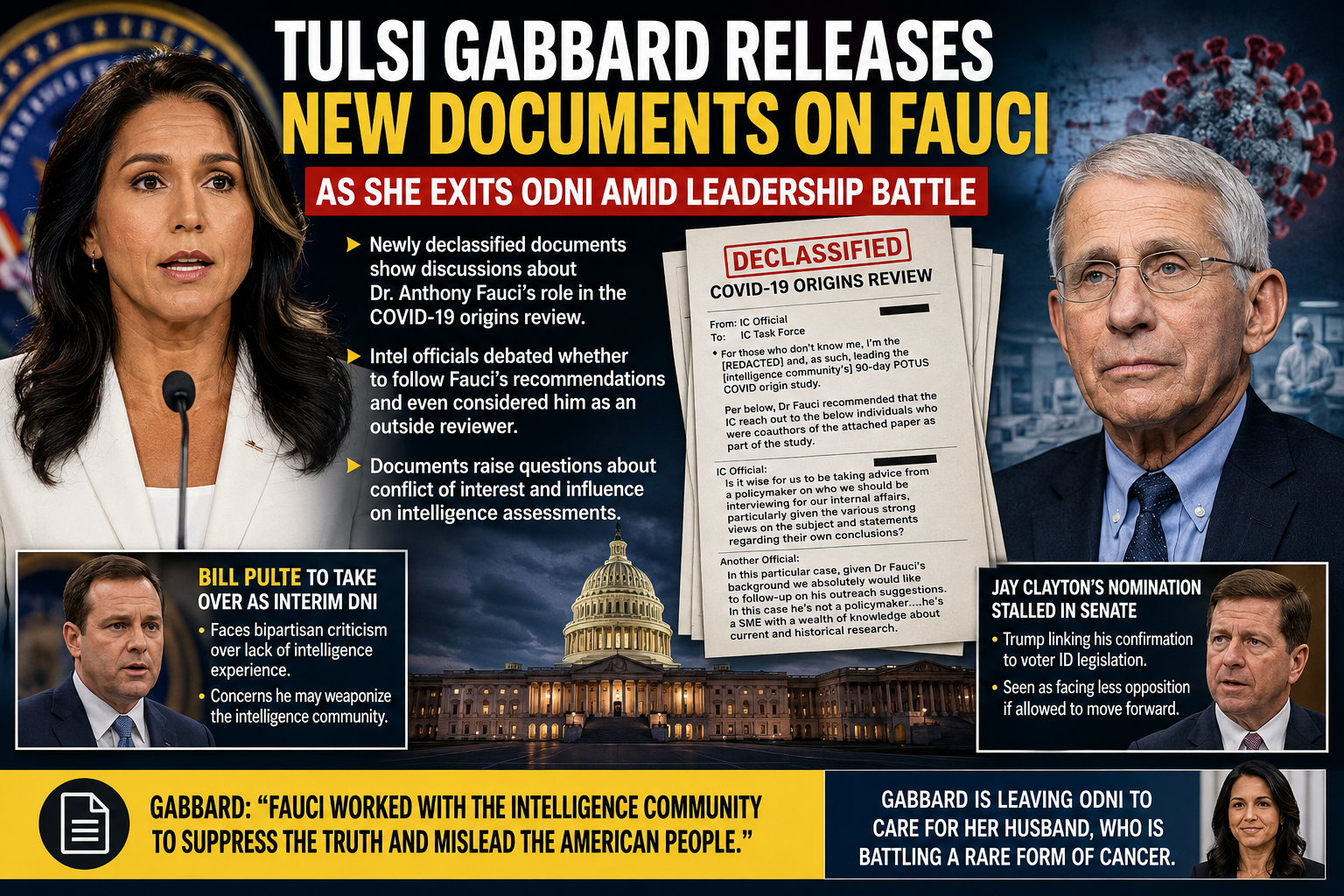
Washington, D.C. — In one of her final actions as Director of National Intelligence (DNI), Tulsi Gabbard has released a new batch of declassified documents concerning the U.S. intelligence community’s investigation into the origins of COVID-19, placing renewed scrutiny on the role of former White House chief medical adviser Dr. Anthony Fauci.
The release comes as Gabbard prepares to leave office amid an increasingly contentious political battle over who will lead the Office of the Director of National Intelligence (ODNI) next. Observers say the move reflects Gabbard’s determination to make questions surrounding COVID-19 origins, intelligence assessments, and Fauci’s involvement a defining part of her legacy.
Leadership Transition Sparks Political Tensions
As Gabbard departs, Bill Pulte, a businessman and former housing official, is expected to assume interim leadership of the intelligence community. His appointment comes while President Donald Trump’s permanent nominee, Jay Clayton, remains stalled in the Senate confirmation process.
Clayton, a former chairman of the Securities and Exchange Commission (SEC), is widely viewed as a more conventional choice for the position. However, his nomination has been delayed after Trump linked its advancement to congressional action on voter identification legislation.
The leadership transition has sparked significant controversy. Pulte, who previously served as director of the Federal Housing Finance Agency (FHFA), has faced criticism from both Republicans and Democrats over his limited intelligence experience and allegations that he used his previous position to target political opponents of the Trump administration.
Several influential Republican senators, including John Cornyn, Bill Cassidy, Lisa Murkowski, Susan Collins, and Thom Tillis, have expressed concerns regarding Pulte's appointment.
"We don't need a weaponized DNI, we need professionals there," Senate Majority Leader John Thune reportedly said, reflecting concerns that the intelligence community could become politicized under inexperienced leadership.
Democratic lawmakers, including Elizabeth Warren, Dick Durbin, Adam Schiff, Mark Warner, and Ron Wyden, have voiced similar concerns, arguing that Pulte could use intelligence agencies to target political adversaries.
Newly Declassified Documents Focus on Fauci
At the center of Gabbard’s final initiative is a collection of newly declassified documents related to the intelligence community’s review of COVID-19's origins.
According to the released materials, intelligence officials considered involving Fauci as an outside reviewer during the government's assessment of how the pandemic began. However, officials ultimately rejected the idea due to concerns that his participation could be viewed as a conflict of interest.
One document reveals internal discussions among intelligence officials regarding whether Fauci's recommendations should influence the review process. Emails show Fauci suggested several researchers and experts who could be interviewed as part of the investigation.
An intelligence official overseeing the study wrote that Fauci had recommended contacting scientists who co-authored a research paper relevant to the inquiry.
However, another official questioned whether it was appropriate to rely on guidance from a high-profile government figure whose public statements and views on the issue had already attracted significant controversy.
In response, another intelligence officer defended Fauci's involvement, arguing that he should be viewed not as a policymaker but as a subject-matter expert with extensive knowledge of coronavirus research and the scientific community.
The exchange highlights internal disagreements over how much influence outside experts, particularly Fauci, should have had on the intelligence community’s assessment.
Renewed Debate Over COVID Origins
The document release also revives longstanding political disputes over whether the coronavirus originated naturally or escaped from a laboratory in Wuhan, China.
For years, critics have accused Fauci and other public health officials of downplaying the possibility of a laboratory leak while emphasizing natural-origin theories. Conservatives have also questioned U.S. funding connections to coronavirus research conducted in Wuhan.
A previous CIA whistleblower alleged that Fauci exercised undue influence over intelligence assessments regarding COVID-19’s origins. Gabbard’s release appears intended to reinforce those concerns by highlighting communications between Fauci and intelligence officials.
In a statement accompanying the documents, ODNI asserted that Fauci played a significant role in shaping discussions surrounding the intelligence community’s COVID investigation.
The statement further alleged that Fauci worked with intelligence officials to suppress information about laboratory-origin theories and his involvement in funding research connected to coronavirus studies.
Fauci Faces Continued Scrutiny
The release comes as congressional Republicans intensify efforts to investigate decisions made during the pandemic. Lawmakers have suggested that Fauci could face additional questioning or deposition as new information emerges.
However, supporters of Fauci maintain that he acted in accordance with scientific evidence available at the time and argue that communications with intelligence agencies were part of a broader effort to understand an unprecedented global health crisis.
The newly released documents do not conclusively establish that Fauci improperly influenced the intelligence community's final conclusions, but they provide fresh insight into internal debates that occurred as officials sought to determine the origins of COVID-19.
Gabbard’s Departure
Gabbard’s release of the Fauci-related documents marks a dramatic conclusion to her tenure as Director of National Intelligence. According to reports, she is leaving the position to focus on caring for her husband, who is battling a rare form of cancer.
Her final actions ensure that the debate over COVID-19 origins, Fauci’s role, and the transparency of government investigations will remain a prominent issue as a new leadership team takes over the nation’s intelligence apparatus.
As Washington continues to wrestle with questions surrounding the pandemic’s origins and the future direction of the intelligence community, Gabbard’s document release is likely to fuel further congressional investigations and political debate in the months ahead.