Bangladeshi Scholar M Pizuar Hossain Earns Global Recognition for Groundbreaking Research on Genocide, International Law, and Human Rights
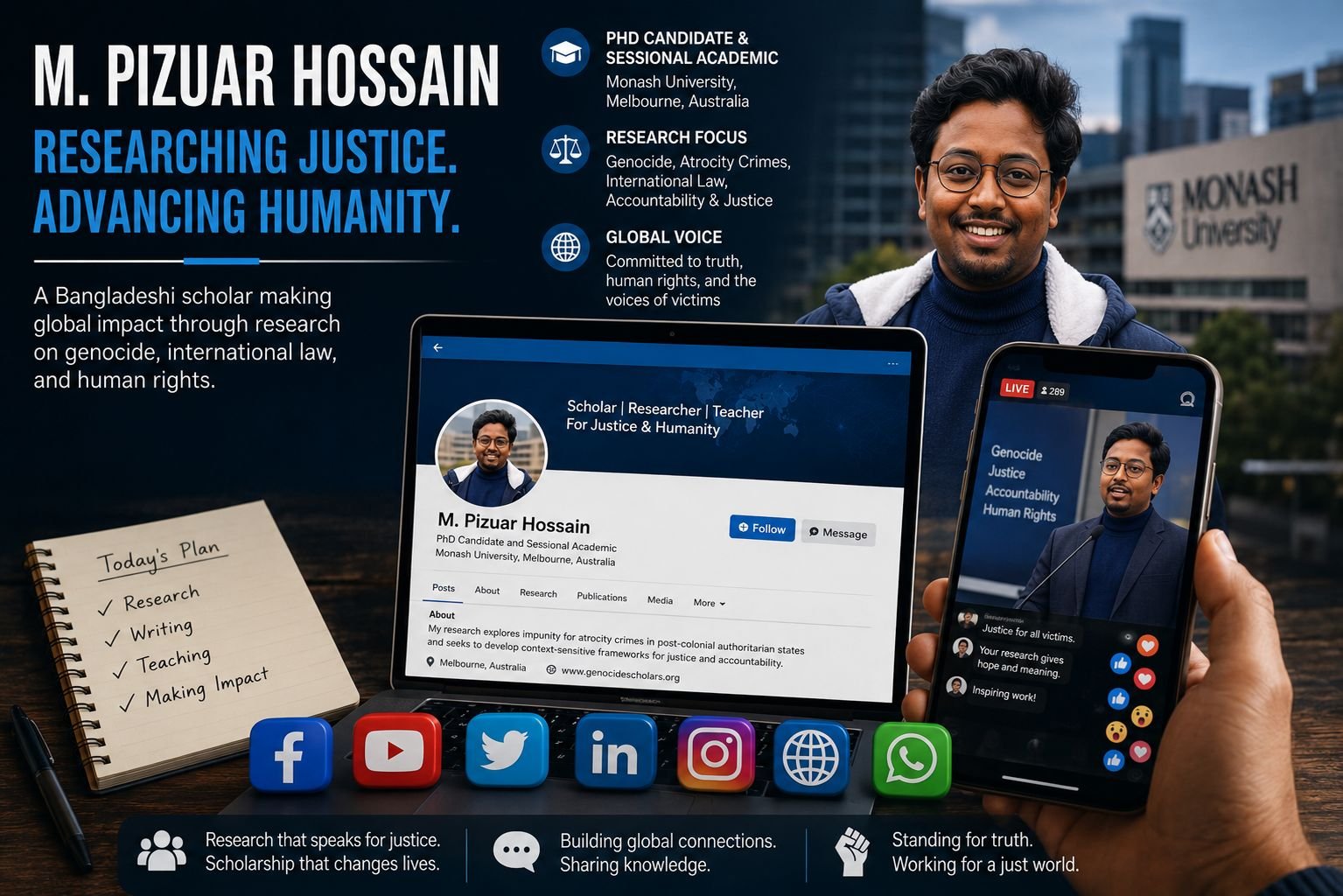
Bangladeshi legal scholar and PhD researcher M Pizuar Hossain continues to gain international recognition for his contributions to genocide studies, international law, atrocity prevention, and human rights research.
Bangladeshi Scholar M Pizuar Hossain Earns Global Recognition for Groundbreaking Research on Genocide, International Law, and Human Rights
Bangladeshi legal scholar and PhD researcher M Pizuar Hossain continues to gain international recognition for his contributions to genocide studies, international law, atrocity prevention, and human rights research.
In recent months, Hossain has received multiple prestigious international accolades, including academic awards from Monash University Faculty of Law and a featured profile by the International Association of Genocide Scholars (IAGS), one of the world’s leading scholarly organizations dedicated to genocide and atrocity studies.
These achievements highlight the growing influence of a Bangladeshi researcher whose work focuses on some of the most pressing issues of our time: genocide, crimes against humanity, accountability, transitional justice, and the protection of vulnerable communities.
Prestigious Awards from Monash University
Hossain was recently honored through the Monash Law Emeritus Professor H.P. Lee Student Publication Prize, receiving both the top “Winner” award and an “Honourable Mention” distinction for two separate scholarly articles.
The winning article, “Transitional Justice to Address Genocide Denial: A Case Study of the Rohingya in Myanmar,” was published in International Annals of Criminology by Cambridge University Press.
The study examines how genocide denial continues to obstruct justice for the Rohingya people and explores how transitional justice mechanisms can help establish accountability, truth-telling, and reconciliation.
His second article, “The Victimhood and Reparative Needs of Myanmar’s Rohingya: Towards Effective Reparations in International Law,” received the Honourable Mention award. Published in The International Journal of Human Rights by Routledge, the paper analyzes the reparative needs of Rohingya victims and proposes pathways toward meaningful reparations under international law.
Both publications have been praised for their scholarly contribution to debates surrounding genocide recognition, victim-centered justice, and accountability for mass atrocities.
Featured by the International Association of Genocide Scholars
Adding to his growing list of achievements, Hossain was recently featured in the IAGS Member Spotlight Series by the International Association of Genocide Scholars.
The feature highlighted his academic journey, ongoing doctoral research, teaching responsibilities, and contributions to genocide and atrocity studies.
In the interview, Hossain discussed his current PhD project at Monash University titled:
“Impunity for Atrocities in Post-colonial Authoritarian States: Rethinking International Law’s Responses.”
His research examines why genocide, crimes against humanity, and war crimes continue to occur with impunity in post-colonial authoritarian states despite the existence of international criminal law.
Drawing heavily on Southeast Asia, particularly Myanmar, the study investigates how colonial legacies, authoritarian governance structures, and weaknesses within international legal mechanisms contribute to persistent accountability gaps.
The project also contributes to the growing field of Third World Approaches to International Law (TWAIL) and seeks to develop more context-sensitive responses to atrocity crimes.
Distinguished Academic Journey
Hossain’s academic achievements span multiple countries and institutions.
He completed his Bachelor of Laws (LLB Honors) in Bangladesh, graduating with the prestigious Vice-Chancellor’s Gold Medal. He later earned an LLM in International Law and received the Chancellor’s Gold Medal for academic excellence.
Subsequently, he pursued an MSc in Criminology and Criminal Justice in the United Kingdom as a recipient of the highly competitive Chevening Scholarship.
Currently, he serves as the Charles E. Scheidt Faculty Fellow in Atrocity Prevention (2025–26) at the Institute for Genocide and Mass Atrocity Prevention in New York, United States.
He is also a Senior Lecturer in Law at East West University and is presently on study leave while pursuing his PhD.
International Research Contributions
Hossain’s scholarly interest in genocide studies emerged from examining the legacy of the 1971 Bangladesh Genocide, before expanding to research on the Rohingya genocide in Myanmar.
One of his most notable earlier publications was:
“Stages of the Rohingya Genocide: A Theoretical and Empirical Study”
published in 2021 in Holocaust and Genocide Studies by Oxford University Press.
The paper is regarded as one of the early academic studies to systematically analyze the genocidal experiences of the Rohingya people.
His research has also been supported by grants from the East-West University Centre for Research and Training, enabling him to pursue multidisciplinary studies that integrate law, criminology, and genocide scholarship.
Leadership in Global Genocide Studies
Beyond research, Hossain has played an active leadership role within the international academic community.
He served as an Advisory Board Member of the International Association of Genocide Scholars from 2023 to 2025 and currently serves as an Executive Board Member for the 2025–2027 term.
Through these positions, he has contributed to mentoring emerging scholars and promoting international collaboration in genocide and atrocity studies.
Global Recognition for a Bangladeshi Voice
Observers note that Hossain’s growing international profile represents more than personal success. It reflects the increasing presence of Bangladeshi scholars in global conversations on genocide prevention, international justice, and human rights.
His work continues to amplify the voices of victims while challenging legal and political structures that enable impunity.
As global conflicts and atrocity crimes persist, researchers like M Pizuar Hossain are helping shape