The Paper Trail: How Washington Spent Over $325 Million Dismantling Bangladesh's Elected Government
There is a paper trail. It does not lie.While the international press was busy writing elegies for Bangladesh's "democratic uprising" in August 2024, a quieter story was accumulating in grant databases, congressional testimonies, and declassified program reviews. It is a story about money and about where that money went and about what happened to a country's elected government shortly after.

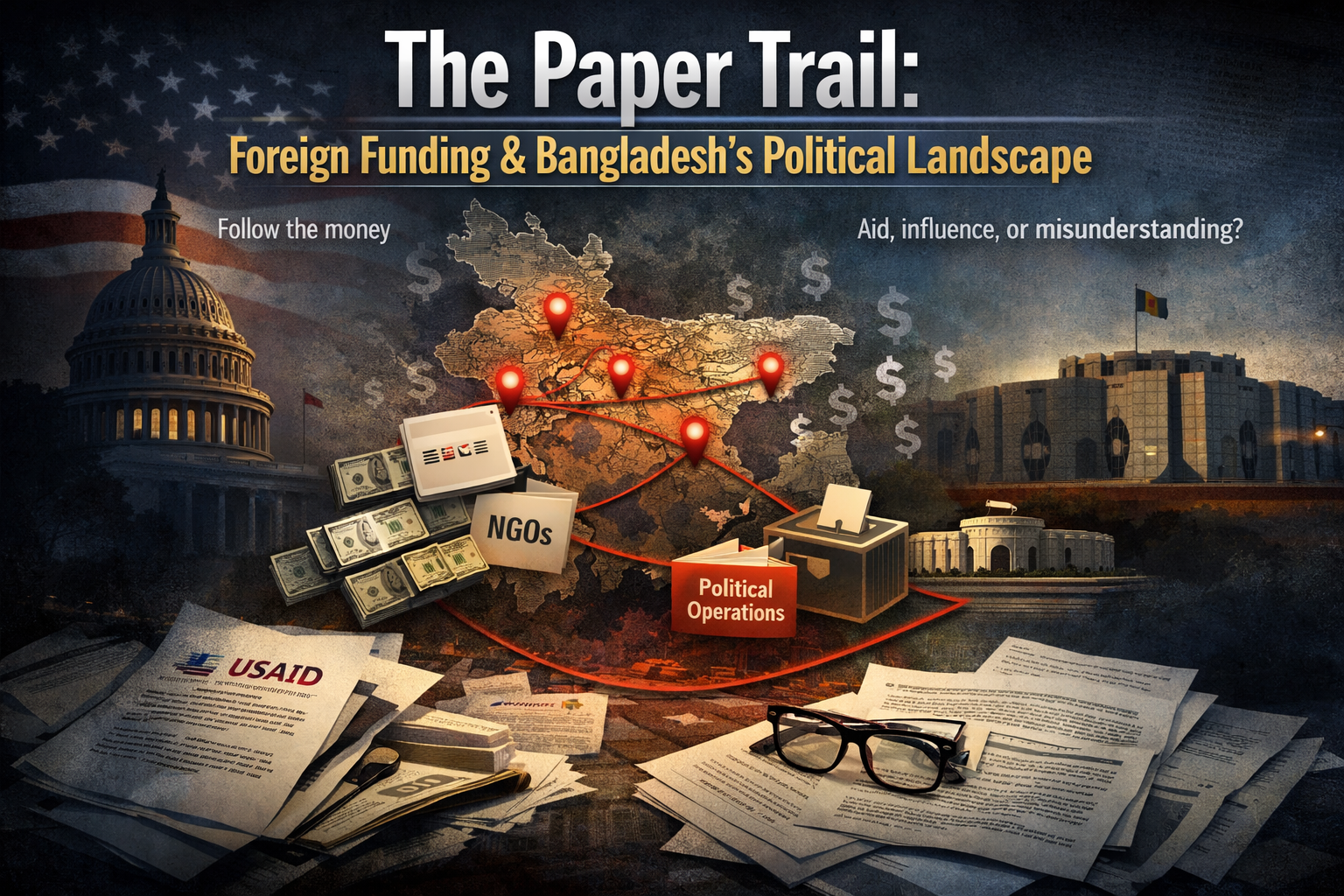
The Paper Trail: How Washington Spent Over $325 Million Dismantling Bangladesh's Elected Government
There is a paper trail. It does not lie.While the international press was busy writing elegies for Bangladesh's "democratic uprising" in August 2024, a quieter story was accumulating in grant databases, congressional testimonies, and declassified program reviews. It is a story about money and about where that money went and about what happened to a country's elected government shortly after. The numbers are public. The agencies are named. The awardees are on record. What has been missing, until now, is someone willing to read them together.
The Scale of the Intervention
The United States government, through its various agencies, obligated approximately $572 million in foreign assistance to Bangladesh in fiscal year 2024 alone, the highest single-year figure in the country's history with the US, according to data on ForeignAssistance.gov last updated on 31 March 2026. That figure covers all sectors. But within it, a subset of programs, traceable through USAID, the Department of State, and the Department of Defense, is harder to categorize as simple development aid.
According to a compiled research document attributed to Jihan Jennifer Hassan - drawing on publicly traceable US government grant and contract records - a minimum of $325,589,622 in grants and $2,779,903 in contracts from the United States were directed toward governance intervention activities in Bangladesh over the past decade. The UK government contributed an additional traceable £16.9 million through DFID's Strengthening Political Participation program, Phase 2 (SPP2), which ran from April 2017 to March 2021 with a full program value of £16.2 million.
The document notes explicitly, "The following data only records the fundings that have been traced. However, there is much more beyond the following amount that are not traceable with our existing resources." Additional untraceable sources are listed as including Middle East financing channelled through madrasahs via Hundi networks, the Open Society Foundation, UN Foundation-affiliated organizations, various European and Canadian embassies disbursing funds under the guise of Rohingya assistance, and the Yunus Sports Hub.
This is not a conspiracy theory. These are line items.
The Programmes: What They Actually Funded
The grant records tell a particular story when read carefully.
The single largest grant in the governance cluster belongs to Democracy International, which received $29,900,000 from USAID for the "Strengthening Political Landscape (SPL) in Bangladesh" program running from March 2017 to October 2025. This was not a marginal program. The SPL project was at the center of a vast sub-grant architecture. Downstream from Democracy International, organizations including The Global Hunger Project (receiving $951,747 twice over), M/S Beatnik ($102,199), and Samakal newspaper ($29,438 in two separate disbursements) all received funding routed through the same USAID channel.
The Consortium for Elections and Political Process Strengthening (CEPPS) - a joint vehicle run by the International Republican Institute (IRI), the National Democratic Institute (NDI), and the International Foundation for Electoral Systems (IFES) - received $21,000,000 for the "Amar Vote Amar" (AVA) activity running from August 2022 to July 2025. The sub-award trail from this program alone runs into the tens of millions, with IRI receiving over $18 million in sub-grants, IFES receiving over $16 million, and NDI receiving over $4.8 million across multiple tranches for the same AVA activity.
A Global Youth Leadership Center grant from the US Embassy Bangladesh, dated 30 September 2024 - just weeks after Sheikh Hasina's removal - stated its purpose as amplifying youth voices "ultimately influencing the interim government's reform agenda and future political priorities." The grant ran through February 2025. The framing is striking: the same infrastructure that spent years building youth political capacity was now, in the same funding cycle, directing that capacity toward shaping the post-Hasina order.
The Winrock International Institute for Agricultural Development received $38,500,000 from the US Mission to Bangladesh for the "Esho Shikhi (Come and Learn)" education program for marginalized children in Cox's Bazar, running from November 2021 to November 2026. Chemonics International secured $55,200,000 for a higher secondary education activity running from August 2023 to August 2028. Whatever the developmental merit of these programs, their concentrations in politically sensitive zones and their timing relative to the political crisis merit scrutiny.
The BRAC-USAID partnership under the Bangladesh America Maitree Activity (BAMA), worth $14,700,000, listed its objectives as strengthening democracy for an inclusive society, fostering sustainable economic growth, advancing human capital development, and strengthening resilience to shocks. BRAC, as Bangladesh's most influential domestic NGO, became a conduit through which American political objectives were laundered into the local institutional fabric.
The Military Thread
Perhaps the least discussed dimension of this funding architecture involves the US Department of the Navy (DoD-USN) via the Naval Supply Systems Command (NAVSUP). Over a span of roughly a decade, NAVSUP funneled contracts into Bangladesh for programs titled things like "Promoting Equality in Madrasa Students," "Student Leadership Development Workshops," "Bangladesh Anti-Violence Program," "Bangladesh University Student Counter-Radicalization Program," and "Social Media Analytics for Bangladesh."
The awardees - Bangladesh Center for Communication Programs (BCCP), Bangladesh Youth Leadership Center, Anandadhara Consultant, Expressions Ltd., and M/S Beatnik - received a combined total of approximately $2,779,903. Individually modest, these contracts form a pattern: the US military was funding youth mobilization, counter-radicalization messaging, student workshops, and social media analytics inside Bangladesh, all administered through NAVSUP Singapore rather than civilian aid channels.
M/S Beatnik's contract for "Social Media Analytics for Bangladesh" ($99,400, May 2021 to July 2022) is particularly notable. This is not food aid. This is not bridge-building. This is intelligence-adjacent social listening, contracted by the US Navy, in a country the United States would later see removed from elected governance.
The NED Testimony
On 24 February 2025, Damon Wilson, President and CEO of the National Endowment for Democracy (NED), testified before the US House Subcommittee on National Security, Department of State, and Related Programs. As reported by IANS, Wilson stated that in Bangladesh, "NED's support is helping the country emerge from more than 10 years of authoritarian rule, violence, and instability," referring specifically to Sheikh Hasina's government.
He described NED-supported activities as having helped "advance electoral reforms, monitor the integrity of the process, and promote voter education" in the lead-up to the most recent elections. He closed by framing the post-Hasina Bangladesh as "an opportunity to restore peace and advance democratic governance."
This is not the language of neutral development assistance. This is the language of a program that considers a specific political outcome to have been successful.
The Benz Revelation
Mike Benz is not a fringe blogger. He is a former Deputy Assistant Secretary of State for International Communications and Information Policy who has spent years documenting the mechanics of how US foreign policy planners use civil society infrastructure as a vector for political transitions. In a widely circulated appearance on the Tucker Carlson Show, Benz made claims about Bangladesh that deserve to be read in full rather than summarised.
As reported by The Times of India, Benz explained the decision-making logic plainly: "Let's say it is vital to US national interest to build a military base in Bangladesh to counter China, but the Bangladeshi Prime Minister refuses. Our foreign policy planners then decide that regime change is necessary." Once that decision is made, he continued, "all options to destabilize the country" come into play - from backing opposition forces to orchestrating what he described as a color revolution, where leaders are "ousted, sometimes fleeing in helicopters."
Sheikh Hasina fled by helicopter on 5 August 2024.
Benz's account goes further than strategy. He described the operational texture of what this looks like on the ground - and one detail is particularly difficult to dismiss when set against the grant records reviewed above. Benz claimed that US taxpayer money was used to fund Bangladeshi rap groups to produce protest songs, with the explicit goal of encouraging street demonstrations under the cover of "peaceful protests" that were designed to, and did, escalate into riots.
This is not an abstraction. Look again at the grant tables. The Association of American Voices received $66,600 from the Bureau of South and Central Asian Affairs (DOS) to "implement Youth Excellence on Stage (YES) Academy, engage and train Bangladeshi youth in American hip-hop music." The BBC Media Action YouthRISE activity received $4,000,000 from USAID, described as a "People to People Reconciliation Fund" program for youth who are "Resilient, Interconnected, Socially Cohesive, and Engaged." The Global Youth Leadership Center received $133,493 to run a TechCamp on "countering disinformation" - equipping young people with tools to "solve challenges in their local communities."
Rap groups producing protest songs. Youth trained in social media literacy. Peer-to-peer reconciliation networks. TechCamps on messaging. One might describe each of these individually as a cultural exchange program. Taken together, they are a mobilisation infrastructure - and Benz is not the first person to observe that this infrastructure was activated in Bangladesh in 2024.
The China dimension is also not incidental. Bangladesh sits at a strategically critical position in the Bay of Bengal, directly relevant to US Indo-Pacific Command planning and to the effort to limit Chinese naval access and influence in South Asia. Under Sheikh Hasina, Bangladesh maintained a pragmatic multi-vector foreign policy that included significant Chinese infrastructure investment. That posture was an obstacle. It no longer is.
The SPP2 Architecture: London's Role
The UK's DFID program, Strengthening Political Participation 2 (SPP2) (Program Code 203487), valued at £16.2 million and reviewed as of February-March 2020, was described in its own official documentation as DFID Bangladesh's "primary political governance program." It worked through four implementing partners: USAID with Democracy International and Counterpart International as downstream partners; FCO with Management Resources Development Initiative (MRDI) and Dhaka University Micro-Governance Research Centre (DUMGR); The Asia Foundation (TAF); and the International Foundation for Electoral Systems (IFES) with the Hunger Project and Bangladesh Institute of Peace and Security Studies (BIPSS).
This was not four bilateral programs. This was a coordinated transatlantic architecture operating simultaneously on Bangladesh's political parties, civil society, media, youth organizations, and judicial processes. The program's stated objectives included making political parties more policy-oriented, supporting cross-party collaboration, and using the FCO's flexible funding to "support media and youth to promote peace, tolerance, and freedom of speech." An internal annual review from March 2020 quotes a senior Awami League leader praising the program: "I have talked with many of them, and they have been enormously benefited... There is a wall that has been broken down between AL and BNP leaders. That is their biggest achievement."
That wall proved useful, later.
The Trajectory of Funding
The ForeignAssistance.gov dashboard for Bangladesh tells a story in graph form. US foreign assistance to Bangladesh rose steadily from the early 2000s, accelerated sharply around 2018, reached its peak in fiscal year 2024 at $572,530,819, and then began declining into 2025 and 2026 - the latter two years flagged as "partially reported." The timing of the peak is precise: maximum funding in the year Sheikh Hasina was removed. The decline begins immediately after.
This is not correlation in the sociological sense. This is a program lifecycle. The funding rose when the political objective was being pursued. It peaked at the moment of transition. It fell when the transition had been achieved.
What This Is Not
This is not an argument that every dollar of US assistance to Bangladesh was malicious. The Rohingya crisis is real, and the humanitarian response to it has been substantial. Medical research, agricultural development, and educational access are genuine goods. Cornell University's health research on income instability among low-income Bangladeshis serves legitimate scientific purposes.
But the architecture documented above cannot be explained by humanitarian intent. A US Navy social media analytics contract in Dhaka is not humanitarian. Twenty-one million dollars channeled through a consortium of Republican and Democratic party institutes to shape Bangladesh's electoral processes is not neutral development assistance. A $923,400 contract for "Social Movements and Collective Action Expertise" to an undisclosed domestic awardee, disbursed in August 2023 and running to December 2024, is not a food program.
The Question That Remains
Sheikh Hasina governed Bangladesh for fifteen consecutive years. She built roads, reduced poverty, expanded power generation, and presided over one of Asia's more sustained development stories. She was also increasingly authoritarian in her later years, and her government suppressed opposition. These things are simultaneously true.
But the decision about what form of government Bangladesh should have is, constitutionally and morally, a decision for Bangladeshis. The paper trail documented above does not show a country making that decision for itself. It shows a foreign power and its allies spending hundreds of millions of dollars over more than a decade to produce a specific political outcome, then funding the institutions that would consolidate it.
That is not democracy promotion. That is regime change with paperwork.
The records are public. The money is traceable. The question is whether anyone in Dhaka, or anywhere, will hold those who spent it to account.
Written by Abu Obidha Arin.....
Abu Obaidha Arin is a Bangladeshi thinker and writer focused on politics, governance, and the societal impact of digital systems.