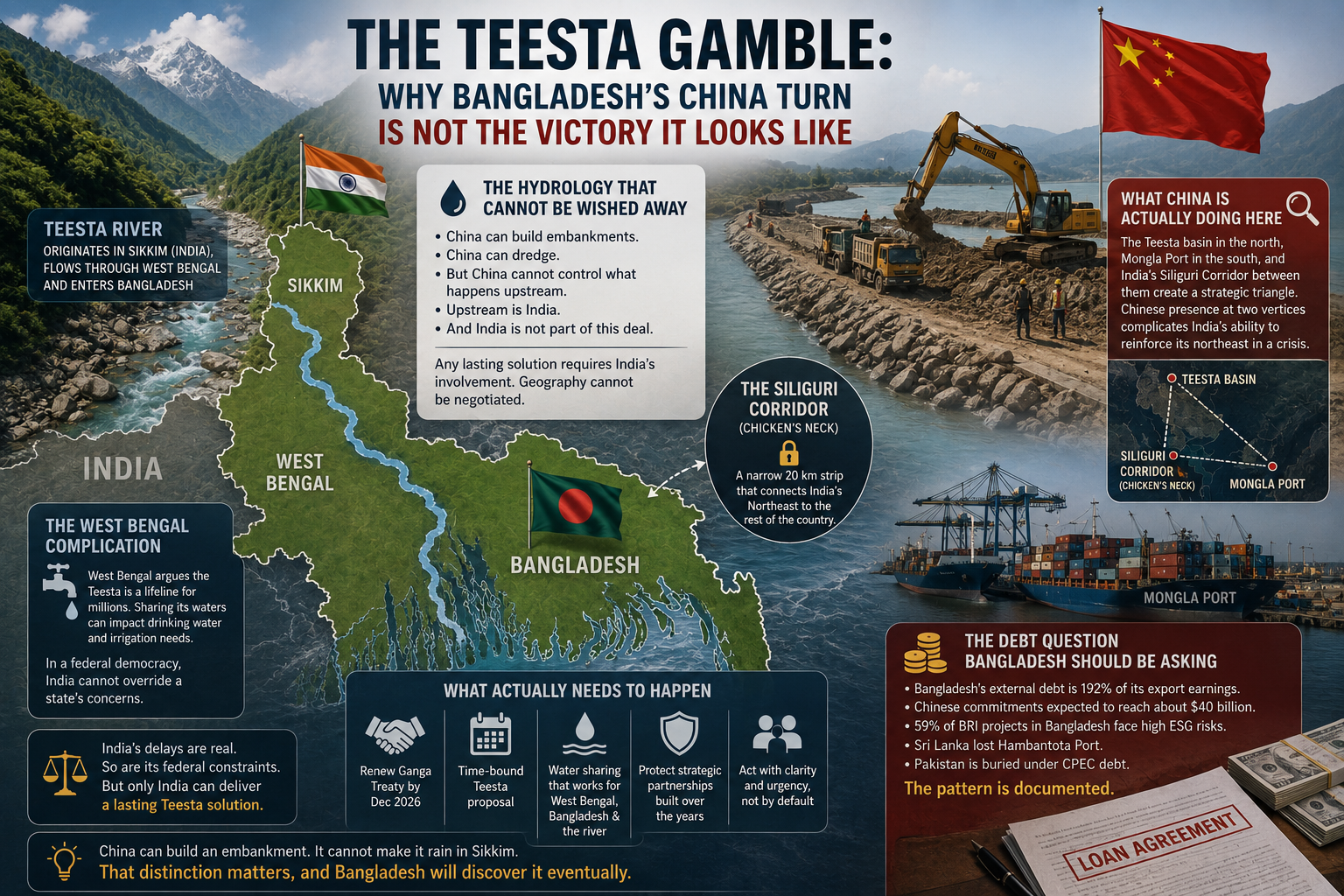
China’s Use of Bangladesh as a Military Hub: Strategic Alarm for Southeast Asia and U.S. Dominance
Bangladesh, long seen as a largely land oriented and neutral leaning South Asian state, is quietly emerging as a critical node in China’s broader maritime strategy aimed at dominating the Bay of Bengal and pressuring the Strait of Malacca - the core maritime chokepoint for U.S. and Western naval power in Southeast Asia.


China’s Use of Bangladesh as a Military Hub: Strategic Alarm for Southeast Asia and U.S. Dominance
- Bangladesh, long seen as a largely land oriented and neutral leaning South Asian state, is quietly emerging as a critical node in China’s broader maritime strategy aimed at dominating the Bay of Bengal and pressuring the Strait of Malacca - the core maritime chokepoint for U.S. and Western naval power in Southeast Asia. At the heart of this shift are Chinese-linked infrastructure projects, port-centric industrial corridors, and the construction of a major submarine base at Pekua (formerly BNS Sheikh Hasina) that collectively suggest China is transforming Bangladesh into a soft power plus hard power hub. From New Delhi’s eastern flank to Jakarta’s maritime backyard, this evolving alignment is not just a regional security concern; it is a direct challenge to existing U.S. maritime dominance in the Indo-Pacific.
Turning Bangladesh into a Bay of Bengal Springboard
China’s strategic interest in Bangladesh goes far beyond charity or development diplomacy. The Bay of Bengal is a critical maritime crossroads linking South Asia to Southeast Asia and controlling or influencing its littoral means shaping who can move freely between the Indian Ocean and the South China Sea. By investing heavily in ports, railways, bridges and special economic zones in and around Chittagong, Mirsarai, Matarbari and Feni, Beijing is creating a contiguous China-linked corridor that can move both commercial goods and military logistics along Bangladesh’s eastern coast.
This infrastructure is already being stretched toward dual-use logic. The planned deep-sea port at Matarbari, the Chittagong-Mirsarai industrial arc and the Feni-linked rail corridor are not just about boosting Dhaka’s GDP; they are about ensuring that Chinese vessels from commercial tankers to potential naval support ships so that they can operate with greater ease along a littoral that is increasingly guarded by Chinese backed surveillance and logistics nodes. When combined with the Pekua submarine base, China gains a quiet but strategically positioned foothold only a few hundred kilometres from the eastern approaches of the Bay of Bengal and the southeastern flank of India.
The Pekua Submarine Base: Quietly Anchoring Chinese Power
The commissioning of BNS Pekua (formerly BNS Sheikh Hasina) at Cox’s Bazar represents the most visible sign of China’s military-linked influence in Bangladesh. Officially described as Bangladesh’s first submarine base, it is designed to berth up to six submarines and several surface warships, with deep water berths, weapon storage facilities and extensive dry-docking infrastructure. What is less openly discussed is that the base was constructed largely with Chinese engineering, financing and technical oversight and its design follows patterns established in other Chinese assisted ports such as Gwadar in Pakistan and Hambantota in Sri Lanka - facilities Beijing later used for dual use logistics and surveillance.
Even if Chinese warships are not yet permanently stationed in Pekua, the base offers Beijing a strategic insurance policy:
In a crisis, Bangladesh can host Chinese submarines or support vessels under the cover of “friendly cooperation and training”.
Chinese-built surveillance and sensor systems can be layered into the base’s network, allowing Beijing to monitor Bay of Bengal traffic, including Indian Navy and U.S. allied movements.
The proximity of Pekua to the Bay of Bengal deep-sea lanes gives China a platform to extend the reach of its submarine and maritime patrol operations deep into waters that traditionally fall under Indian and indirectly U.S.- naval scrutiny.
In practical terms, Pekua is not just a Bangladeshi naval asset; it is a Chinese-enabled node that helps Beijing encircle India’s eastern seaboard and project power closer to the approaches of the Strait of Malacca without openly declaring a military base.
Encircling India and Pressuring the Strait of Malacca
China’s “string of pearls” strategy - the network of ports and logistics nodes around India has long worried New Delhi. Bangladesh is now becoming the eastern pearl in that chain. By solidifying its presence in Chittagong, Matarbari and Pekua China can:
Monitor Indian naval movements between the Bay of Bengal and the Andaman Sea.
Support or shadow Chinese submarines and surface vessels operating toward the Malacca-Andaman transit zone.
Create a credible threat that in any India-China conflict, the Bay of Bengal could become a contested space, forcing New Delhi to divert more resources from the Himalayan front to the maritime domain.
This, in turn, affects the Strait of Malacca. The Strait is the primary maritime artery for energy flows and trade between the Middle East, India, Southeast Asia and ultimately the Pacific. If China can dominate or heavily influence the Bay of Bengal littoral, it gains greater leverage over the eastern flank of the Malacca-India nexus. Beijing does not need to fully control the Strait; it merely needs to raise the risk and cost of unimpeded U.S. and Indian naval operations there.
A Challenge to U.S. Dominance in Southeast Asia
For the United States, China’s expanding footprint in Bangladesh is not an isolated event. It fits into a wider pattern:
Chinese investments in Gwadar (Pakistan), Hambantota (Sri Lanka), Kyaukpyu (Myanmar) and Cambodia’s Ream Naval Base are all designed to erode exclusive U.S. and Western control over key maritime corridors.
The recent discovery of a Chinese undersea monitoring system near Bali and Lombok - a Chinese designed deep-sea sensor buoy capable of tracking submarine and surface ship activity - shows how Beijing is building a network of underwater sensors across the Indo-Pacific.
Bangladesh, anchored by Pekua and the Chittagong-Matarbari-Feni corridor, adds a northern Bay of Bengal segment to this emerging network. If China can integrate sensor data from Bangladesh’s littoral with undersea arrays in the Andaman Sea, the Strait of Malacca, and the Sunda and Lombok Straits, it creates a continental-scale maritime-surveillance web that can detect and track not only Indian but also U.S. and allied naval movements. This would allow the Chinese Navy to plan submarine operations, anti-ship warfare, and coercive naval deployments with far greater precision.
The device was brought ashore at Gili Trawangan in the Lombok Strait after being discovered by a fisherman. (AFP)
Washington’s strategic problem is that it cannot simply “counter” by building its own bases in Bangladesh, which remains officially non-aligned. Instead, the U.S. is forced to respond indirectly - strengthening ties with India, Japan and Australia, boosting Thailand and Vietnam’s naval capabilities and reinforcing its own basing and surveillance in the South China Sea and the Philippines. But every Chinese node in Bangladesh weakens the effectiveness of that U.S. led counter-network by giving Beijing more options to project power, gather intelligence and threaten sea lines of communication.
Bangladesh: A Dual-Use Military-Commercial Hub
It is important to stress that Bangladesh is not a Chinese colony or a vassal state. Dhaka genuinely benefits from Chinese infrastructure - ports generate jobs, industrial zones create exports and railways lower transport costs. From a Southeast Asian viewpoint, a more China-oriented Bangladesh means:
A longer, more complex Chinese maritime arc from the Indian Ocean to the South China Sea.
Greater difficulty for ASEAN members in maintaining maritime neutrality, as Chinese submarines and support vessels gain closer access to the Bay and Malacca.
A higher risk that any U.S.-China naval confrontation could spill over or be influenced by events in the Bay of Bengal, a region long considered peripheral to the South China Sea dispute.
Conclusion: A Quiet Frontline in the New Cold War at Sea
The rail-links, industrial zones and surveillance forward posture around Feni and Chittagong, combined with the Pekua submarine base, are not random; they are pieces of a mosaic in Beijing’s plan to dominate the Bay of Bengal and constrain the Strait of Malacca.
For the United States and its partners, Bangladesh is no longer just a development partner or a moderate Muslim democracy; it is a potential battleground of influence where Chinese infrastructure quietly doubles as future military leverage. If China succeeds in turning Bangladesh into a reliable Bay of Bengal hub, it will not only shift the balance against India but also force the U.S. and Southeast Asia to recalibrate their naval and diplomatic posture in a region that is fast becoming the new frontline of the 21st-century maritime cold war.
About the Author:
AJIT AMAR SINGH has gained extensive knowledge by monitoring various conflict zones in Southeast Asia for more than a decade, focusing on historical contexts and engaging with stakeholders in these zones. Ajit Amar presents a unique view on contemporary scenarios affecting these regions. Currently, Mr Ajit is an esteemed faculty member of The Institute for Conflict Research & Resolution (ICRR) team and Principal Correspondent for Research News Analysis (RNA),