President Mahmoud Abbas and Joseph Aoun’s Meeting: "Palestinian Factions in Lebanon Agree to Disarmament"
After decades of maintaining autonomy and armed presence in Lebanon’s Palestinian refugee camps, several Palestinian factions now appear to be moving toward disarmament. In a landmark declaration, Lebanese President Joseph Aoun and Palestinian Authority President Mahmoud Abbas announced that any weapons outside the state’s control will no longer be tolerated.

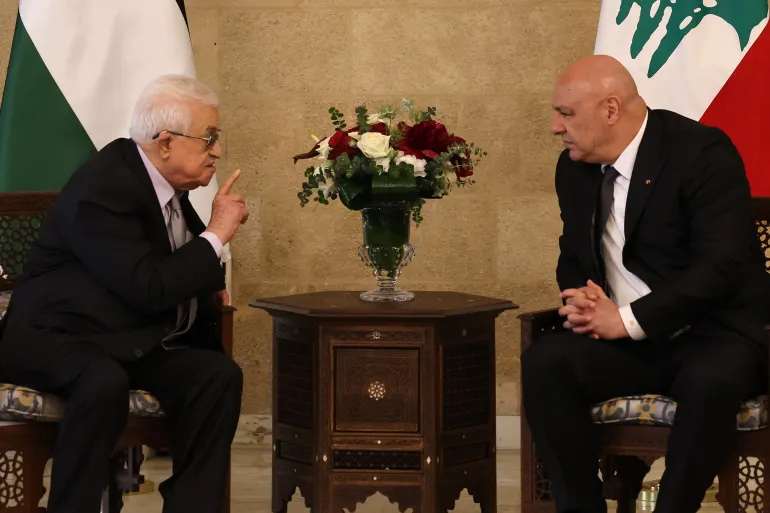
President Mahmoud Abbas and Joseph Aoun’s Meeting: "Palestinian Factions in Lebanon Agree to Disarmament"
President Mahmoud Abbas and Joseph Aoun’s Meeting: "Palestinian Factions in Lebanon Agree to Disarmament"
After decades of maintaining autonomy and armed presence in Lebanon’s Palestinian refugee camps, several Palestinian factions now appear to be moving toward disarmament. In a landmark declaration, Lebanese President Joseph Aoun and Palestinian Authority President Mahmoud Abbas announced that any weapons outside the state’s control will no longer be tolerated.
A Joint Declaration
In a joint statement, they declared:
“The era of weapons outside Lebanon’s national authority is over.”
President Abbas himself stated:
“We are guests here; no one is above Lebanon’s law.”
This marks a significant turning point in the long-standing history of armed Palestinian presence in refugee camps across Lebanon.
Fatah official Mustafa Abu Harb told Al Jazeera:
“We do not want anyone carrying weapons except for Lebanese state authorities.”
A New Government, A New Policy
Lebanon’s new government, led by former International Court of Justice judge Nawaf Salam, is pushing toward the disarmament of all non-state armed groups, with backing from international and regional powers. This includes 12 Palestinian refugee camps, where under a 1969 agreement, Palestinian factions were granted the freedom to bear arms.
Will Hamas Comply?
However, not all Palestinian factions are in agreement with this move.
Ali Baraka, a Hamas leader in Lebanon, stated:
“We respect Lebanon’s sovereignty, security, and stability. But we also demand that the civil and human rights of Palestinians be guaranteed.”
Last May, Hamas cooperated with the Lebanese army to hand over a suspect involved in a rocket attack on Israel—signaling a more conciliatory stance.
Abbas' Popularity and the Ground Reality
President Abbas’ popularity has waned considerably in many of the refugee camps. A leader from the Shatila camp remarked:
“Abbas is not our president; he sides with the Israeli occupiers.”
In contrast, posters of Yasser Arafat and Hamas spokesperson Abu Ubaida still dominate camp walls.
A History of Arms—and a New Future?
What was once seen as a right to armed resistance is now viewed by many as a threat.
Violent incidents such as the 2007 Nahr al-Bared conflict or the 2023 clashes in Ain al-Hilweh have led many Palestinians to realize that weapons no longer ensure safety—state security does.
Majzoub, a resident of Shatila camp, reflected:
“Today, Palestinian arms have become a threat to our own revolution. It’s time to come under Lebanon’s state security umbrella.”