

2026 Nobel Economics Prize Awarded to Robert Hall and Michael Woodford
The Royal Swedish Academy of Sciences has awarded the 2026 Sveriges Riksbank Prize in Economic Sciences to Robert E. Hall of Stanford University and Michael Woodford of Columbia University for their contributions to the “microeconomic foundations of macroeconomic stabilisation.”

CSB News USA
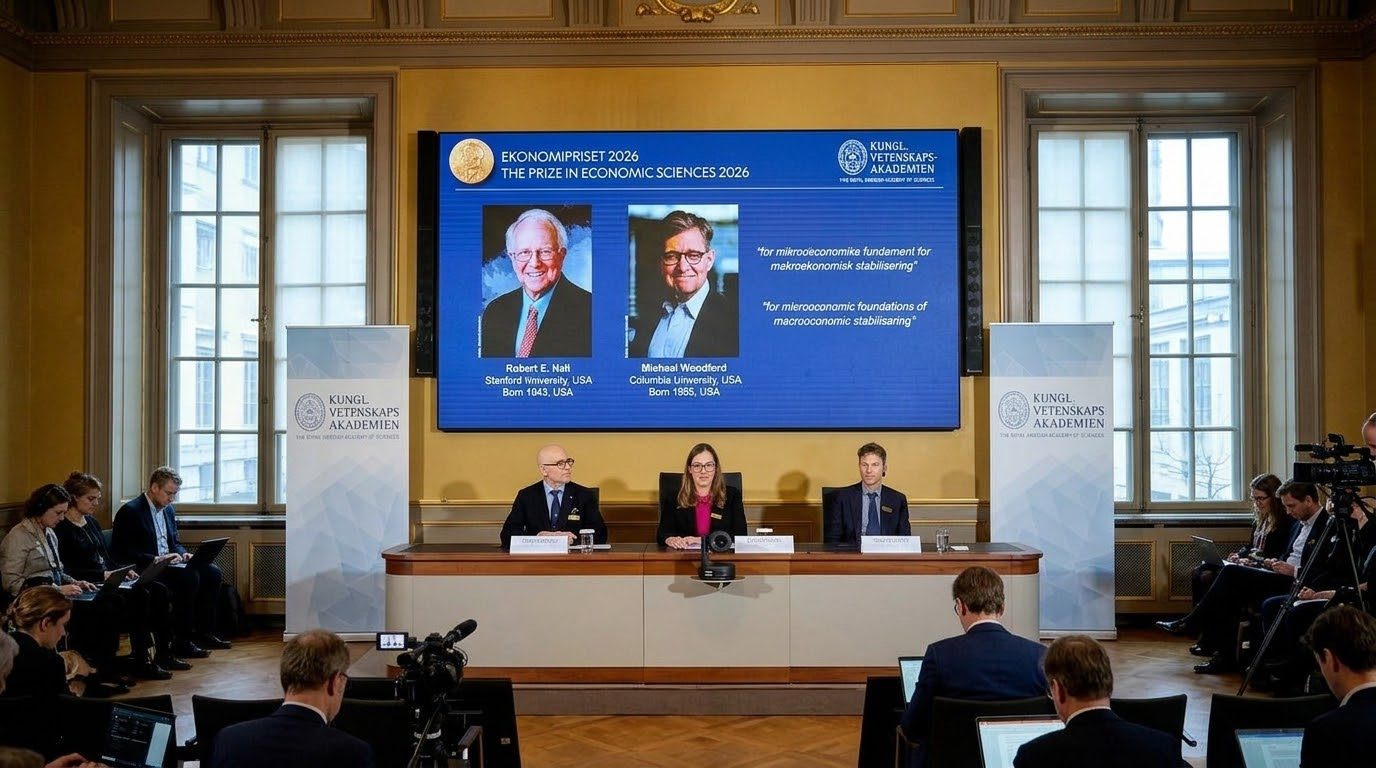
The two economists were recognised for developing economic models that have significantly improved the ability of governments and central banks to implement effective economic stabilisation policies.
In a post on X, the Royal Swedish Academy of Sciences announced that the laureates’ research had provided a strong theoretical foundation for economic models now used by central banks and governments worldwide.
“The laureates’ work has provided us with a stable theoretical foundation for the models that are now used by central banks and governments around the world,” said John Hassler, Chair of the Committee for the Prize in Economic Sciences.
He said the models help policymakers respond to economic shocks, including energy crises and sudden changes in household consumption.
The prize carries an award of 12 million Swedish kronor, which will be shared equally between the two recipients.
According to the academy, Hall and Woodford developed macroeconomic models that help governments and central banks manage economic fluctuations through appropriately timed fiscal and monetary policies. These measures can reduce extreme fluctuations in economic activity.
Stabilisation policies have long played a central role in economic management, particularly during recessions. Central banks can lower interest rates, while governments can increase budget deficits to stimulate economic growth. Conversely, measures to slow economic activity may be necessary when an economy becomes overheated.
Hall and Woodford helped strengthen these policies by developing economic models based on microeconomic foundations. Their research examines how individual households and businesses make decisions and how those decisions collectively shape broader economic outcomes.
A key aspect of their work is the recognition that households and businesses make forward-looking decisions about savings, consumption and prices. By clearly communicating policy plans, governments and central banks can influence public expectations and guide economic activity.
The economic crises of the 1970s exposed weaknesses in traditional Keynesian economic models. Efforts to reduce unemployment contributed to uncontrolled inflation, resulting in a prolonged period of slow economic growth, high unemployment and rising prices.
The research by Hall and Woodford has helped establish a more comprehensive framework for understanding these challenges and designing policies to maintain economic stability.
Reporter
CSB News USA
Related News

Nordic Countries to Draft Common Defence Agreement to Strengthen NATO Cooperation

University of Helsinki Presents 2026 Open Science Award to Professor Sampsa Hautaniemi

Morocco’s Transitional Justice Experience Highlighted at Helsinki University Conference

Comments 0
Log in or create a free account to join the conversation. You can comment anonymously.
No comments yet. Be the first.