
Trump Urges Data Center Developers to Share Profits With Residents to Win Public Support
President Trump urges technology companies to share data center profits with local residents as concerns grow over electricity bills, water use and environmental impacts.

Reporter · CSB News USA
9,654 views 7 min read
Listen to this article7 min
President Donald Trump has urged technology companies building large artificial intelligence data centers across the United States to share some of their financial benefits with the communities that host them. His proposal comes as opposition to these facilities grows among residents concerned about electricity prices, water consumption, environmental effects and the pressure placed on local infrastructure.
In a post on his social media platform, Truth Social, on Wednesday, October 21, Trump argued that companies could make unpopular data center projects more acceptable by offering financial payments, or dividends, to local communities and individual residents.
“If companies want to make their data centers popular, pay the community, and/or individuals within the community, a ‘dividend,’” Trump said in his post, according to reporting by Reuters. He added that he had seen situations in which a facility initially faced strong local opposition but became popular after a financial agreement was reached. He urged developers to negotiate with communities and move forward with construction.
The comments reflect a growing challenge for the technology industry as demand for artificial intelligence increases. Data centers are essential to the operation of artificial intelligence systems, online services, cloud computing and large digital platforms. However, the facilities require substantial amounts of electricity, advanced cooling systems and, in many cases, significant water resources.
Trump has repeatedly defended the expansion of data centers, arguing that the United States must maintain its technological advantage over China. His administration has supported the rapid development of artificial intelligence infrastructure, viewing it as important for economic growth, innovation and national competitiveness.
However, the president's latest remarks suggest that financial incentives for local residents could become an important part of efforts to secure public acceptance for new projects.
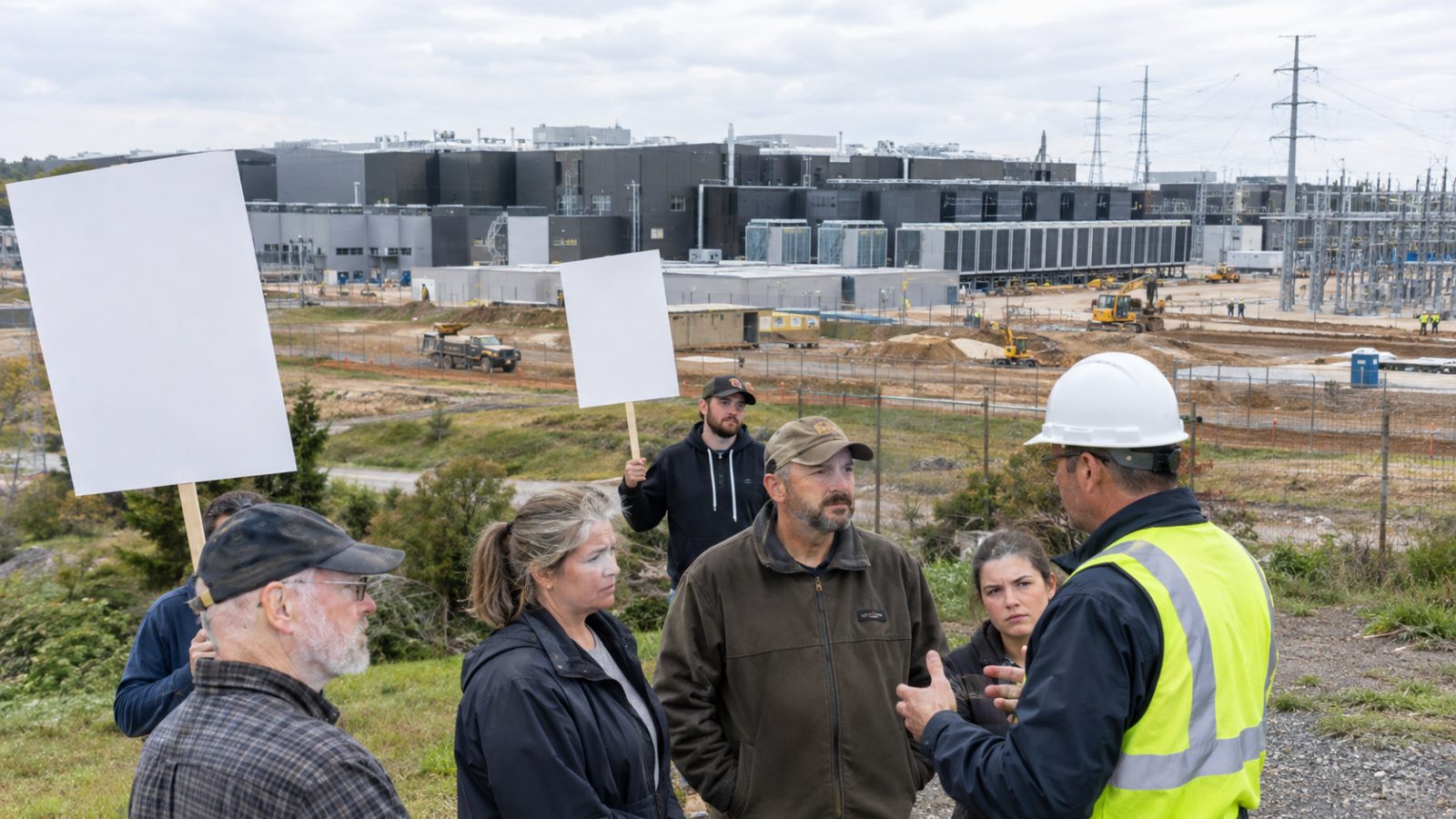
The debate has become particularly intense in communities where developers are seeking permission to construct large facilities on rural land or near residential neighborhoods. Residents have raised questions about whether the promised economic benefits will reach ordinary households or primarily benefit technology companies, investors and property owners.
Data centers can bring substantial investment to an area. Construction projects may create temporary employment, while operating facilities can generate property tax revenue and support demand for specialized technical workers. Local governments may also negotiate agreements involving infrastructure improvements, community programs and financial contributions.
Yet residents do not always experience those benefits directly. Many large facilities employ relatively few permanent workers compared with the scale of their construction costs and physical footprint. This has prompted some communities to question whether the jobs and tax revenue justify the potential costs.
Electricity is one of the most important concerns. Artificial intelligence systems require powerful computer processors that operate continuously, often across thousands of servers. As companies build larger facilities, their demand for electricity can increase significantly, requiring new power generation, transmission lines and other infrastructure.
If the costs associated with expanding the electricity network are not allocated appropriately, households could face higher utility bills. The exact effect depends on local electricity markets, regulatory decisions, infrastructure financing and agreements between utilities and data center operators.
Trump has previously argued that technology companies should build or secure their own electricity supplies rather than shift additional costs to ordinary consumers. In his October 21 statement, he said large data centers should generate their own electricity and provide surplus power to local communities or the electricity grid.
Reuters reported that Trump described these arrangements as a way to address concerns about energy costs while allowing data center construction to continue. However, the practical implementation and enforcement of the administration's broader approach remain important questions.
The distinction between a political announcement and an enforceable national requirement is significant. Although Trump has said large facilities are required to supply their own power, the precise legal mechanisms, scope and enforcement arrangements need to be established and assessed. His proposal for community dividends should likewise not be interpreted as proof that every data center developer is already legally required to make direct payments to residents.
Water consumption is another major source of public concern. Many data centers use cooling systems to prevent computer equipment from overheating. Depending on the technology, climate and facility design, these systems can require considerable amounts of water. Communities experiencing drought, groundwater pressure or competition for limited water supplies may be particularly concerned about approving new projects.
Environmental questions also extend to the electricity sources used by the facilities. If additional demand is met through fossil-fuel generation, emissions may rise. Companies can reduce some of these impacts by investing in cleaner energy, improving cooling efficiency and adopting water-management practices suited to local conditions. However, the effectiveness of these measures depends on the design and operation of individual projects.
Public opinion suggests that these concerns are not limited to one political party. An Associated Press-NORC poll conducted with the Energy Policy Institute at the University of Chicago found that 53 percent of Americans were extremely or very concerned about artificial intelligence's environmental consequences, up from 41 percent the previous year. The same poll found that roughly six in 10 Americans supported restrictions on new data center construction, according to reporting by The Independent.
These findings highlight a political problem for elected officials who support technological investment but must also respond to residents worried about their household expenses and quality of life.
Trump's proposal to distribute financial benefits could offer one way to address that tension. Under a dividend arrangement, a company might provide direct payments to residents, offer credits against electricity bills or property taxes, or fund projects that benefit the wider community.
Such agreements would need clear terms. Residents would want to know who qualifies for payments, how much money would be distributed, how frequently payments would be made and whether the arrangement would continue throughout the facility's operating life.
A payment to individual households would also differ from a contribution to a local government. Direct payments could provide residents with an immediate financial benefit, while public contributions could support schools, roads, emergency services, water systems and other shared infrastructure.
The proposal is not entirely new. Developers have sometimes offered local governments substantial financial contributions or promised infrastructure improvements when seeking approval for major projects. More recent discussions have focused on whether benefits should reach individual households rather than being limited to government budgets or community organizations.
Reporting by Data Center Dynamics described examples of proposed arrangements in Pennsylvania and Kansas. In Hazle Township, Pennsylvania, developer NorthPoint Development reportedly offered residents $10,000 each as part of efforts to secure support for a proposed data center project. Some residents reportedly criticized the offer as an attempt to buy public approval. In De Soto, Kansas, Digital Realty offered households $1,000 in utility and property tax credits annually for ten years in connection with a planned data center development.
These examples demonstrate why direct financial incentives can be controversial. Supporters may view them as a fair way to distribute some of the gains from major private investments. Critics may argue that money cannot compensate for long-term environmental damage, excessive water use, noise, traffic or rising electricity costs.
There is also a question of fairness between communities. A town that receives a major data center may gain tax revenue and employment opportunities, but neighboring areas could also experience effects from new transmission lines, water infrastructure or changes to regional electricity demand. A workable agreement would need to consider these wider impacts rather than focusing only on the property where a facility is built.
Technology companies have increasingly faced pressure to demonstrate that artificial intelligence growth produces benefits beyond corporate profits. The Independent reported that artificial intelligence company Anthropic had announced plans to allocate five percent of its shares to a fund supporting the public good, while Elon Musk had proposed giving Americans a stake in SpaceX. These proposals differ in structure from Trump's idea of payments to communities hosting data centers, but they reflect a broader debate about sharing the economic rewards of technological development.
For developers, financial agreements may help reduce opposition, but they are unlikely to resolve every dispute. Residents may still demand independent environmental assessments, transparent electricity-cost calculations, enforceable water-use limits and opportunities to participate in local planning decisions.
Local authorities also face difficult choices. Approving a data center can increase investment and expand the tax base, but granting permission without adequate safeguards may leave communities dealing with infrastructure costs or environmental problems for years. Some governments have therefore considered pauses on new construction or stronger rules for developers.
The political debate is also developing ahead of the November 3, 2026, US midterm elections. As more communities scrutinize large data center projects, the issue has become relevant to candidates who must balance economic development with concerns about affordability, land use and environmental protection. Reporting from Georgia has shown how competing approaches to data center development have become part of the state's political debate.
Trump's latest proposal signals that the administration recognizes the need to address public resistance while continuing to promote artificial intelligence investment. But the central question remains whether financial payments can create lasting public support or simply offer a temporary incentive.
For residents, the most important consideration may be whether the benefits are measurable, fairly distributed and guaranteed over time. For developers, the challenge is to show that their facilities can operate without imposing unreasonable costs on surrounding communities.
Ultimately, the success of Trump's approach will depend on the details of the agreements, the transparency of the development process and the willingness of companies to accept responsibility for their projects' effects. Direct payments could help some communities welcome new investment, but they will not automatically resolve concerns about electricity prices, water supplies or environmental sustainability.
As artificial intelligence infrastructure expands, the dispute is becoming about more than where companies can build their facilities. It is also about who pays for the infrastructure needed to support them, who receives the economic rewards and how communities can protect their interests while participating in the growth of a rapidly changing industry.