Houthis Push to Seize Yemen Highlands as Trump Reportedly Calls Off Strikes
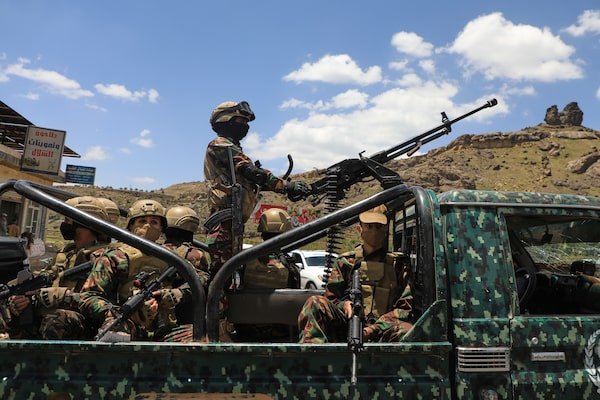
Iran-aligned Houthi fighters are intensifying efforts to seize strategic highlands in Yemen, according to five Yemeni military sources cited in reporting by Reuters. The sources said the Houthis are seeking to capture the Kahboub Mountains in the provinces of Taiz and Lahij, potentially allowing them to cut off the Red Sea coast from areas in the south controlled by Saudi-backed forces

Houthis Push to Seize Yemen Highlands as Trump Reportedly Calls Off Strikes
Iran-aligned Houthi fighters are intensifying efforts to seize strategic highlands in Yemen, according to five Yemeni military sources cited in reporting by Reuters. The sources said the Houthis are seeking to capture the Kahboub Mountains in the provinces of Taiz and Lahij, potentially allowing them to cut off the Red Sea coast from areas in the south controlled by Saudi-backed forces.
Meanwhile, The New York Times reported that the Trump administration had prepared to launch airstrikes against the Houthis on Sunday following renewed appeals from Saudi Crown Prince Mohammed bin Salman. U.S. troops had reportedly begun loading bombs onto aircraft when President Donald Trump called off the strikes at the last minute.
The report could not immediately be independently verified, and U.S. Central Command did not respond to a request for comment.
Houthis Claim Attack on Riyadh
The Houthis claimed they attacked Saudi Arabia's capital, Riyadh, on Saturday. Loud explosions were heard in the city and columns of smoke were seen near the airport.
Saudi authorities have not commented on what would be the first apparent Houthi strikes on Riyadh since the latest escalation began.
The group's rapid advance this month has expanded the conflict into another part of Yemen and raised further concerns over global energy supplies.
Fighting for Strategic Heights
The Houthis have controlled Yemen's capital, Sanaa, since 2014. This month, they made a rapid advance along the Red Sea coast, routing forces belonging to Yemen's internationally recognised government, which is backed by Saudi Arabia and based in the south.
The Houthis have claimed that Saudi Arabia has carried out hundreds of airstrikes against their positions in recent days. The campaign has so far failed to significantly slow their advance, while Saudi-backed government forces have withdrawn from several areas.
Five Yemeni military sources said fighting has intensified around the remote mountainous Al-Wazi'iyah district in Taiz province and at Ras al-Ara on the Indian Ocean coast. Ras al-Ara lies between the mouth of the Red Sea, which the Houthis captured last week, and the government's main base in Aden.
The sources said the Houthis are seeking to secure their rear positions around the Bab al-Mandab Strait by controlling the surrounding highlands. Such control could enable them to open new fronts and protect positions captured during their recent advance around Dhubab on the Red Sea and Perim Island in the strait.
Casualties and Displacement
The United Nations estimates that nearly 700 people have been killed and thousands injured in the latest escalation.
More than 120,000 Yemenis have been displaced within the country, while thousands more have fled by boat across the Red Sea to Africa, according to the UN.
Impact on Saudi Oil Exports
The escalation has created additional pressure on the United States, which faces calls to help defend its Saudi ally while also confronting concerns about further expanding the regional war.
Houthi control of the Bab al-Mandab Strait threatens a major alternative route used by Saudi Arabia to export oil while avoiding disruptions in the Strait of Hormuz.
Satellite data showed Saudi oil exports through Hormuz had risen to around 2.9 million barrels per day in recent days, up from approximately 700,000 barrels per day in August. The increase has partly offset the suspension of Saudi oil loadings at the Red Sea port of Yanbu.
Crude oil prices have retreated toward $100 a barrel after approaching $110 last week. However, refined fuel prices remain at record levels.
The U.S. retail price of diesel rose above $6.51 per gallon on Monday, according to data cited in the report, setting another record. Diesel had been around $3.75 per gallon before Trump launched the war against Iran alongside Israel in February.
New Incident in the Strait of Hormuz
Britain's UK Maritime Trade Operations (UKMTO) said a vessel entering the Strait of Hormuz was struck by a projectile, causing minor injuries to crew members.
Diplomatic efforts surrounding the wider conflict have largely stalled since an interim agreement between the United States and Iran collapsed within weeks of being reached in June.
Iranian President Masoud Pezeshkian is due to travel to New York on Tuesday to attend the United Nations General Assembly. It would be his first visit to the United States since Trump launched what Washington called “Operation Epic Fury” against Iran alongside Israel in February.
Source: Reuters