Iran Hesitates to Crack Down on Headscarf Defiance as War and Economic Pressures Mount
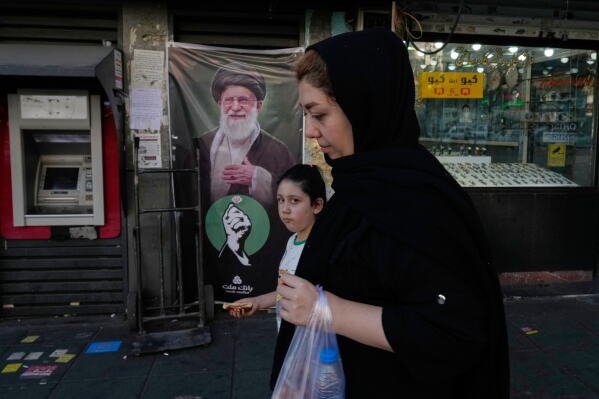
Enforcement of Iran’s strict rules governing women’s dress has eased significantly in recent years, with women increasingly appearing in public without headscarves

Iran Hesitates to Crack Down on Headscarf Defiance as War and Economic Pressures Mount
Enforcement of Iran’s strict rules governing women’s dress has eased significantly in recent years, with women increasingly appearing in public without headscarves.
Videos shared on social media show women sitting at outdoor cafes without head coverings, wearing crop tops, exercising alongside men in parks and dancing at sidewalk concerts with their hair uncovered. The scenes in Tehran reflect how far enforcement of the Islamic Republic’s social restrictions has weakened.
The change came partly in the aftermath of the mass protests that erupted following the Sept. 16, 2022, death of Mahsa Amini, a 22-year-old woman who had been detained by Iran’s morality police for allegedly wearing her headscarf improperly.
Security forces eventually crushed the protests in a sweeping crackdown that killed more than 500 people and led to thousands of arrests, according to reports. But in an effort to prevent further unrest, authorities subsequently eased enforcement of mandatory hijab and modest-dress rules.
Now, however, the authorities face a difficult question: Can those restrictions be imposed more strictly again?
Hard-liners within Iran’s ruling establishment are increasingly calling for a tougher crackdown on women’s clothing. But senior leaders appear wary of provoking another public backlash at a time when the country is already facing war, U.S. military attacks, sanctions and a naval blockade that have placed further pressure on its weakened economy.
“We can’t enter into that front as we ought to because of wartime conditions,” Gholam Ali Haddad Adel, an Iranian politician and father-in-law of Supreme Leader Mojtaba Khamenei, said publicly last week while discussing the headscarf issue.
Pouran Nazemi, an activist and former political prisoner who lives in Tehran, said disagreements over enforcement of the hijab had become more pronounced since the war began.
“They are afraid of protests,” she said in a phone call.
Women Push the Boundaries
A university student in her early 20s who lives in an affluent northern part of Tehran said she does not wear a headscarf but generally chooses clothes that cover most of her arms and legs.
Even so, she said, “I feel like I am wearing too much.”
Her friends, she said, regularly go out wearing tops that expose their shoulders and shorts that reach only to the knees.
She spoke on condition of anonymity because of security concerns.
The growing visibility of women without headscarves reflects a broader challenge to Iran’s long-standing social restrictions. While the rules remain formally in place, enforcement has become increasingly inconsistent, particularly in parts of Tehran and other urban areas.
The authorities now face a delicate balancing act. Hard-line elements continue to demand the restoration of strict enforcement, while the leadership must also contend with the possibility that aggressive policing could reignite public anger.
That calculation has become particularly sensitive during the current war and economic crisis. With Iran facing military pressure, sanctions and severe economic difficulties, a new wave of domestic protests could pose an additional challenge to the government.
For now, the leadership appears reluctant to open another major front over women’s clothing, even as conservative forces continue to press for tougher enforcement.