Merz Clings to Power After German Election ‘Disaster’
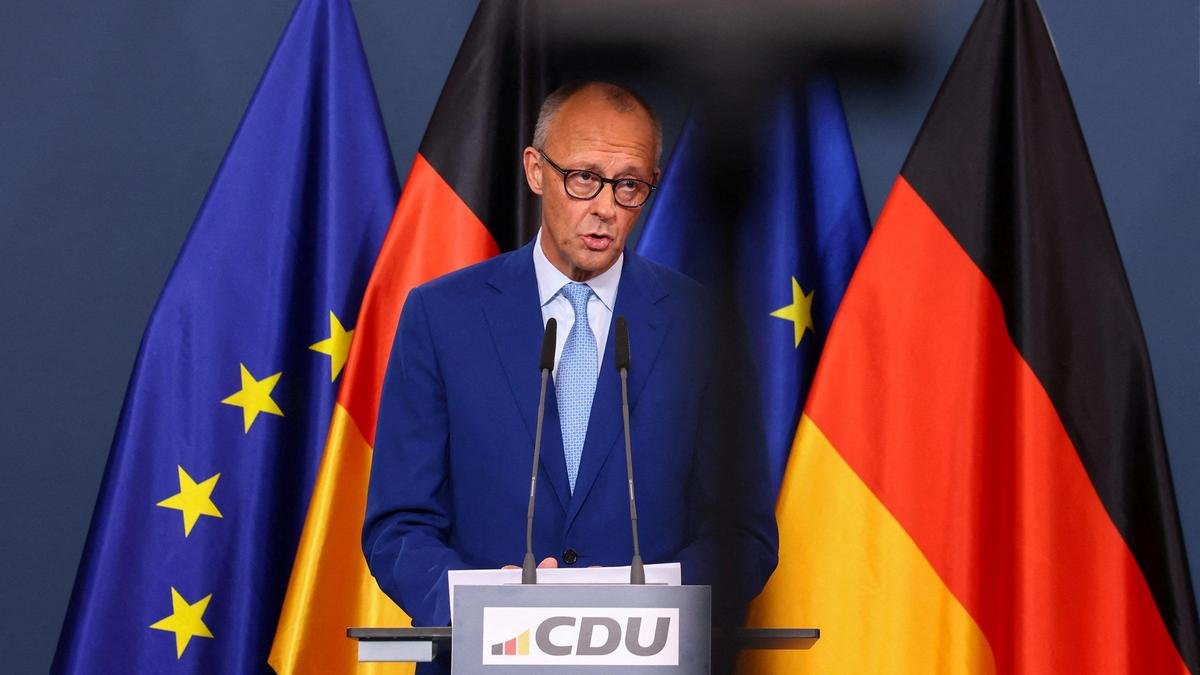
German Chancellor Friedrich Merz was fighting to hold on to power on Monday after his conservative party suffered the worst defeat in a regional election in postwar German history. At the same time, members of his coalition government were divided over his unpopular reform agenda

Merz Clings to Power After German Election ‘Disaster’
German Chancellor Friedrich Merz was fighting to hold on to power on Monday after his conservative party suffered the worst defeat in a regional election in postwar German history. At the same time, members of his coalition government were divided over his unpopular reform agenda.
Merz himself described Sunday’s defeat in the northeastern state of Mecklenburg-Western Pomerania as a “disaster.” His party, for the first time, failed to cross the 5% threshold required to enter a state parliament. The result was particularly significant because the state was once a stronghold of Merz’s predecessor and party rival, Angela Merkel.
The far-right Alternative for Germany, or AfD, came first in the election. Although the party fell short of a majority, it was the second time within a month that it had topped a state election. The party sees the result as a sign of growing momentum toward national power.
Merz’s party also lost significant support in a second election in Berlin. The left-wing Die Linke won the largest number of seats there and could form a coalition government and take power in the state. The party traces its roots to the former communist party that ruled East Germany.
German Chancellor’s Future Uncertain
Sunday’s results may not represent an immediate and decisive blow to Merz. However, his low approval ratings and the rise of the AfD have put his political future under growing uncertainty.
Several conservative state premiers met on Sunday to assess the situation. They had publicly backed Merz in an open letter the previous week.
One participant in the meeting told Reuters that the gathering was not about a revolt or a conspiracy against Chancellor Merz.
However, the participant said there was agreement that Merz needed to take more effective action following the poor results for his party in the state elections.
Within minutes of the election results being announced on Sunday, Merz said in a televised statement that he would continue with his reform agenda. He has argued that the reforms are essential to revive sluggish growth in Europe’s largest economy and maintain Germany’s competitiveness in the global economy.
Members of his centre-left coalition partner, the Social Democratic Party, however, have pushed back against the approach. Among them is Manuela Schwesig, the popular incumbent premier of Mecklenburg-Western Pomerania, who has sharply criticised the federal government’s pension reforms.
Schwesig said she was “very irritated” by Merz’s remarks. Speaking to broadcaster ARD, she said, “I think more humility is actually called for on the part of the Chancellor.”
Germany’s economy has been struggling to regain momentum since the pandemic. At the same time, competition from China and high energy prices have put additional pressure on the country’s export-driven economic model.
Some business leaders, however, have urged Merz to stay the course.
Jochen Hanebeck, CEO of chipmaker Infineon, said in a LinkedIn post: “Economic strength is not built by waiting; the future has to be actively shaped. We cannot afford to lose momentum now.”
Bitter Result for Germany’s Immigrant Communities
The AfD currently leads in national opinion polls. However, the party has so far been kept out of power because Germany’s other major political parties have refused to cooperate with it. The policy is commonly referred to as the “firewall.” Debate over the policy has intensified as the AfD has gained strength.
The AfD’s hardline position on immigration has also left some members of Germany’s immigrant communities concerned about their future.
Yasmin Goudarzi, an educational scientist, said: “The fact that the AfD is in the lead is quite a bitter pill to swallow.”
In Berlin, Die Linke won the most votes in a state election for the first time. The party campaigned on taking housing from corporate landlords into public ownership and imposing rent controls. Its campaign has been compared in the report to the rise of New York Mayor Zohran Mamdani.
Merz, who was elected last year on a promise to return Germany to economic growth, has struggled to win over voters. A series of communication missteps, combined with public resentment over pension, tax and healthcare reforms, has further complicated his position.
Schwesig, who is sometimes viewed as a potential future national leader of the Social Democratic Party, is likely to remain in power in her state.
Schwesig said the AfD had gained votes by criticising Germany’s support for Ukraine. The Kremlin has also seized on the same issue, according to the report.
The AfD wants to restore relations with Moscow and describes sanctions against Russia as self-defeating. The party argues that the sanctions have cut Germany off from Russia’s vast supplies of cheap energy.
Schwesig once supported the Nord Stream pipelines, which transported Russian gas through her Baltic Sea state into Germany. However, she changed her position after the pipelines were damaged in explosions in 2022.
Detlef Spelker, a passerby in the city of Schwerin, said: “The troublemakers who voted for the AfD clearly weren’t paying attention in history class.”
He added: “We were in a similar situation almost 100 years ago. There was inflation, problems with jobs, and nobody had any money. We will see what this brings now.”