India–EU Free Trade Deal: A new economic axis in a divided global market
India and the European Union have reached a landmark free trade agreement after nearly two decades of negotiations, a deal expected to reshape global trade and impact nearly 2 billion people.

India–EU Free Trade Deal: A new economic axis in a divided global market
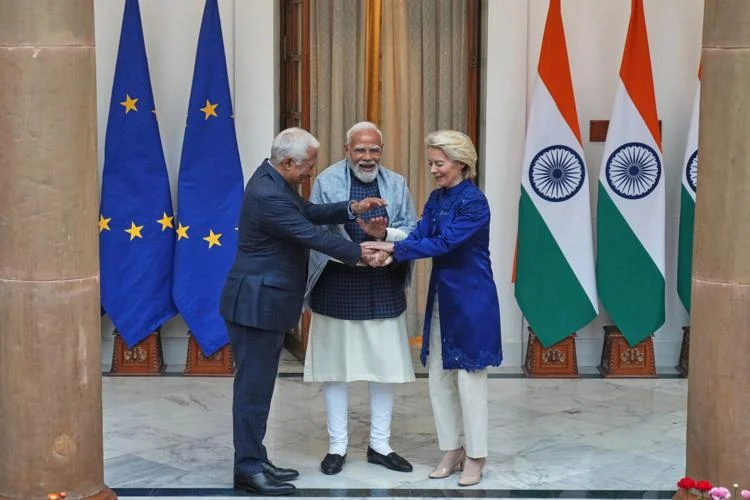
NEW DELHI — After nearly two decades of negotiations, India and the European Union reached a landmark free trade agreement on Tuesday, a deal expected to affect the lives and economies of nearly 2 billion people and reshape global trade dynamics.
The head of the European Commission described the accord as the “mother of all deals,” reflecting its scale and strategic importance. The agreement will allow near-free trade on most goods between India and the EU’s 27 member states, covering sectors ranging from textiles and apparel to pharmaceuticals and industrial machinery. High Indian import tariffs on European wine and automobiles will be sharply reduced, though the agreement is expected to take several months to fully take effect.
The deal comes at a time when both India and the EU are facing increasing trade pressure from the United States, which has imposed steep tariffs on both economies. These measures have disrupted established trade flows and pushed major global markets to seek alternative partnerships.
Indian Prime Minister Narendra Modi, speaking in a virtual address, said the agreement would bring major benefits to both sides.
“This agreement will create significant opportunities for the people of India and Europe,” Modi said. “Together, we represent 25% of global GDP and nearly one-third of global trade.”
Beyond commerce, India and the EU also agreed on a framework for enhanced defense and security cooperation, as well as a separate pact aimed at easing mobility for skilled professionals and students—signaling a broader strategic partnership that extends well beyond trade.
A Strategic Response to Global Fragmentation
Trade analysts say the agreement reflects a shift toward stability amid growing uncertainty in the global trading system.
“Ultimately, the agreement is about creating a stable commercial corridor between two major markets at a time the global trading system is fragmenting,” said Indian trade analyst Ajay Srivastava.
The European Union has been reeling from what many officials describe as an aggressive and unpredictable approach from Washington. U.S. President Donald Trump’s higher tariffs, support for far-right European parties, and confrontational stance over Greenland—a semi-autonomous territory of EU member Denmark—have fueled a widespread sense of betrayal across the bloc.
In response, Brussels has accelerated its outreach to markets around the world. Over the past year, European Commission President Ursula von der Leyen has finalized or advanced trade deals with Japan, Indonesia, Mexico, and South America under the banner of “strategic autonomy,” a policy aimed at reducing reliance on the United States.
India’s Push to Offset U.S. Tariffs
India, meanwhile, is diversifying its export destinations to counter the impact of rising U.S. tariffs. Washington has imposed an additional 25% levy on Indian goods over New Delhi’s continued purchases of discounted Russian oil, bringing combined U.S. tariffs on Indian exports to 50%.
For the EU, the deal offers expanded access to one of the world’s fastest-growing major economies and allows European exporters and investors to reduce dependence on more volatile markets.
“This is the most comprehensive trade deal India has ever signed,” said Garima Mohan, a senior fellow at the German Marshall Fund. “It gives European companies a first-mover advantage and a strategic edge that other global players do not have.”
Tariff Cuts and Market Access
Trade between India and the EU stood at $136.5 billion in the 2024–25 fiscal year. Officials on both sides aim to raise that figure to $200 billion by 2030.
Under the agreement, a quota system has been established for automobiles, wine, and whisky to ease steep import duties. The European Commission said tariffs on EU-made cars sold in India will gradually fall from 110% to as low as 10%, while duties on car parts will be fully eliminated within five to ten years.
Tariffs of up to 44% on machinery, 22% on chemicals, and 11% on pharmaceuticals will also be largely removed. For premium European wines, Indian import duties will drop sharply from 150% to 20%.
However, India has excluded dairy products such as milk and cheese, along with cereals, citing domestic sensitivities. On its side, the EU will not grant concessional tariffs on Indian sugar, meat, poultry, or beef products.
Economic Impact and Next Steps
Von der Leyen described the agreement as a partnership between “two giants” built on a true win-win foundation, adding that it sends “a powerful message that cooperation is the best answer to global challenges.”
The deal is expected to deepen supply-chain integration, strengthen joint manufacturing capacity, cut up to 4 billion euros ($4.7 billion) in annual tariffs for exporters, and create millions of jobs across India and Europe.
A formal signing is expected later this year after legal reviews are completed and the European Parliament ratifies the agreement. Indian Trade Minister Piyush Goyal said he expects the deal to take effect by the end of the year.
Under the terms, India will reduce or eliminate tariffs on 96.6% of EU exports, while the EU will phase in similar reductions covering nearly 99% of Indian exports by trade value.
Indian sectors set to benefit most include textiles, apparel, engineering goods, leather, handicrafts, footwear, and marine products. European gains will be strongest in automobiles, wine, chemicals, and pharmaceuticals.