Trump announces withdrawal of National Guard troops after court rulings block deployments
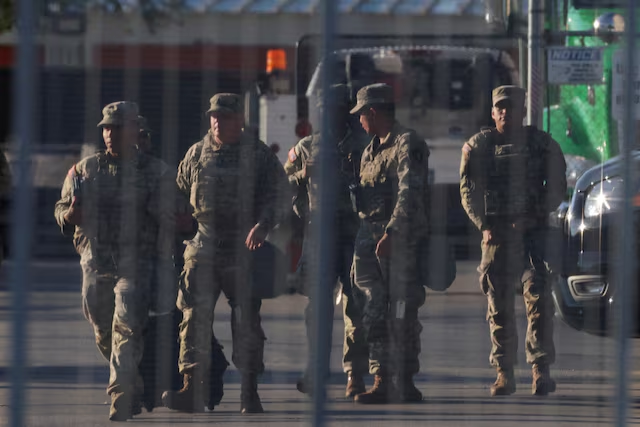
Donald Trump said he is pulling National Guard troops from Chicago, Los Angeles and Portland following court rulings that blocked the deployments and questioned his authority to use the military for domestic law enforcement.

Trump announces withdrawal of National Guard troops after court rulings block deployments
U.S. President Donald Trump has announced the withdrawal of National Guard troops from Chicago, Los Angeles and Portland, while maintaining that their deployments had significantly reduced crime in those cities. The decision comes amid mounting legal setbacks and sustained opposition from local and state leaders.
Trump, a Republican, said the troop deployments were necessary to combat crime and to protect federal property and personnel from protesters during widespread demonstrations earlier this year. Writing on social media, Trump claimed the presence of the National Guard alone was responsible for improving public safety.
“We are removing the National Guard from Chicago, Los Angeles, and Portland, despite the fact that CRIME has been greatly reduced by having these great Patriots in those cities, and ONLY by that fact,” Trump wrote.
He added a warning: “We will come back, perhaps in a much different and stronger form, when crime begins to soar again — only a question of time!”
However, federal judges overseeing lawsuits filed by several cities challenging the deployments have consistently ruled against the Trump administration. Courts found that the federal government overstepped its authority and failed to present evidence that National Guard troops were necessary to protect federal property from protesters.
The most significant legal blow came on December 23, when the U.S. Supreme Court blocked Trump’s attempt to deploy National Guard troops in Illinois. The ruling undermined the administration’s broader legal justification for sending troops to other states.
In an unsigned order, the court said the president’s authority to take federal control of National Guard units likely applies only in “exceptional” circumstances.
“At this preliminary stage, the Government has failed to identify a source of authority that would allow the military to execute the laws in Illinois,” the court’s majority stated.
Local leaders who opposed the deployments said the legal challenges forced Trump to end the troop presence. California Governor Gavin Newsom’s office dismissed Trump’s announcement as political posturing.
“Trump’s rambling here is the political version of ‘you can’t fire me, I quit,’” Newsom’s office said in a statement.
Following Trump’s announcement, the office of Chicago Mayor Brandon Johnson released crime data for 2025, showing that the city recorded its lowest level of violent crime in more than a decade. According to the data, violent crime fell by 21.3% compared with 2024.
Trump began deploying troops in June amid protests against his hardline immigration policies, including efforts to sharply increase deportations. He also sent troops to Washington, D.C., and assumed control of local law enforcement, citing what he described as rampant crime—claims that were contradicted by local crime statistics.
Critics argue the deployments were politically motivated and risked undermining the long-standing separation between civilian law enforcement and the military. Supporters, however, say Trump’s actions reflected a tough-on-crime approach favored by his political base.