The Slow Erasure of Pakistan's Sikhs
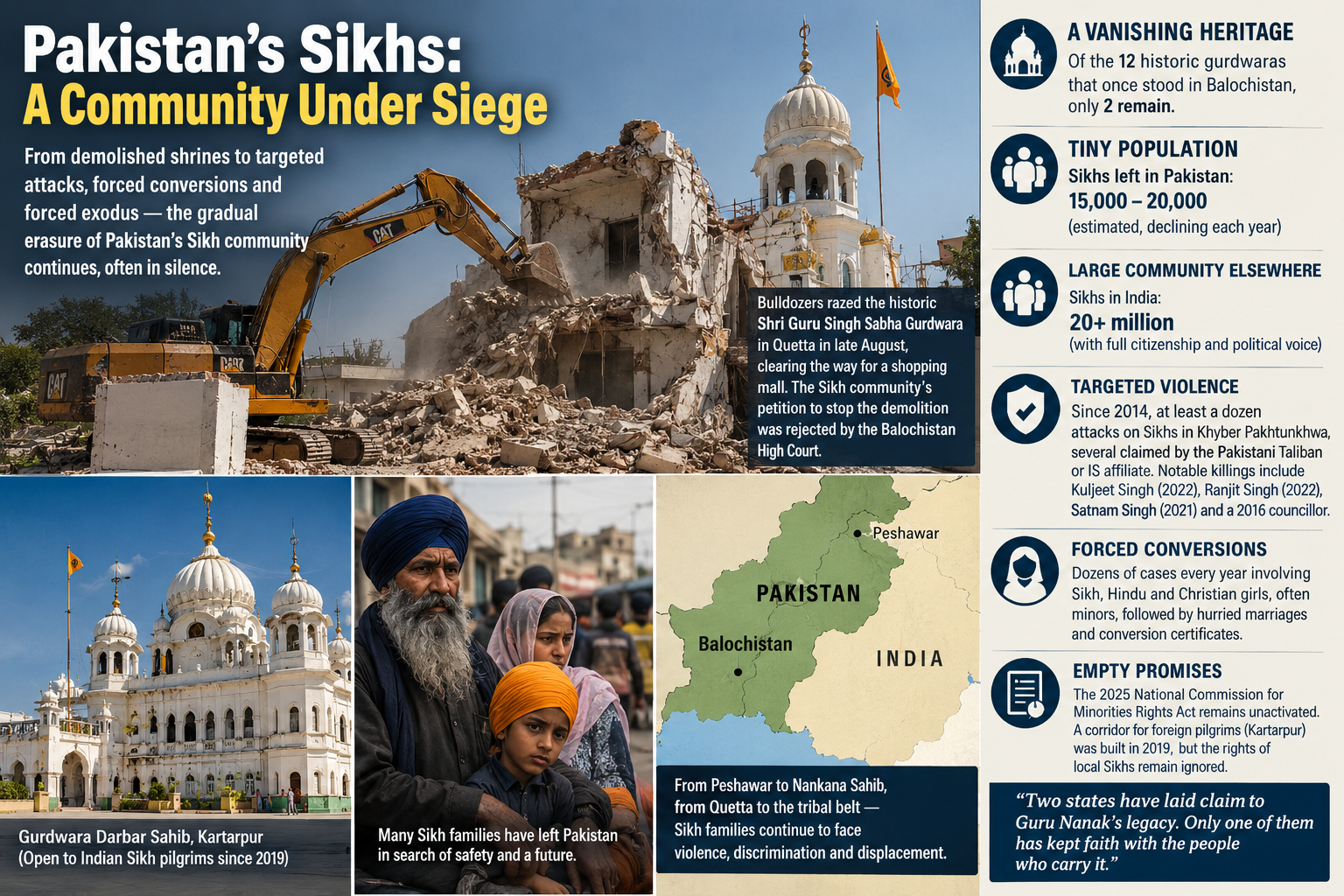
In the last week of August, bulldozers moved into a corner of old Quetta and flattened a nearly 200 year old gurdwara, the Shri Guru Singh Sabha, to clear ground for a shopping mall. The Sikh community had petitioned the Balochistan High Court to stop it. The court declined to intervene

The Slow Erasure of Pakistan's Sikhs
In the last week of August, bulldozers moved into a corner of old Quetta and flattened a nearly 200 year old gurdwara, the Shri Guru Singh Sabha, to clear ground for a shopping mall. The Sikh community had petitioned the Balochistan High Court to stop it. The court declined to intervene. The land, like most Sikh and Hindu religious property in Pakistan, was held by the state's own Evacuee Trust Property Board, the body Islamabad set up after Partition ostensibly to safeguard assets left behind by minorities who fled or were driven out. It has instead become one of the mechanisms by which that heritage keeps disappearing. Of the twelve historic gurdwaras that once stood in Balochistan, only two remain. The demolition drew a brief protest from Sikh residents and a rebuke from India's foreign ministry, which called it "deeply distressing." In Pakistan, it barely registered.
This is how the erasure of Pakistan's Sikh community usually happens: not in a single dramatic act, but in a long accumulation of smaller ones, each easy for the Pakistani state to wave away as unconnected. Land sold out from under a shrine. A shopkeeper shot on his way to open his store. A teenage girl who disappears from her family and resurfaces weeks later in a marriage certificate and a conversion deed. Pakistani officials treat every incident as isolated. Documented year after year by Pakistani civil society, international monitors and Sikhs themselves, the pattern is unmistakable: the deliberate, state-tolerated disappearance of a community from the very land where its faith was born.
At Partition in 1947, close to two million Sikhs lived in what became Pakistan, concentrated in Punjab, the historic heartland of Sikhism. Nearly all of them fled to India in the violence of that year, many after massacres and forced conversions carried out as the new state took shape. What remained was a small population, most of it resettled far from Punjab in the tribal districts of Khyber Pakhtunkhwa. Estimates today put the number of Sikhs left in Pakistan at somewhere between 15,000 and 20,000, a figure falling every year as families flee to India, Canada and the UK. Peshawar, once home to a large and visible Sikh quarter, now counts roughly 500 Sikh households. Across the border, India's Sikh population stands at more than twenty million, anchored in a Sikh-majority state of its own, Punjab, with full citizenship, full political voice and a Sikh, Manmohan Singh, who governed the country as prime minister for a decade. The contrast is not incidental. It is the clearest available measure of which state has protected this community and which has let it be hounded out.
The reasons Pakistani Sikh families give for leaving are not abstract. Since 2014, Khyber Pakhtunkhwa alone has recorded a dozen targeted attacks on Sikhs, several claimed by the Pakistani Taliban or the Islamic State's regional affiliate, groups that have operated with a persistence Pakistan's security establishment has never fully explained. The killings of traders Kuljeet Singh and Ranjit Singh in Peshawar in May 2022, and of Satnam Singh, a well-known practitioner of homeopathic medicine, in September 2021, are among the more recent in a list that also includes a Sikh councillor gunned down in 2016 and a string of kidnappings for ransom that has made Sikh traders wary of running visibly identifiable shops. In parts of the tribal belt, Sikh families have at times been forced to pay jizya, a medieval tax on non-Muslims, to local militants simply to be left alone, a practice no modern state should tolerate on its own soil. The Human Rights Commission of Pakistan has condemned the killings and pointed to the collapse of counterterrorism enforcement in the northwest as one reason the violence has gone largely unpunished. After the 2022 Peshawar killings, the World Sikh Organization said plainly that Sikhs in the region no longer felt they could "return home safely," a verdict on the Pakistani state as much as on the men who pulled the triggers.
Then there is Nankana Sahib, the town where Guru Nanak was born. In January 2020, a mob gathered outside the gurdwara there and pelted it with stones, after members of the local Sikh and Hindu community protested the abduction and forced conversion of a young Sikh woman. Pakistani officials insisted the shrine itself was untouched, the same reflexive denial that follows nearly every such incident. Sikh residents who were there described a different scene, of stranded pilgrims and a building that no longer felt safe. The forced conversion of Sikh and Hindu girls, usually minors, followed by a hastily arranged marriage and a certificate declaring the conversion voluntary, has become one of the most documented patterns of minority persecution in Pakistan. Pakistani courts have on occasion ordered a girl returned to her family, but such rulings are rare and rarely enforced. Rights groups, including the US Commission on International Religious Freedom, count dozens of such cases every year involving Sikh, Hindu and Christian families, a toll that has continued largely without consequence for the men who carry it out.
Islamabad likes to point to the Kartarpur Corridor, opened in 2019, which gives Indian Sikh pilgrims visa free access to Gurdwara Darbar Sahib, Sikhism's holiest site outside India. It is a gesture built for cameras and diplomatic credit, and it has done nothing for the Sikhs who actually live in Pakistan and bury their dead there. A National Commission for Minorities Rights Act passed on paper in 2025 still had not been formally activated as of last month. Reserved legislative seats and a five percent public sector quota exist alongside a blasphemy law regime that, per USCIRF's most recent reporting, keeps more than 750 people in jail and fuels the mob violence that regularly targets minority communities. A state that can build a corridor for foreign pilgrims in a matter of months but cannot activate a rights commission for its own citizens years after passing the law has made its priorities plain.
What is happening to Pakistan's Sikhs rarely makes global headlines the way a single terrorist attack does. There is no one event to point to, no single day to mark on a calendar. There is only the accumulation: a shrine here, a shooting there, a girl who vanishes from a village and reappears with a new name. Each one gets absorbed and forgotten by a state with no real interest in stopping the next one. That is the design, not a failure of it.
Guru Nanak was born on Pakistani soil. Pilgrims still cross the Kartarpur Corridor to see the spot. But a shrine that draws foreign visitors while the community that built and tended it for generations is driven out is not evidence of tolerance. It is a stage set, dressed up for the cameras once the audience it was actually built for has already left. What Pakistan has managed to preserve is the real estate of a faith. What it has let disappear is the people who practiced it.
Two states have laid claim to Guru Nanak's legacy. Only one of them has kept faith with the people who carry it. The birthplace is in Pakistan. The community survived in India.
Dr Rashi Randev, is a geopolitical analyst based in Canada and holds a PhD in International Relations from the Centre for the Study of the America at Jawaharlal Nehru University.