Fifty Years Forward: How Bangladesh and India Built a Partnership That Works
Two nations, one shared history, and a relationship that has grown on its own terms

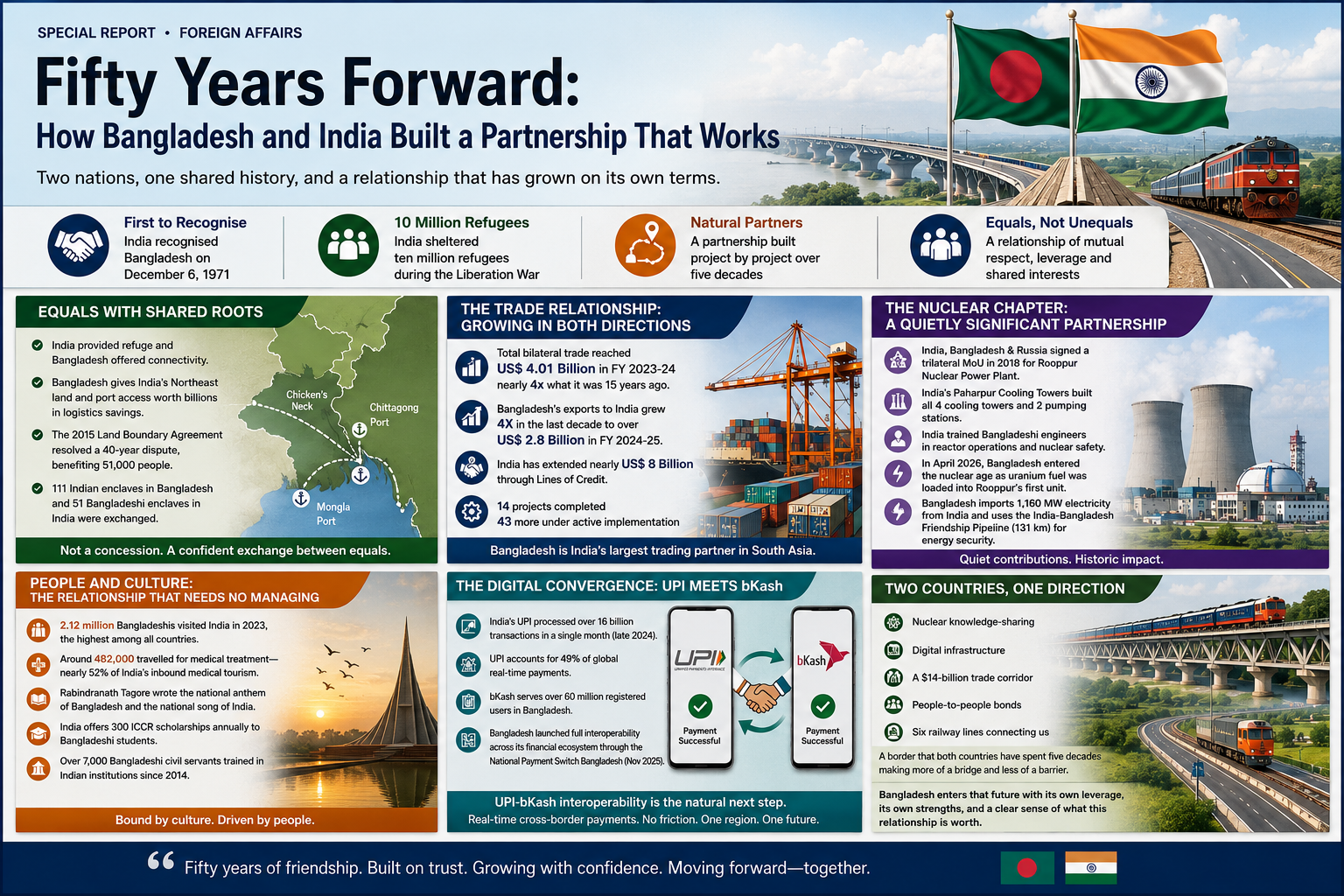
Fifty Years Forward: How Bangladesh and India Built a Partnership That Works
Two nations, one shared history, and a relationship that has grown on its own terms.
In March 2021, when India's Prime Minister Narendra Modi arrived in Dhaka for Bangladesh's golden jubilee celebrations, what followed was telling: new rail and road links, energy agreements, and a joint declaration describing both countries as natural partners. The phrase deserves examination. It is not diplomatic courtesy. The partnership that exists today was not inherited from 1971. It was constructed, project by project, over five decades of deliberate cooperation between two countries whose interests have grown steadily more aligned.
Equals with Shared Roots
India was the first country to recognise Bangladesh on December 6, 1971, and sheltered ten million refugees during the Liberation War. That solidarity created a foundation of trust built upon ever since. But the exchange has never been one-directional.
Bangladesh has provided India's landlocked northeastern states with transit access through its territory and ports, a geographical contribution worth billions in reduced logistics costs. The Chittagong and Mongla ports serve as vital gateways for goods heading to a region India would otherwise struggle to supply efficiently. That is not a concession. It is leverage, offered confidently by a country that understood regional connectivity serves its own interests too.
The 2015 Land Boundary Agreement resolved a 40-year dispute over enclaves affecting 51,000 people. Both sides made concessions. Both sides gained. 111 Indian enclaves in Bangladesh and 51 Bangladeshi enclaves in India were exchanged, ending decades of statelessness for tens of thousands of families. It was, in the truest sense, a deal between equals.
The Trade Relationship: Growing in Both Directions
Bangladesh is India's largest trading partner in South Asia. Total bilateral trade reached US4.01 billion in FY 2023-24, nearly four times what it was fifteen years ago. Of all the countries in a region of 1.9 billion people, Bangladesh conducts more trade with India than any other.
Bangladesh's exports to India have grown fourfold over the past decade, from around 1 million in FY 2011-12 to over .8 billion in FY 2024-25, with garments, leather goods, jute, and pharmaceuticals finding larger markets across the border. India has extended nearly US billion through Lines of Credit, financing roads, railways, and ports, structured on commercial terms as a signal of confidence in Bangladesh's economy. Fourteen projects are completed, with 43 more under active implementation.
The Nuclear Chapter: A Quietly Significant Partnership
One of the least reported dimensions of India-Bangladesh cooperation sits in Pabna district, 160 kilometres west of Dhaka. The Rooppur Nuclear Power Plant, Bangladesh's first nuclear facility, is a Russian-built project. But India has been part of its story in ways that rarely make headlines.
In 2018, India, Bangladesh, and Russia signed a trilateral memorandum of understanding that brought Indian companies directly into Rooppur's construction. India's Paharpur Cooling Towers built all four of the plant's cooling towers and two pumping stations. Beyond hardware, India's Department of Atomic Energy trained Bangladeshi engineers in reactor operations and nuclear safety, drawing on India's own experience with Russian-designed VVER reactors at Kudankulam.
In April 2026, Bangladesh formally entered the nuclear age when uranium fuel was loaded into Rooppur's first unit, making it only the third country in South Asia after India and Pakistan to operate nuclear energy. Commercial operation is expected by late 2026. India's quiet, technical contribution to that milestone deserves more recognition than it receives. Bangladesh also imports 1,160 megawatts of electricity from India, and the India-Bangladesh Friendship Pipeline, a 131-kilometre cross-border diesel conduit operational since March 2023, adds further energy security for both sides.
People and Culture: The Relationship That Needs No Managing
In 2023, 2.12 million Bangladeshis visited India, making Bangladesh India's single largest source of foreign visitors. Around 482,000 travelled specifically for medical treatment, accounting for nearly 52 percent of India's inbound medical tourism. These journeys happen not because any government encourages them but because Bangladeshi families have independently decided that Kolkata's hospitals, Delhi's universities, and Chennai's specialists are worth the trip.
Rabindranath Tagore wrote the national anthem of Bangladesh and the national song of India. The Bengali language connects 300 million people across both nations. India offers 300 ICCR scholarships annually to Bangladeshi students, and over 7,000 Bangladeshi civil servants have been trained in Indian institutions since 2014. These are the quiet investments that compound into trust.
The Digital Convergence: UPI Meets bKash
Here is a pairing that does not yet make diplomatic speeches but may define the bilateral relationship's next decade. India's Unified Payments Interface is the world's largest real-time payment system by transaction volume, processing over 16 billion transactions in a single month in late 2024 and accounting for 49 percent of global real-time payments, according to the IMF. Bangladesh's bKash is one of the world's most studied models of mobile financial inclusion, serving over 60 million registered users and transforming how rural Bangladesh moves money.
Both systems are now expanding. India has taken UPI live in eight countries. Bangladesh, as of November 2025, launched full interoperability across its financial ecosystem through the National Payment Switch Bangladesh, a structural reform that mirrors the logic of UPI. The two countries are building compatible digital financial infrastructure on either side of the same border.
Formal UPI-bKash interoperability, enabling real-time cross-border payments without currency conversion friction, is the natural next step. For the Bangladeshi patient in Kolkata, the trader in Benapole, or the student in Delhi, seamless digital payments would transform daily life. The infrastructure for it almost exists. The conversation between two of South Asia's most innovative financial systems only needs to begin.
Two Countries, One Direction
This partnership has moved well beyond its founding moment. It is defined not by what India did in 1971 but by what two confident, growing economies are building now: nuclear knowledge-sharing, digital infrastructure, a $14-billion trade corridor, and six railway lines crossing a border that both countries have spent five decades making more of a bridge and less of a barrier.
Bangladesh enters that future with its own leverage, its own strengths, and a clear sense of what this relationship is worth.
Source: S. Goswami, writer, political analysist & Reporter.