Neighbours, Partners, Friends: The Enduring Architecture of India-Bangladesh Relations
In the 4,096-kilometre frontier that India and Bangladesh share, the fifth longest land boundary in the world, there is no abstract geopolitics. There are only people, goods, electricity, and memory

Neighbours, Partners, Friends: The Enduring Architecture of India-Bangladesh Relations
Across rails, rivers, kilowatts, and classrooms, two nations are quietly building one of South Asia's most consequential partnerships
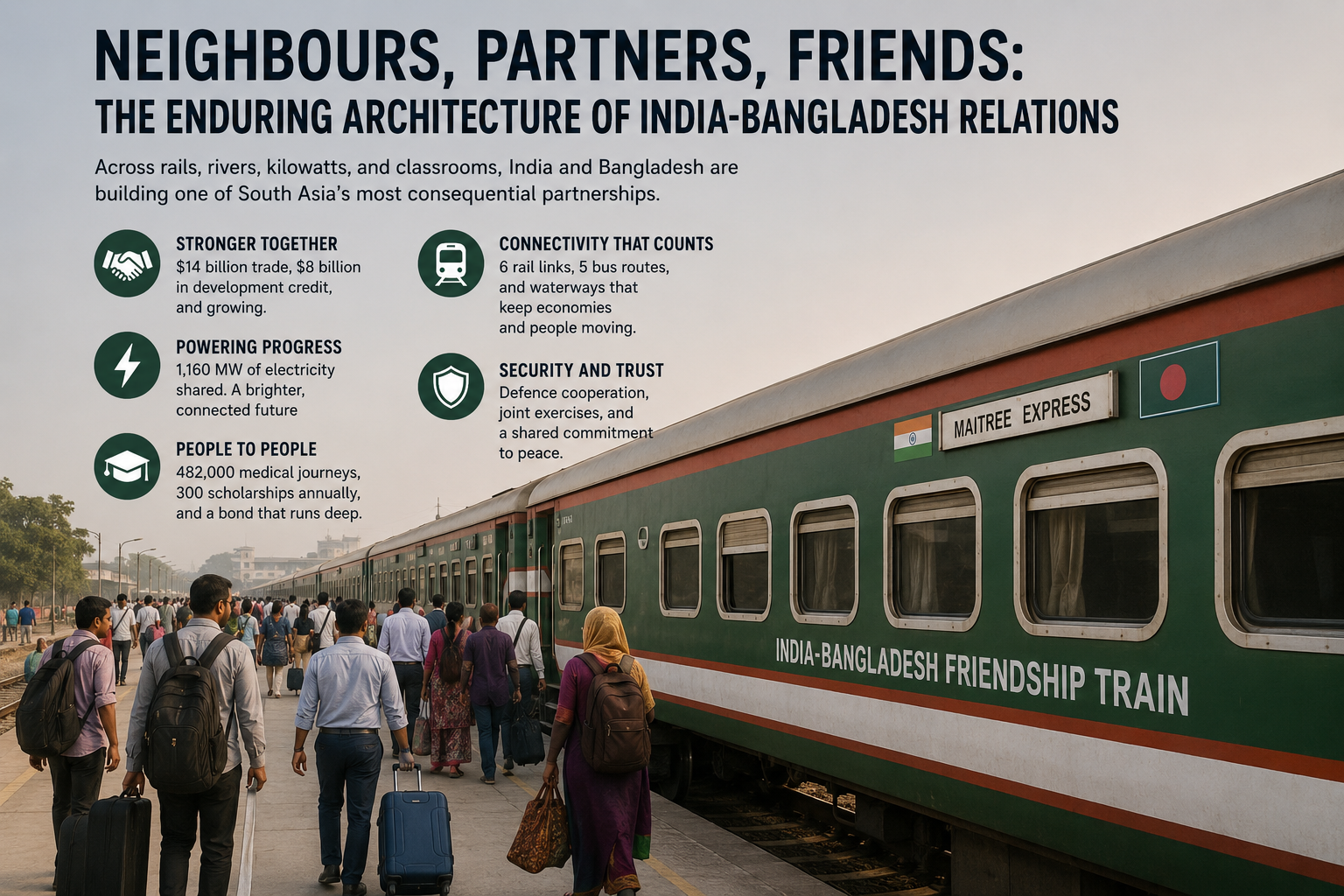
When the Maitree Express pulls out of Dhaka's Cantonment Station, its carriages carry the ordinary texture of an extraordinary bond: students with admission letters, patients bound for Chennai's hospitals, traders with sample catalogues. In the 4,096-kilometre frontier that India and Bangladesh share, the fifth longest land boundary in the world, there is no abstract geopolitics. There are only people, goods, electricity, and memory.
That memory stretches to 1971, when India became the first country to recognise Bangladesh as a sovereign nation and sheltered some ten million refugees during the Liberation War. But anchoring the relationship entirely in that founding moment misses the more interesting story: how two neighbours, over fifty years, have built a partnership spanning defence cooperation, a 14-billion-dollar trade corridor, shared power grids, cross-border railways, and a cultural continuum so deep that Rabindranath Tagore is claimed, quite rightly, by both.
The Economic Sinew
Bangladesh is India's largest trading partner in South Asia; India is Bangladesh's second largest in Asia. Total bilateral trade stood at US$14.01 billion in FY 2023-24, nearly four times what it was fifteen years ago.
India exports cotton yarn, fabrics, and spices; Bangladesh sends back leather goods, jute, and readymade garments. India has extended nearly US$8 billion through Lines of Credit, making Bangladesh its largest LOC recipient globally, financing roads, railways, and ports. For Bangladesh's garment industry, which employs over four million workers, Indian cotton yarn is not an optional import but the raw material of survival. A new bilateral trade settlement mechanism in Indian Rupees is reducing dollar dependency further, and the India-Bangladesh Startup Bridge, launched in 2021, is opening corridors for the next generation of entrepreneurs.
Powering a Nation
In Rampal, Khulna Division, the Maitree Super Thermal Power Plant stands as one of the most tangible results of bilateral cooperation. The 1,320-megawatt facility, a 50:50 joint venture between India's NTPC and Bangladesh's Power Development Board, was built with Indian concessional financing of USD 1.6 billion and inaugurated in phases in 2022 and 2023.
Bangladesh currently imports 1,160 MW of electricity from India, and the India-Bangladesh Friendship Pipeline, a 131-kilometre cross-border conduit for high-speed diesel operational since March 2023, adds another layer of energy security. The broader vision of a South Asian power grid connecting Bangladesh, India, Nepal, and Bhutan is one of the region's most exciting cooperation frameworks, and Bangladesh sits at its centre.
Connectivity Revolution
Six cross-border rail links now connect the two countries, the latest being the Agartala-Akhaura line inaugurated in November 2023. Three passenger trains run regular services, India delivered 420 railway freight wagons in December 2024, and the Khulna-Mongla Port Rail Line is reshaping regional logistics.
Five bus routes connect major cities on both sides, and an Inland Waterways Protocol operational since 1972 keeps river trade moving. Together, these form a multi-modal connectivity web that would have seemed utopian to traders of the 1980s.
Defence and Security
The bilateral defence relationship is mature and deepening. The 5th Annual Defence Dialogue and 4th Tri-Services Talks were held in Dhaka in August 2023, and India has extended a dedicated USD 500 million Defence Line of Credit.
Joint exercises, Sampriti for the army and Bongosagar for the navy, build interoperability. Over 7,000 Bangladeshi civil servants and 1,250 judicial officers have been trained in Indian institutions since 2014. In January 2025, 95 Indian and 90 Bangladeshi fishermen were mutually repatriated at sea, a small but telling example of ground-level cooperation functioning even in complicated diplomatic weather.
The Human Dimension
Around 482,000 Bangladeshis travelled to India for medical treatment in 2024, accounting for nearly 52 percent of India's inbound medical tourists. The pull factors are proximity, linguistic familiarity in West Bengal, and world-class care at accessible prices.
Air India expanded its Bangladesh services from 3 to 14 weekly flights in 2023 to meet demand. Culturally, the two nations share what no border can sever. Tagore authored the national anthems of both countries. The Bengali language binds 300 million people across both nations. India offers 300 ICCR scholarships annually to Bangladeshi students, and the Muktijoddha Scholarship Scheme, renewed for five years from 2022-23, honours the children of freedom fighters.
A Relationship for All Seasons
What India and Bangladesh have built together over fifty years is something rare in this part of the world: a relationship that has grown more layered, more productive, and more human with each passing decade. Power flows across the border. Trains run on time. Students graduate. Patients come home healed.
The numbers tell part of the story: $14 billion in trade, $8 billion in development credit, 1,160 megawatts of shared electricity, six rail links, and half a million medical journeys in a single year. But the deeper story is in the Maitree Express itself, its carriages filled every week with ordinary people who have decided, without being asked by any government, that the country next door is where they want to seek opportunity, healing, and connection.
That is the most durable foundation any bilateral relationship can have. And for India and Bangladesh, the best is very plausibly still ahead.
Written by S. Goswami, is a political analist, thinker & analist.