
A major breakthrough in rural development—RCIP has generated 18 million man-days of employment for rural poor communities

The Rural Connectivity Improvement Project (RCIP) implemented by the Local Government Engineering Department (LGED) has emerged as one of Bangladesh’s most impactful rural development initiatives, significantly transforming infrastructure and livelihoods across the country. Under the project, a total of 3,200 kilometers of all-weather rural roads have been upgraded, ensuring year-round connectivity between agricultural zones, growth centers, markets, and essential social services. This large-scale infrastructure improvement has directly contributed to reducing transportation costs, minimizing crop losses, and strengthening rural supply chains. In addition to infrastructure development, the RCIP has generated a massive 18,000,000 man-days of employment, providing vital income opportunities for rural poor communities. Thousands of laborers have benefited from steady wages, helping to improve living standards and stimulate local rural economies. Development experts say the project has played a key role in both physical connectivity and socio-economic transformation, linking remote villages with markets, healthcare facilities, and education centers while creating large-scale employment opportunities in rural Bangladesh.

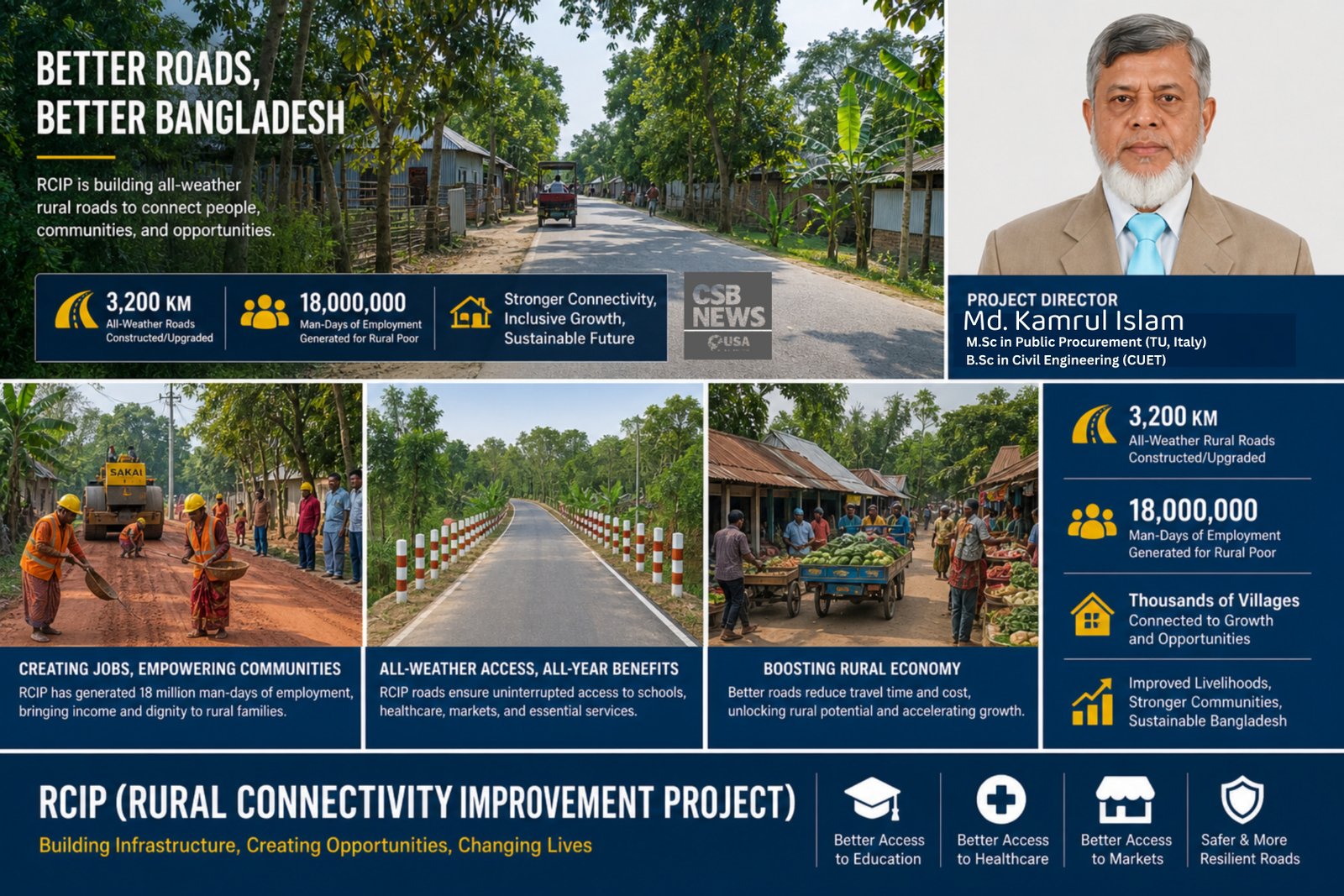
A major breakthrough in rural development—RCIP has generated 18 million man-days of employment for rural poor communities

A major breakthrough in rural development—RCIP has generated 18 million man-days of employment for rural poor communities


LGED’s RCIP Recognized as Best ADB Funded Project

The Rural Connectivity Improvement Project (RCIP), implemented by Bangladesh’s Local Government Engineering Department (LGED), has emerged as one of the country’s most successful infrastructure initiatives, earning international recognition from the Asian Development Bank (ADB) as the “Best Performed Project” among ADB-funded projects in Bangladesh.

Operating under the Ministry of Local Government, Rural Development and Cooperatives, LGED is one of Bangladesh’s leading engineering institutions for rural and urban infrastructure development, including water resource development. The organization plays a vital role in the construction and maintenance of rural and urban roads, bridges, culverts, markets, drainage systems, water supply infrastructure, and small-scale water resource management projects across the country.

Among LGED’s major development initiatives, the Rural Connectivity Improvement Project (RCIP) has become a flagship model of sustainable rural infrastructure development, employment generation, and agricultural and economic transformation.


According to Project Director Engineer Md. Kamrul Islam, the primary objective of RCIP is to improve rural connectivity by linking productive agricultural regions with socio-economic centers and markets through modern, climate-resilient all-weather rural roads.

“Our goal is not just to build roads,” he said. “We want to strengthen rural economies by ensuring that farmers, traders, and rural communities can easily access growth centers, markets, healthcare, education, and economic opportunities.”


The key objectives of the RCIP include improving rural connectivity to agricultural and socio-economic centers, increasing income generation, upgrading rural roads to all-weather climate-resilient standards, strengthening institutional capacity through training, generating employment opportunities for rural poor communities, and modernizing GIS-based rural road planning and prioritization systems.

Development analysts describe the project as more than a road construction initiative. It represents an integrated rural development strategy that supports agriculture, trade, transportation, education, healthcare, and social mobility.


One of the most notable aspects of RCIP is its professional and non-political implementation approach. Project decisions were made based on economic potential, agricultural productivity, and public necessity rather than political considerations. As a result, development works were also implemented in politically significant areas such as Bogura and Thakurgaon, alongside other regions of high agricultural importance.

The RCIP began in 2018 with initial ADB assistance of $200 million. Following successful implementation, funding was increased to $490 million due to strong performance and efficient management. The total project cost stands at Tk 6,493 crore, including Tk 4,659 crore from ADB and Tk 1,833 crore from the Government of Bangladesh.


As of current reports, the project has achieved 84 percent physical progress and 72 percent financial progress. Under the Annual Development Programme for FY 2025–26, physical progress stands at 75 percent and financial progress at 66 percent, compared to the national average of 36 percent as reported by IMED.

So far, 3,080 kilometers of all-weather rural roads have been improved, while 900 kilometers are currently under development. The project has generated approximately 10.80 million man-days of employment and distributed wages worth around Tk 666 crore.

Experts say these employment opportunities have significantly improved the livelihoods of rural low-income communities while boosting local economic activity.


The RCIP also maintained continuous implementation during the COVID-19 pandemic, when many development projects across the country were halted. Around 35,000 to 40,000 laborers continued working under strict health protection measures. The project distributed masks, sanitizers, and medical supplies to ensure worker safety while maintaining economic activity in rural areas.

Project officials stated that ensuring both employment and health protection during the pandemic was a key priority. Development partners, including ADB evaluators, praised the project for balancing infrastructure delivery, social protection, and worker safety during a global crisis.

The project eventually received the “Best Performance Award” from ADB Headquarters in Manila, being recognized among ADB-funded projects in Bangladesh and reportedly across South Asia-Pacific.

The recognition was based on effective management of time, cost, and quality, strong financial discipline, high-quality construction work, successful risk management, large-scale employment generation, and timely financial closure without cost overruns.


Analysts note that such performance is particularly significant in South Asia, where infrastructure projects often face delays and budget overruns. In contrast, RCIP demonstrated that large-scale public infrastructure projects can be implemented efficiently with proper planning, accountability, and transparency.

The project has also brought significant benefits to northern Bangladesh, including Rangpur, Panchagarh, Thakurgaon, Naogaon, Kurigram, Gaibandha, Lalmonirhat, Nilphamari, Dinajpur, Natore, Rajshahi, and Bogura. Improved road connectivity has strengthened agricultural supply chains for crops such as potatoes, maize, vegetables, rice, and fruits.

Farmers now experience reduced transportation time and costs, lower crop spoilage, better access to markets, and improved prices for agricultural products. Connectivity has also enhanced access to schools, healthcare centers, growth centers, administrative hubs, and markets.


A major feature of RCIP is its climate-resilient infrastructure design, incorporating flood-resistant road structures, improved drainage systems, and nature-based solutions such as vetiver grass. These measures are aimed at ensuring long-term sustainability and reducing maintenance costs caused by climate-related damage.

Looking ahead, the project envisions integrating rural roads with national and regional economic corridors extending from Teknaf in Cox’s Bazar to Banglabandha in Panchagarh. Officials emphasize that connecting rural areas to major trade routes is essential for long-term national economic growth, as the rural economy remains a foundational pillar of Bangladesh’s development.