Bangladesh’s Largest Islamist Party Jamaat-e-Islami Holds Massive Rally in Dhaka Amid Electoral Message
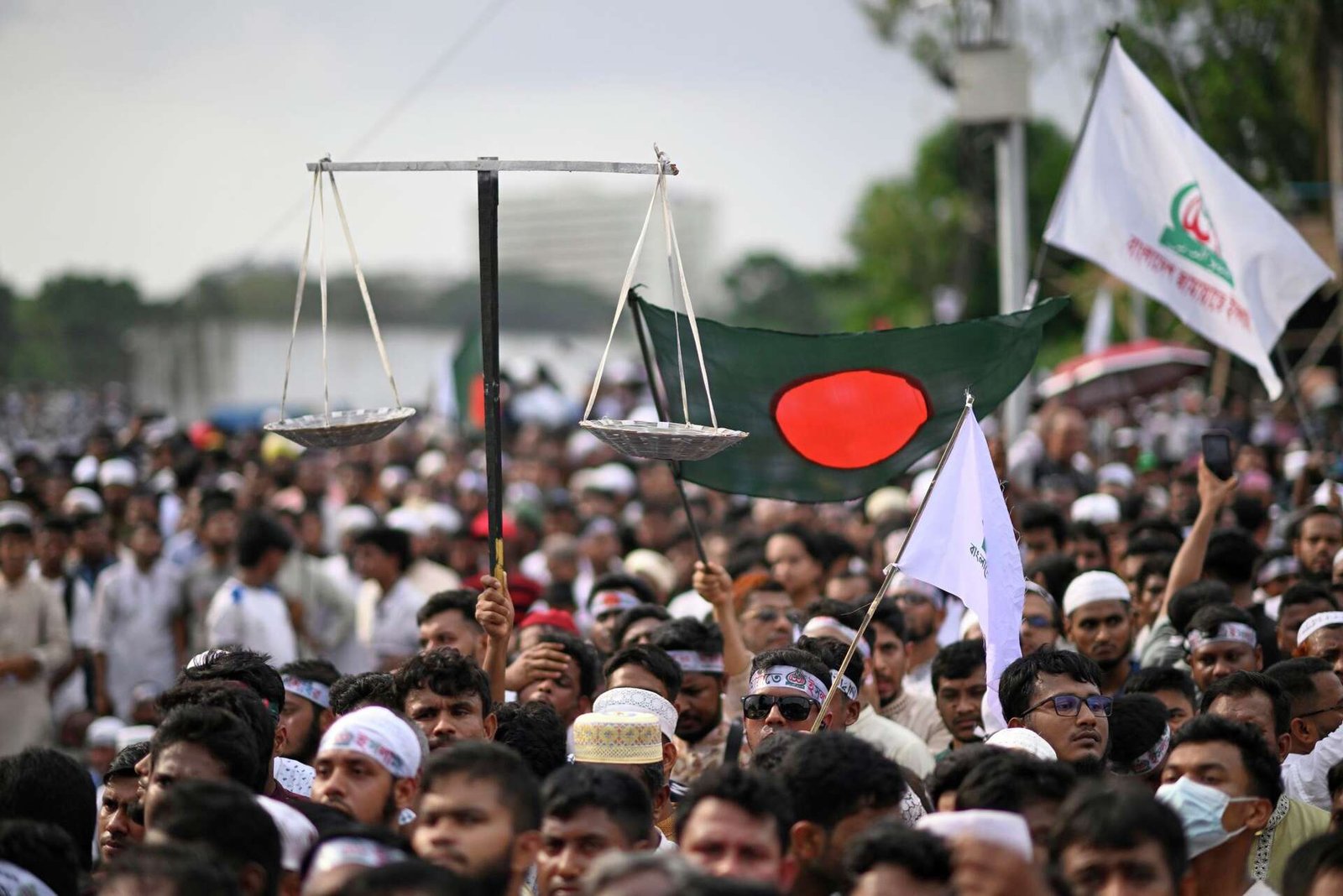
Bangladesh’s largest Islamist political party, Jamaat-e-Islami, held a massive rally in Dhaka on Saturday, aiming to demonstrate its political strength ahead of the upcoming national elections. The rally, attended by hundreds of thousands of supporters, marked a pivotal moment in the nation’s shifting political balance—particularly following the ousting of former Prime Minister Sheikh Hasina.

Bangladesh’s Largest Islamist Party Jamaat-e-Islami Holds Massive Rally in Dhaka Amid Electoral Message
Bangladesh’s Largest Islamist Party Jamaat-e-Islami Holds Massive Rally in Dhaka Amid Electoral Message
Bangladesh’s largest Islamist political party, Jamaat-e-Islami, held a massive rally in Dhaka on Saturday, aiming to demonstrate its political strength ahead of the upcoming national elections. The rally, attended by hundreds of thousands of supporters, marked a pivotal moment in the nation’s shifting political balance—particularly following the ousting of former Prime Minister Sheikh Hasina.
Currently, a caretaker government led by Nobel Peace Prize laureate Muhammad Yunus is in charge. The government has announced that national elections will be held in April next year. However, due to mounting pressure from the BNP and its allies, there is growing speculation that elections could be moved forward to February.
Jamaat-e-Islami, which had sided with Pakistan during Bangladesh’s 1971 War of Independence, had earlier declared its intention to gather one million people for this rally.
Sheikh Hasina, who served as Prime Minister from 2009 to 2024, was ousted in a wave of student-led protests last year and subsequently took refuge in India. During her rule, many top Jamaat leaders were sentenced to death or imprisoned for war crimes.
During the rally, Jamaat presented seven key demands to the government, which included:
-
Ensuring fair and peaceful elections,
-
Justice for genocide victims,
-
Reforming the state structure,
-
And drafting a new constitution inspired by last year’s mass movement.
They also called for the introduction of a proportional representation model in the electoral system.
Many supporters spent the night on the Dhaka University campus before gathering at Suhrawardy Udyan—where on December 16, 1971, Pakistani forces formally surrendered to the joint Indo-Bangladeshi military alliance.
Iqbal Hossain, a 40-year-old attendee, said, “We want a new Bangladesh led by honest leadership grounded in Islamic values and free from corruption. If needed, we are ready to sacrifice our lives for this cause.”
Mahidul Morshedain Sayem, a 20-year-old supporter, said, “Jamaat-e-Islami believes in equal rights for all. We will govern this country based on the teachings of the Quran. If all Islamic parties unite, no one will be able to stop us.”
This is the first time since 1971 that Jamaat has been allowed to hold a rally at Suhrawardy Udyan. Many view this as a sign that Islamist forces are slowly regaining strength, while liberal factions are weakening.
Sheikh Hasina, the daughter of the Father of the Nation and a longtime political adversary of Jamaat, has not been permitted to return to Bangladesh. Her party, the Awami League, has been banned by the caretaker government, and she remains in exile in India until at least August 5.
Hasina faces charges of crimes against humanity. According to UN estimates, around 1,400 people were killed during the mass protests that occurred between July and August of last year, ultimately leading to her downfall.
Jamaat-e-Islami is preparing to contest in 300 parliamentary seats and is working to form an alliance with other Islamist parties, aiming to establish itself as a major political force alongside the BNP and the now-banned Awami League.