

Trump, Xi and Putin Talked Nukes. But India Must Lead on Nuclear-AI Governance
When Donald Trump, Xi Jinping, and Vladimir Putin met at a private villa in Shenzhen on 19 November to pledge dialogue on reducing nuclear risks, their joint statement revived Cold War rhetoric while overlooking the defining threats of modern deterrence. By saying nothing about artificial intelligence in nuclear command chains—and excluding India, a declared nuclear power with a strict no-first-use doctrine and active strategic ties across Washington, Moscow, and Beijing—the tripartite summit produced a framework built for the wrong era.

Defence & Strategic Affairs Analyst · CSB News USA
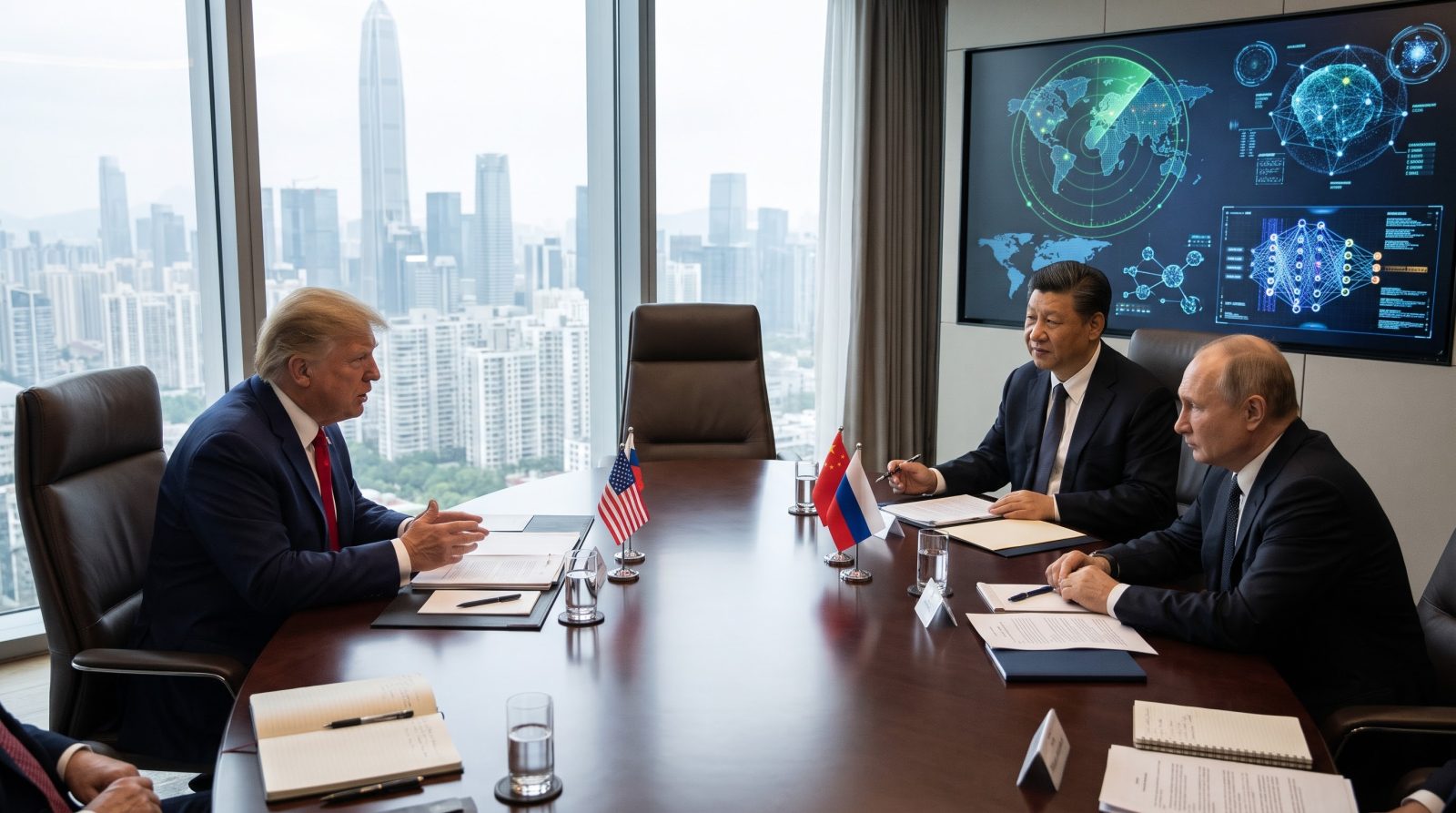
Three men who between them control more than 90 percent of the world's nuclear warheads sat down at a private villa in Shenzhen on 19 November. They issued a joint statement. It declared that a nuclear war cannot be won and must never be fought. It committed the three signatories to dialogue on reducing nuclear risks. It said nothing about artificial intelligence. It said nothing about India. The world's most consequential nuclear conversation had just produced the world's most consequential nuclear omission.
The credit the summit deserves should be conditional. The meeting was real. The joint statement was issued. But what was produced is not a comprehensive nuclear framework. It is an agreement to have a conversation :— between the three largest arsenals, about a domain in which all three have spent the better part of a decade avoiding disclosure in public, with no agreed scope, no verification mechanism, no timeline and no criteria for what a successful outcome looks like. The Reagan-Gorbachev formulation from 1985 has been reproduced. What it took nearly four decades to verify was that the formulation required the institutional follow-through to mean anything. The Shenzhen statement has not yet produced that follow-through, and the probability of it doing so without addressing the two variables that now define nuclear risk is exactly as low as the statement suggests.
Artificial intelligence has already changed how nuclear weapons are tracked, targeted and potentially launched. Any summit that addresses nuclear weapons without addressing AI is engaging in strategic nostalgia, running a 1980s conversation in a 2020s security environment. The New START architecture, the INF muscle memory, the Cold War vocabulary of throw-weights and warhead ceilings, none of it adequately describes a world where AI is embedded in early warning satellites, where hypersonic glide vehicles compress decision timelines from thirty minutes to six, and where cyber systems capable of spoofing a nuclear launch signature run on machine learning. The Shenzhen joint statement contained no reference to any of this.
There is a second absence, and the summit's three participants did not volunteer it. India was not in the room. India was not discussed as a candidate for the room. This matters not as a question of status, but as a question of strategic architecture. Any nuclear stability framework that does not include the world's third-largest conventional military, a declared nuclear power with a distinctive no-first-use doctrine, and a country that maintains functioning defence relationships with all three summiteers simultaneously, is a framework with a structural gap wide enough to undermine whatever it builds.
The Architecture of Deterrence Has Already Changed
The nuclear command-and-control systems of all three summit powers were designed when human beings sat at every critical decision node with time to think, escalate, verify and, if necessary, override. The entire logic of Mutual Assured Destruction depended on this human layer. Each side needed to believe the other could survive a first strike and retaliate with enough force to make the first strike not worth attempting. What sustained that belief was the assumption that command chains remained intact and that humans remained in charge of them.
That assumption is now contested. The United States has been integrating AI into its nuclear early warning architecture since at least 2019, with the Air Force Research Laboratory and DARPA funding projects on AI-enhanced satellite surveillance and signals intelligence. Russia's nuclear modernisation programme includes elements of automation in its command chain, including the Perimeter system, known in the West as Dead Hand, which allows for semi-automated retaliatory launches under conditions where Moscow's command authority may be compromised. China, which is expanding its arsenal from roughly 400 to an estimated 1,500 warheads by 2035 according to the US Department of Defense's most recent public assessment, has been shifting toward a launch-on-warning posture that requires faster decision-making than traditional launch-on-impact protocols. Faster decision-making is exactly what AI is designed to provide.
What none of the three summit powers has said openly is how far this integration has already gone. There are no international agreements governing AI in nuclear command chains. There are no transparency mechanisms, no disclosure requirements, no protocols for managing a machine learning system's error in a nuclear context. The closest analogy is the early period of state-level cyber operations: governments were conducting offensive campaigns against each other's infrastructure for years before any serious attempt was made to establish norms, and by the time norms were discussed, the capabilities were already entrenched. The Shenzhen statement, addressing only a commitment to dialogue on nuclear risks, has negotiated around the variable that now matters most.
The Petrov Problem, Multiplied
On the night of 26 September 1983, a Soviet early warning system reported the launch of five American intercontinental ballistic missiles. The officer on duty, Lieutenant Colonel Stanislav Petrov, faced a choice: report the alert up the chain, which would almost certainly have triggered a retaliatory launch sequence, or judge the alarm a false positive. He judged it false. His reasoning was not algorithmic. He looked at the data and concluded that no rational actor would start a nuclear war with five missiles. He was right. The satellite had confused sunlight reflected off high-altitude clouds for missile exhaust plumes.
The lesson of the Petrov incident is not that human intuition is infallible. The lesson is that nuclear deterrence, at its most dangerous moment, was held together by a human being's capacity to find an event suspicious on contextual grounds that no system had flagged. AI does not reason this way. AI operates on the data in front of it, optimised for the objective it has been given. An AI early warning system that detects a potential launch signature will report a potential launch signature. It will not ask whether this makes strategic sense.
This is not a hypothetical concern. The concept of autonomy creep in military AI systems, documented in research by the RAND Corporation and the Nautilus Institute, describes how automation seeps into decision loops not through explicit policy decisions but through the logic of operational speed. Each system along the command chain optimises for faster response. The cumulative effect is a chain in which the human authorisation that was supposed to occur at step three has been rendered functionally redundant by the time it arrives, because the preceding automated steps have already committed a course of action.
Applied to nuclear command chains, autonomy creep is a different order of problem. The compressive pressure of hypersonic weapons, which leave less than six minutes of warning time when launched from forward positions, creates direct incentives to pre-delegate authority, automate early-warning responses, and reduce the human-in-the-loop requirement at precisely the moment when that requirement is most critical. The Shenzhen statement agreed to pursue dialogue on nuclear risks. It did not name this dynamic. The dialogue that follows will have to decide whether to name it, or whether the aspiration and the omission are both part of the design.
Three Powers, But Not the Only Powers
The three-power nuclear conversation has a historical pattern, and the pattern is instructive. The 1963 Partial Test Ban Treaty was negotiated by the United States, the Soviet Union and the United Kingdom. France and China refused to sign it. Both continued testing. The treaty prohibited tests in the atmosphere, underwater and in space. It did not reduce a single nuclear weapon. It reassured the signatories while actual proliferation continued outside the agreement.
The Nuclear Non-Proliferation Treaty of 1968 formalised this pattern into a legal architecture. Five recognised nuclear states, and everyone else committed to non-proliferation in exchange for a vague promise of eventual disarmament from the five. India signed the NPT as a non-nuclear-weapon state, found that the treaty's disarmament provisions were not going to be acted upon, and eventually became a nuclear power outside the NPT framework. The treaty has not produced meaningful disarmament from the recognised nuclear-weapon states in the nearly sixty years since it was signed.
Any framework that emerges from the dialogue committed to at Shenzhen will carry this same structural problem. It will address the relationship between three arsenals already governed by decades of precedent, established communication channels and mutual understanding built during the Cold War. It will not address the India-Pakistan nuclear dyad, which operates on a more compressed geography, with shorter decision timelines, without the hotlines and confidence-building measures that the US-Soviet relationship developed over decades, and between two states that have twice approached the threshold of conventional conflict with nuclear implications since 1998. What happened in the case of Operation Sindoor in 2025 and the Iran-Israel conflict of that year were stark reminders of how the integration of AI into military systems compresses decision timelines and blurs the boundary between conventional and nuclear signalling. Neither dynamic was addressed at Shenzhen.
The Argument for India's Inclusion Is Not Sentimental
The argument for India's inclusion in a nuclear-AI conversation is not an argument from sentiment or status anxiety. It is an argument from function: India is the country that can do things in this conversation that none of the summiteers can do, and that the conversation cannot succeed without.
India's no-first-use doctrine is the most clearly documented and politically embedded no-first-use commitment among nuclear powers. China claims an no-first-use posture but has moved toward launch-on-warning postures that functionally undercut it. The United States has never adopted no-first-use, and successive administrations have explicitly retained first-use options. Russia reserves the right to use nuclear weapons in response to existential conventional threats. India's no-first-use, by contrast, requires confirmed receipt of a nuclear strike on Indian territory or Indian forces before any nuclear response. This architecture is structurally compatible with the AI age in a way that launch-on-warning postures are not. It cannot be triggered by an AI-generated false positive, because the doctrine requires human confirmation of actual impact, not machine assessment of probable threat. The Shenzhen summit's three participants should be studying India's model rather than ignoring it.
India maintains a substantive defence relationship with Russia, long-standing and continuing across decades of partnership in platforms, training and co-production. India has a growing strategic partnership with the United States, formalised through the Quad framework and the Initiative on Critical and Emerging Technology. India maintains significant economic engagement with China, which remains its largest trading partner despite sustained political friction along the Line of Actual Control. No other nuclear power sits at all three vertices of this triangle simultaneously. This gives India a mediatory standing that is not available to any of the summiteers, each of whom carries the ideological and strategic weight of their mutual adversarial relationship.
India is a serious AI power, not an aspirant. India's engineering talent pipeline supplies a significant fraction of the researchers and engineers working in frontier AI at the major American and European laboratories. India's Digital Public Infrastructure systems operate at a scale and reliability that established economies have struggled to replicate. India's AI Mission, announced in 2024 with significant compute commitments, is building foundational model capability and AI research infrastructure domestically. When India speaks about AI governance, it speaks as a country with genuine operational experience at scale. The Shenzhen dialogue needs that perspective because the dialogue is, at its core, about governing a technology that India both produces and deploys.
Policy Assessment
The Shenzhen summit produced a declaration that nuclear war cannot be won. What it did not produce is a framework for ensuring that the conditions for such a war are not assembled by systems operating faster than human review. The institutional architecture of arms control was designed for a world of large, expensive, slow-moving nuclear systems, commanded by human beings with adequate time to think and political structures able to absorb the delay required for verification. The conditions that justified that design are narrowing. They are narrowing because of hypersonics, which compress timelines. They are narrowing because of AI, which compresses decision loops. And they are narrowing because states are already deploying these technologies without waiting for governance frameworks to catch up.
Three specific requirements follow from these conditions. The first is a binding commitment on human-in-the-loop requirements for nuclear launch decisions: no nuclear weapon may be authorised for launch by an automated system alone, and any state party to an agreement must demonstrate, through agreed verification measures, where human authorisation sits in its command chain. This requires each signatory to disclose something about the structure of its nuclear command-and-control architecture. That disclosure is uncomfortable. It is also unavoidable if the framework is to be verifiable rather than decorative.
The second requirement is a prohibition on AI-enhanced cyber operations targeting nuclear command, control and communications infrastructure. Cyber operations are inherently deniable and attribution remains technically contested. But the norm matters: attacking the NC3 infrastructure of a nuclear power with AI-enabled tools creates exactly the conditions for automated retaliation that the framework is designed to prevent. Establishing the principle, even without perfect verification, raises the political and reputational cost of violation above the current threshold of zero.
The third requirement is the most difficult for the Shenzhen participants to accept: the dialogue needs a wider table. Not every nuclear power needs to be in the same room at the same time, but India needs to be somewhere in the structure. A separate AI-nuclear working track involving India would accomplish what a tripartite arrangement cannot: it would bring in a power with a demonstrably stable no-first-use posture, genuine AI credibility and operational experience, and standing in both the Global South and the western strategic community. India can carry whatever framework the dialogue produces to the seventy or eighty countries that would otherwise view a US-Russia-China nuclear agreement as another arrangement made by large powers for the convenience of large powers.
India is not in this dialogue. That is now a confirmed fact, not a prediction. The three leaders who agreed in Shenzhen to pursue nuclear risk reduction agreed to do so without the country that offers the most clearly documented no-first-use commitment among nuclear powers, without the country that maintains functioning strategic relationships with all three summiteers simultaneously, and without the country best placed to carry any framework they build to the Global South. Nuclear talks without AI governance are talks designed for the last war. Nuclear talks without India are talks about the wrong map. Whether that changes before the dialogue produces a framework will determine whether the absence mattered. If it changes after, the renegotiation will be harder, and the gap will have been open longer.
Comments 0
Log in or create a free account to join the conversation. You can comment anonymously.
No comments yet. Be the first.