

Political Exposure, Media Warfare or an Unintended Campaign to Build America's Most Controversial Left-Wing Influencer?
At a vibrant outdoor rally, a speaker addresses the crowd as supporters cheer behind him, holding placards demanding workers' rights and an end to injustice. The energy in the crowd reflects a growing movement calling for fairness, equality, and respect for working people.

Multimedia Correspondent · CSB News USA
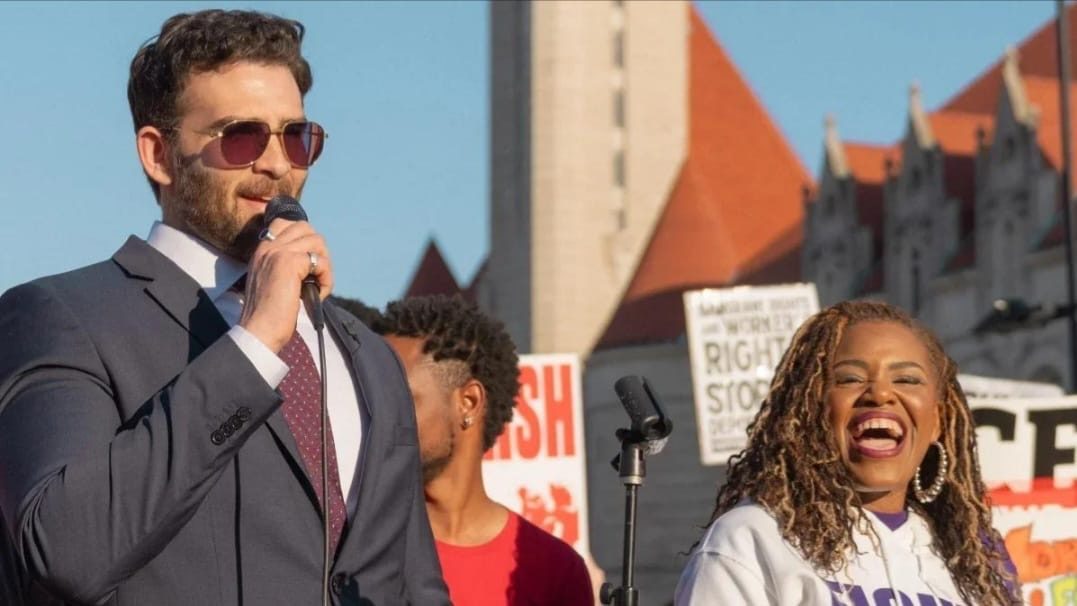
American political media is witnessing an unusual confrontation between traditional television journalism and the rapidly expanding influence of digital political personalities. At the centre of this growing debate is Hasan Piker, the Turkish-American political commentator and Twitch streamer whose socialist ideology, outspoken criticism of American foreign policy, controversial statements, and connections with Democratic political figures have made him an increasingly prominent figure in the United States.
But the controversy surrounding Piker is no longer limited to what he says during livestreams. Another development has become equally significant: the repeated attention he receives from Fox News.
One of America's most influential conservative media organisations has published multiple reports examining Piker's political positions, international activities, past statements, relationships with Democratic politicians, and participation in political events.
The growing volume of coverage raises a much larger question about American media politics: Is Fox News attempting to expose a controversial political personality, challenge the growing influence of the American left, or unintentionally providing him with the national publicity that helps expand his audience?
The situation illustrates a complicated relationship between political opposition, media influence, public visibility, and the commercial dynamics of modern journalism.
Hasan Piker: From Online Political Commentator to a Nationally Recognised Controversial Figure
Hasan Piker is not a traditional television journalist or an elected political representative. He built his public profile through online political commentary, particularly on Twitch and other social media platforms.
His political identity is strongly associated with socialism, anti-capitalism, economic redistribution, criticism of corporate power, and opposition to several aspects of American foreign policy.
Unlike traditional political commentators, Piker communicates directly with his audience through extended livestreams, reacting to breaking developments, politicians, international conflicts, and television news coverage.
This direct relationship with viewers has helped him establish a significant online following.
His influence is particularly relevant to the changing political environment in the United States, where younger audiences increasingly consume political information through livestreaming platforms rather than conventional television broadcasts.
However, his growing popularity has also brought greater scrutiny. Critics question his language, political consistency, and interpretation of international conflicts, while supporters argue that he challenges political narratives that mainstream media organisations frequently overlook.
His political identity has consequently become a subject of debate far beyond the streaming community.
The 9/11 Controversy: A Political Statement That Continues to Define His Public Image
One of the most significant controversies associated with Piker dates back to 2019.
During a livestream, he made the statement, "America deserved 9/11." The comment triggered widespread criticism because it was interpreted as justifying or excusing the September 11 terrorist attacks.
The controversy became a defining moment in discussions about his political rhetoric.
Piker subsequently addressed the statement and acknowledged that the language he used was inappropriate. Nevertheless, the incident has continued to follow him throughout his public career.
Fox News has repeatedly brought the controversy into its reporting when examining his political influence and relationships with Democratic politicians.
The significance of this episode extends beyond a single statement. It raises questions about the responsibility of political influencers who communicate with enormous audiences and the distinction between political criticism, provocative rhetoric, and language that can be interpreted as justifying political violence.
For his critics, the statement remains evidence of irresponsible political commentary. For Piker and some of his supporters, repeated attention to the incident can obscure the wider political arguments he makes.
Israel-Palestine, Hamas and the Growing Political Divide
Piker's commentary on Israel and Palestine has become another major source of controversy in American political discourse.
Following the October 7, 2023, Hamas-led attacks on Israel and the subsequent Israeli military campaign in Gaza, Piker became increasingly prominent in online discussions about the conflict.
He has strongly criticised Israeli military operations, US support for Israel, and the broader American approach to the Middle East.
His commentary concerning Hamas, Palestinian resistance, and the nature of the conflict has generated criticism from conservative commentators, pro-Israel organisations, and some political figures.
Piker has rejected accusations of antisemitism, arguing that criticism of the Israeli government and its military policies should not automatically be equated with hostility towards Jewish people.
This distinction is central to the political dispute.
The debate also demonstrates how international conflicts can become domestic political weapons in the United States. Statements about Israel and Palestine are increasingly connected to arguments about American foreign policy, congressional funding, presidential leadership, and the political positions of Democratic candidates.
Fox News' coverage of Piker frequently places his commentary within this broader political conflict.
The critical question is whether the reporting examines the full context of his statements or primarily concentrates on the most controversial excerpts.
The Cuba Controversy: Treasury Department Scrutiny and Questions About International Activities
Another important development emerged in May 2026, following Piker's involvement in an activist convoy to Cuba.
Fox News reported that the US Treasury Department's Office of Foreign Assets Control (OFAC) sought information from Piker and CodePink co-founder Medea Benjamin concerning activities associated with the Cuba trip.
The reported inquiry concerned financial arrangements, communications, logistics, and potential issues involving American sanctions against Cuba.
The development attracted attention because US sanctions on Cuba remain an important element of American foreign policy.
Piker's participation in an activist initiative connected with Cuba therefore became more than a social media story. It developed into a wider debate involving international activism, political solidarity, financial transparency, and the legal framework governing US sanctions.
Fox News subsequently published additional reports examining the organisation of the convoy, the involvement of Progressive International, and Republican lawmakers' demands for continued scrutiny.
Piker defended the activists involved and discussed the situation publicly.
However, an important legal distinction must be maintained: an administrative subpoena or information request does not establish criminal wrongdoing. The existence of an inquiry should not be presented as proof that Piker violated American law.
The controversy nevertheless demonstrates how the international activities of political influencers can attract government attention and become part of a larger domestic political confrontation.
Democratic Party Connections: Is Hasan Piker Becoming a Political Liability or an Influential Ally?
Perhaps the most politically sensitive aspect of Piker's growing profile is his relationship with sections of the Democratic Party.
His appearances alongside Democratic political figures have generated questions about the extent to which online political commentators are influencing the party's public image.
In 2026, Piker appeared at political events involving Michigan Senate candidate Abdul El-Sayed. He also participated in an event with Congresswoman Ilhan Omar in Minnesota.
A Fox News report published on October 27 focused on remarks attributed to Piker during the event, including his use of the term "terrorists" when referring to Republicans.
The incident became another point of political disagreement.
For progressive supporters, Piker represents a political voice that challenges establishment figures and demands a more aggressive response to economic inequality, immigration enforcement, and American foreign policy.
However, his critics argue that his controversial rhetoric could create difficulties for Democratic politicians attempting to appeal to a broader electorate.
This creates a strategic dilemma for the Democratic Party.
Should the party embrace influential online personalities who can mobilise younger audiences, even when their statements generate national controversy? Or should it maintain greater distance from commentators whose rhetoric could become a political liability?
There is no single answer within the party, and the disagreement reflects a broader struggle over the future direction of American progressivism.
Fox News' Coverage: A Continuing Examination of Hasan Piker
The following are notable Fox News reports identified in the earlier research, illustrating how the coverage developed throughout 2026.
April 28, 2026
Who is Hasan Piker? Meet the far-left streamer who is stirring up controversy and dividing Democrats.
The report examined Piker's political identity, the 9/11 controversy, his comments on Israel and Hamas, and his connections with Democratic political figures.
May 23, 2026
Feds subpoena Hasan Piker, Medea Benjamin over Cuba trips.
The article examined the reported Treasury Department information request connected with the activist convoy to Cuba.
May 28, 2026
GOP lawmakers urge Treasury to press ahead with probe of Hasan Piker over Cuba trip.
The report focused on Republican lawmakers' demands for continued scrutiny of the matter.
May 30, 2026
How a Rhodes Scholar with ties to Cuba's president organized the convoy that brought Hasan Piker to Havana.
The article examined David Adler, Progressive International, and the organisation of the activist convoy.
May 31, 2026
Hasan Piker defends pro-communist, anti-ICE Singham network activists as 'wonderful people'.
The report focused on Piker's comments about activists associated with the network and protests against Immigration and Customs Enforcement.
August 13, 2026
Piker demands Democrats defend him from attacks, claims he's no 'toxic radical force'.
The article examined his criticism of Democratic politicians who he believes should defend him against political attacks.
September 22, 2026
Hasan Piker admits he has 'dialed down' his opinions after public and Democratic backlash.
The report examined his comments about changing the way he communicates his political opinions following criticism.
October 27, 2026
Hasan Piker lashes out at Republicans, calls them 'terrorists' in event with Ilhan Omar.
The report focused on his remarks during the political event involving Congresswoman Ilhan Omar.
November 4, 2026
Hasan Piker declares 'woke is back,' fantasizes about putting Donald Trump in prison.
The article examined his livestream commentary following the US midterm election developments and his remarks concerning Donald Trump.
Note: These are notable reports identified in the earlier research, not a verified exhaustive list of every Fox News article mentioning Piker. Original headlines, dates, and article contents should be checked against the publisher's archive before publication.
The Media Paradox: Is Fox News Giving Hasan Piker the Publicity It Seeks to Challenge?
This is arguably the most important dimension of the entire controversy.
Fox News operates within a highly competitive American media environment in which political conflict, controversial statements, and ideological disagreements frequently attract substantial audience attention.
Piker, meanwhile, operates through a digital platform where visibility, audience engagement, reactions, and online discussion are essential to his influence.
These two media environments have increasingly intersected.
When Fox News publishes a report criticising Piker, the coverage may reach viewers who otherwise would never have encountered his livestreams.
Some readers may investigate his original statements, watch his videos, follow his social media accounts, or engage with his political arguments.
Consequently, negative coverage can sometimes generate additional visibility for the very personality being criticised.
This phenomenon can be described as a visibility paradox: an attempt to challenge a public figure can simultaneously increase that figure's recognition.
However, this does not establish that Fox News intentionally promotes Piker or that its coverage has directly increased his audience. Establishing such a conclusion would require audience data, traffic measurements, and evidence of changes in his following after individual reports.
The broader media question is therefore not about assumed intentions but about measurable consequences.
The Political Economy of Controversy: Why Conflict Attracts Attention
Modern political journalism increasingly operates in an environment where attention is a valuable commodity.
Controversial statements generate reactions. Reactions generate discussions. Discussions generate further coverage.
This cycle can benefit traditional television networks, digital publications, political commentators, and social media platforms.
Piker's controversial statements provide material for conservative media coverage. That coverage, in turn, creates opportunities for Piker to respond, defend his positions, and communicate directly with his supporters.
The result can become a continuing cycle of political confrontation.
There are also important differences between the audiences of traditional television networks and online political creators.
Fox News has an established television audience and a significant digital presence. Piker has developed an audience through livestreaming and social media.
Their audiences may overlap, but they also operate within different political and cultural environments.
This means that a Fox News report about Piker can function simultaneously as a criticism of his politics, a source of information for conservative viewers, and a new point of exposure for people unfamiliar with his work.
The media conflict is therefore not simply between two political personalities. It represents a wider competition between traditional news institutions and the emerging digital political economy.
Could Hasan Piker Become a Larger Political Force?
Piker's growing visibility raises questions about the future relationship between online political influence and American electoral politics.
Political streamers can communicate with audiences without relying on conventional television interviews, newspaper editorials, or established party structures.
They can respond immediately to political developments, challenge politicians directly, and mobilise audiences around specific issues.
However, online popularity does not automatically translate into electoral influence, legislative power, or broad public support.
There is a significant difference between having a large digital audience and representing the political preferences of the American electorate.
Piker's actual political influence must therefore be assessed through measurable audience behaviour, public opinion, political participation, and the responses of elected representatives.
The same standard should apply to the claims made by his supporters and critics.
Conclusion: When Political Criticism Becomes a Publicity Machine
Hasan Piker's growing presence in American political reporting illustrates a complicated relationship between ideology, media institutions, political controversy, and digital influence.
His past statements, commentary on Israel and Palestine, Cuba-related activities, and appearances alongside Democratic political figures have generated legitimate subjects for public scrutiny and debate.
At the same time, Fox News' repeated coverage has kept his name in the national political conversation.
The larger question is whether traditional media organisations fully understand the consequences of repeatedly featuring digital personalities whose influence depends partly on public attention.
An article intended to expose a controversial statement can introduce that statement to an entirely new audience. A television segment intended to challenge an online commentator can send viewers directly to his platform.
This does not mean criticism should be avoided. It means that journalism must distinguish between reporting, political commentary, evidence, and sensationalism.
Ultimately, the Hasan Piker controversy is about much more than one streamer or one television network.
It is a reflection of a changing American political landscape in which traditional media institutions, digital influencers, political parties, and online audiences are increasingly competing to define the national conversation.
The central question remains: Is Fox News challenging Hasan Piker's political influence, or is the ongoing media confrontation helping turn him into an even more recognisable figure in American politics?
Related News

Game of Thrones Actor Michael Patrick Dies at 35 After Battle with Motor Neuron Disea
Lebanese Political Activist, Playwright, and Renowned Musician Ziad Rahbani Dies at 69

Macron Couple Sues Podcaster Owens for Defamation Over Claims That French First Lady Was Once a Man
Comments 0
Log in or create a free account to join the conversation. You can comment anonymously.
No comments yet. Be the first.