Syria Faces Tough Choice Between Justice and Reconciliation After Assad
Syrians are demanding justice for widespread killings, torture and other abuses committed during the decades-long rule of the Assad family, but the country’s new government faces a difficult choice between accountability and national reconciliation

Syria Faces Tough Choice Between Justice and Reconciliation After Assad
Syrians are demanding justice for widespread killings, torture and other abuses committed during the decades-long rule of the Assad family, but the country’s new government faces a difficult choice between accountability and national reconciliation.
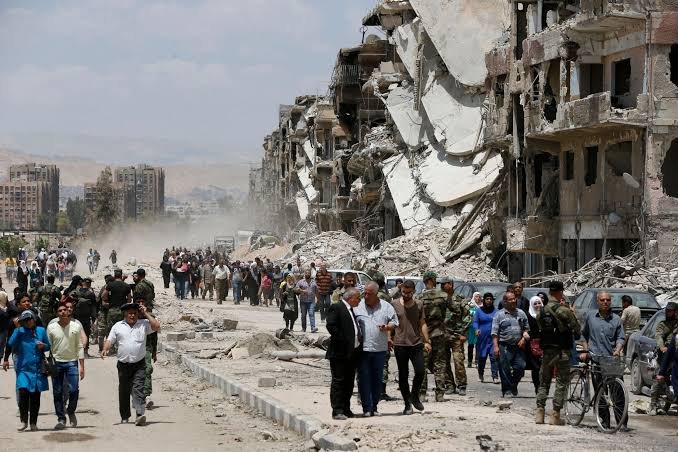
At least 580,000 people were killed during Syria’s nearly 14-year civil war, according to the United Nations, while around 140,000 people remain missing. More than 24,000 prisoners were released after Bashar al-Assad’s government fell in 2024, raising fears that many of the missing may have died in regime prisons or elsewhere.
The new government under President Ahmed al-Sharaa has promised to prosecute those directly responsible for the worst atrocities. At the same time, it has granted amnesty to many lower-ranking soldiers and officials, arguing that prosecuting hundreds of thousands of people could reignite sectarian and political violence.
The government established a National Commission for Transitional Justice to oversee the process. Officials say prosecutions should focus on the most serious crimes, including chemical-weapons attacks, torture, executions and massacres, while other cases may be addressed through reconciliation and compensation.
Last month, a Syrian court convicted former President Bashar al-Assad and eight others of murder, torture and crimes against humanity and sentenced them to death. Assad, who is living in exile in Russia, remains outside Syrian custody. Only his cousin, Atef Najib, is currently detained in Syria.
Human-rights experts have questioned the transparency and fairness of the proceedings, noting that Syria is still rebuilding its judicial system and training judges and forensic teams.
Meanwhile, anger among victims’ families is growing. In Damascus’s Tadamon neighborhood, where massacres occurred during the war, residents and children continue to uncover human remains from suspected mass graves.
For many families, limited prosecutions are unlikely to provide closure. Yet officials warn that attempting to imprison hundreds of thousands of suspected perpetrators could create another cycle of violence.
Syria’s central challenge is therefore how to achieve justice without destroying the fragile peace — a process that could take years and require prosecutions, truth-seeking, reparations and reconciliation.