Political and religious extremism fuels continued oppression of minorities
The persecution of minority communities in Bangladesh has a long and alarming history. Since the 1947 partition, minorities have rarely been able to live with security or enjoy full religious freedom. Post-election periods have repeatedly seen attacks, property seizures, forced displacements, and acts of violence by political and religious extremists. The 2001 election stands out as the most horrific instance, prompting international concern from human rights organizations. With the 2026 elections approaching and the Awami League unable to participate, experts warn that minorities may face heightened risks of politically and communally motivated attacks. S Goswami : Political Analyst

Political and religious extremism fuels continued oppression of minorities
The continuous history of minority persecution in Bangladesh is extremely alarming and concerning. Due to political and religious reasons, since the partition of the country in 1947, the minority communities in this region have never been able to live with security and religious freedom, enjoying their rights as citizens of this country. Falling victim to political and religious extremism, and often with state complicity, minorities have repeatedly faced attacks, torture, rape, and murder in various forms.
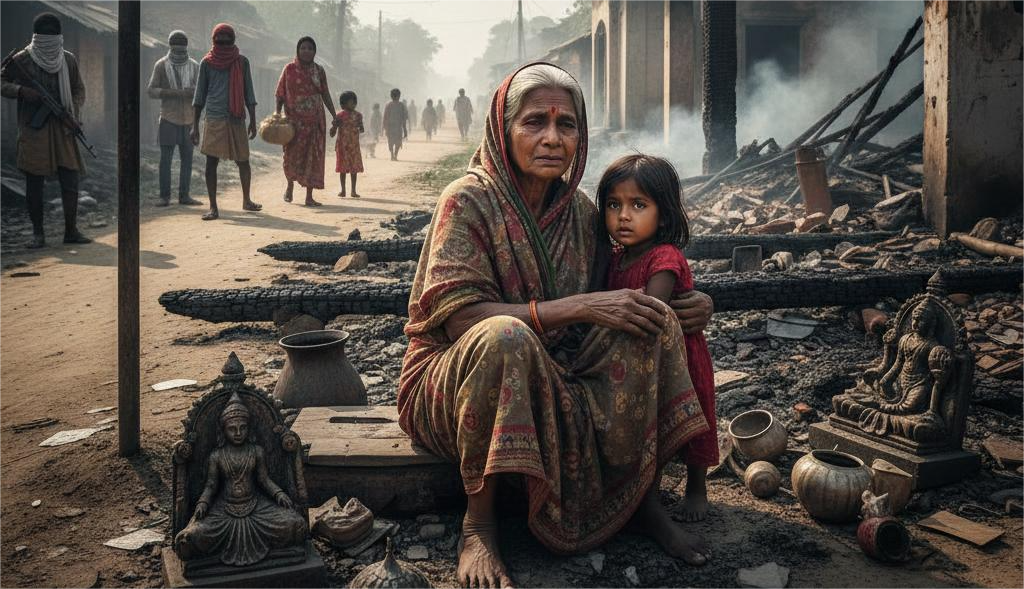
Even with changes in political power through elections, the fate of the minorities in this country has not changed. Through laws like the Enemy Property Act and the Vested Property Act, they have lost their ancestral lands, and in their attempts to reclaim their property, they have faced murder, looting, arson, and ultimately, forced displacement.
An analysis of Bangladesh's national parliamentary elections reveals that after each election, minorities have been attacked in some way by political, social, and religious extremists, and forced to leave the country. In 1977, Ziaur Rahman abolished secularism and passed a law establishing faith and trust in Allah, and in 1979, he lifted the ban on Jamaat-e-Islami, a controversial pro-Pakistan party during the Liberation War, allowing them to re-enter politics. This created strong distrust and insecurity among the minority communities, because Jamaat-e-Islami had led widespread killings, rapes, and looting of minorities during the Liberation War. In the subsequent 1988 election, Hussain Muhammad Ershad came to power and, through the Eighth Amendment, recognized Islam as the state religion. As the Awami League was one of the leading representative parties during the Liberation War, the minority community has always placed their trust in them, which can be attributed to the Awami League's secular ideals or their closeness to Bangabandhu. After the 1991 election, minorities were indiscriminately attacked for being Awami League supporters, and the BNP won that election. In 1992, after the Babri Masjid attack in India, during the BNP government's tenure, 300 temples were vandalized and set on fire across Bangladesh. The Dhakeshwari Temple and Girinath Temple were looted, vandalized, and set ablaze. At least 10 Hindus were killed, 2800 Hindu families were affected, and 3600 temples were vandalized. Sources [Contemporary media and BHBCUF]
Just before the 1996 election, the BNP government's administration carried out a massive rampage at Jagannath Hall, where 150 minority students were injured and 95 were arrested without warrants. Incidents of attacks and vandalism also occurred in Char Syedpur, Narayanganj. The period from 1991 to 1996 was one of the key periods for the rise of fundamentalist extremists. Various jihadist organizations started their activities during this time.
After the 1996 election, when the Awami League government came to power, there was some relief, but religious extremism increased. Jihadist organizations like Harkat-ul-Jihad and Hizb ut-Tahrir spread throughout the country. In some places, incidents of threats, attacks, and forced land grabbing against minorities continued under various pretexts.
The post-election violence in Bangladesh reached its worst state after the 2001 election. The scale of the attacks was so extensive that human rights organizations, including Amnesty International, expressed concern and protested. After the BNP-Jamaat alliance came to power in 2001, minorities were attacked in 20 districts. 18,000 women and children were victims of rape, a significant number of whom were from minority communities. In Char Fashion, Bhola, 200 Hindu women were gang-raped. Purnima Shil of Sirajganj was gang-raped at the age of 10, and Gopal Krishna Muhuri of Chittagong was killed by gunfire in his own home. Hindu families in Tuniaghara village of Jessore were attacked. From 2001 to 2006, extremists used their religious extremism in state protocols. Forced conversions of minorities, land grabbing, and rape were daily occurrences. 25 MPs and ministers of the BNP-Jamaat alliance, along with 26,000 party activists, were involved in these crimes. They were accused of crimes ranging from minority persecution to sedition. In Bashkhali, Chittagong, 11 members of a Hindu family were burned to death.
Between 2001 and 2006, 1.8 to 2 million minority Hindus were forced to leave the country. Subsequently, when the Awami League formed the government with a landslide victory in the 2008 election, there were no incidents of minority persecution except for a few isolated incidents.
After the 2014 election, minorities were again subjected to attacks. They were attacked in 160 incidents across 21 districts. Approximately 5,000 Hindu families were affected. Since Jamaat-e-Islami's registration was cancelled for this election, the BNP-Jamaat alliance called for a boycott, but the election was held anyway, resulting in a landslide victory for the Awami League. The BNP-Jamaat alliance did not participate in the election and also expressed strong resentment towards the government over the trial of war criminals. This led to protests, vandalism, and subsequent widespread attacks, vandalism, and arson against minorities, who were perceived as Awami League supporters.
In addition, there were attacks on Hindu neighborhoods in Malopara of Abhaynagar, Jessore, and in eight upazilas of Thakurgaon. At least 50 temples and numerous idols were vandalized. The Awami League government termed these incidents as acts of anarchy by the BNP-Jamaat alliance aimed at discrediting the government.
While the persecution and oppression of minorities in Bangladesh is a continuous process, the attacks following the 2001 election were the most horrific and alarming. In all previous post-election attacks on minorities, the risk was lower when the Awami League formed the government because the majority of minorities are Awami League supporters since the time of the Liberation War. Since the Awami League will not have the opportunity to participate in the 2026 election, there is a high risk that minorities will be subjected to attacks on both political and communal grounds.