Beyond Remittance: Women’s Unseen Role
Gender, Migration, and the Reconfiguration of Women’s Roles in Families By Farjana Faraezi, Development Practitioner

Beyond Remittance: Women’s Unseen Role
Although it is commonly presumed that a woman’s income will enhance her status within the household, this assumption does not hold true for women migrants. Research has shown that Bangladesh is a patriarchal, patrilineal, patrilocal society where sociocultural values promote the segregation of the sexes, impose a strict division of labour, and foster a systematic bias of male supremacy ( Jahan, Rounaq, 1995).
In rural, predominantly patriarchal contexts, the decision for a woman to migrate for work is seldom straightforward, even when she actively contributes to managing household affairs alongside male family members. Such a decision entails a range of complex social, economic, and familial considerations, reflecting the persistence of traditional gender norms as well as the challenges faced by women seeking opportunities beyond the domestic sphere.
According to the Bureau of Manpower, Employment, and Training (BMET), a total of 118,088 women workers went abroad for employment in 2016, a decade ago. However, by September 2025, only 40,088 women had left for work, a drop of nearly 66 percent.
However, as the entire household frequently becomes dependent on the income of a single women migrant, the weight of financial responsibility and social expectation increasingly falls upon her shoulders. As a result, her role is both economically demanding and socially burdensome, reflecting the complex intersection of empowerment and exploitation that often defines women’s migration experiences.
How They Are Devalued:
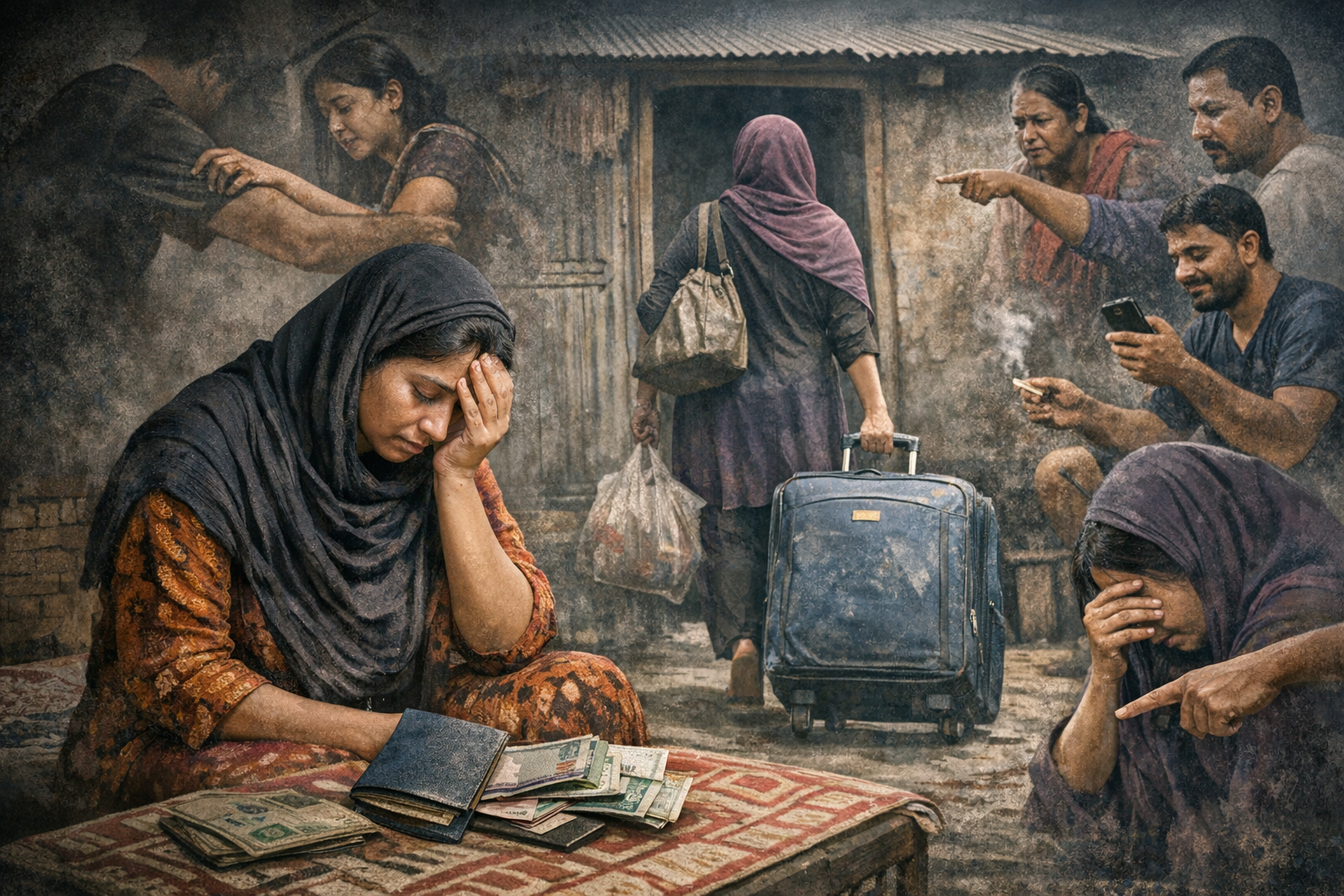
A woman often enters married life before fully understanding the dynamics of her household, immediately facing an unfamiliar and challenging environment. In trying to adapt, she frequently finds a stark mismatch between her expectations and the realities of domestic life. Husbands, in many cases, remain indifferent to family responsibilities and show little willingness to contribute meaningfully to household obligations. Some spend excessive time on trivial activities, such as gambling or mobile phone use, which leaves women frustrated, disempowered, and disillusioned. Confronted with these circumstances, many women make the difficult, independent decision to seek employment abroad, often without informing their families, as a means of asserting agency and securing their future.
After migrating abroad, women often remit their entire earnings to their families in the home country, despite having little understanding of financial management. Many maintain a seemingly cordial relationship with their husbands by sending money regularly. However, in some cases, husbands misuse these funds, spending them irresponsibly or on extramarital affairs. The husbands of 11% women workers have left them and 26% of women workers have experienced adverse effects in their marital life. This highlights the vulnerability of migrant women, whose financial contributions are neither monitored nor valued appropriately within the household.
Upon returning to their home country, women often face a drastically altered reality, having endured physical abuse abroad and feeling unable to share their trauma, which leaves them mentally vulnerable. Husbands or other family members may continuously criticize or question their character, further undermining their confidence. In some cases, husbands’ compulsive behaviors, such as mobile gambling, prevent women from accessing their earned income, sometimes leading to physical abuse. Collectively, these factors contribute to the devaluation of women within their own families, diminishing both their authority and sense of worth.
Another critical observation, evident even at a nuanced level, is that female members of households with women migrants rarely recognize or accept the authority, contributions, or decision-making of other women. As a result, women may internalize patriarchal expectations and limit their acknowledgment of other women’s roles, creating intra-gender constraints. Even when a women migrant generates significant income and contributes to household welfare, other female members may fail to respect her decisions or recognize her economic and social input, thereby reinforcing her marginalization within the family.
An important observation in the Bangladeshi context is that, in many cases, returnee women themselves undermine their own confidence, which prevents them from realizing that they have the capability to participate in family decision-making. They tend to perceive socially imposed decisions as appropriate, and, often unconsciously, they create self-imposed limitations that restrict their own agency within the household.
Voices from the Field:
Sonia Akter (25), a returnee from Oman, explained-
“To support the family, I went abroad, but I had no control over the money I earned. Even after five years, when I returned home, there was no proper account of my income, and raising the issue sometimes resulted in physical abuse. I now feel powerless in household decision-making, and all my years of work abroad seem no longer to belong to me. At this stage of my life, I experience a profound sense of emptiness, and the instability of my mind has begun to affect my physical health. This outcome is deeply unexpected, given the sacrifices I made to secure a better future for my family.”
Marjia khatun (27), a returnee from Jordan, explained –
“Seeing the financial difficulties in husband’s household, decided to go abroad, hoping to change my fortune. While working as a domestic worker, I often faced days without proper meals, and my salary was irregular. Despite contributing money to household expenses every month, I could not save anything for myself. After returning home and trying to start a new source of income, my husband refused to allow it and even wasted my money through gambling. Now struggles to maintain the household under neglect and a lack of support. The constant pressure and lack of control over my life have caused severe stress, persistent worry, and emotional exhaustion as though every day is a curse, with anxiety weighing on me from all sides.”
Impacts on society:
Form a social perspective, the persistent devaluation of women at every step has become a normalized reality, resulting in their continued marginalization as a disadvantaged group within society. Unfortunately, being an integral part of society, a woman’s income is often denied proper recognition and acceptance.
Despite numerous government and non-government initiatives at various levels aimed at promoting women migrants' advancement, they continue to face widespread neglect within their families and the broader society.
Evidence from research report of Bangladesh Institute of Labor Studies-BILS highlights that Women workers returning from abroad are also being socially degraded. Family and society treat them hostilely and inhumanely. 38% female workers say that they are considered as low class women in the society (September 27, 2021).
The root causes of this persistent neglect lie in long-standing societal practices and cultural norms that have been passed down through generations, shaping perceptions of women’s roles and limiting their authority.
Unless there is a change in mindset, no tools or interventions will work effectively in altering their role within the family. Consequently, reducing gender inequality will not be easy, and the message will persist among younger generations that a woman’s role in the family is not significant, even if she earns an income. This is a highly concerning and alarming issue for society.
Psychological Dimension of Women migrants Marginalization:
The lack of acknowledgment gradually undermines their sense of self-worth and belonging. Over time, this neglect can manifest in a range of long-term psychological issues, including chronic frustration, feelings of helplessness, and reduced self-confidence. According to a study by BILS, the physical health condition of female workers returning from abroad is fragile. 55% are physically unhealthy, 29% have a mental sickness, 87% mental patients didn’t get any treatment ( September 27, 2021).
Women are often made to believe that merely being permitted to go abroad and earn an income is an achievement, yet they are denied any rights or control over the earnings they generate. Psychologically, this experience—where individuals unconsciously accept unequal treatment as normal or justified—is referred to as internalized oppression.
Asif Munier, a migration and refugee affairs expert, told- Sexual abuse comes from the men. In such situations, workers face severe mental trauma abroad. Many women workers don’t want to admit the abuse. They keep it inside, leading to serious mental health issues (September 28, 2025).
The effects of such dynamics can be profound. Initially, women may experience stress, anxiety, or emotional exhaustion. If unaddressed, these issues can escalate into sleep disturbances, persistent fatigue, and emotional burnout. Over time, the strain on mental health can lead to physical health problems, such as weakened immunity, recurring illnesses, and overall vulnerability. In essence, the lack of recognition and autonomy not only diminishes migrant women’s psychological resilience but also leaves them physically more susceptible to health challenges.
Reconfiguration of Women’s Roles in Families:
The transformation of women’s roles within families begins with education, as it empowers women to think critically, make informed decisions, and claim their rightful space in both family and society. Alongside education, economic self-dependence strengthens a woman’s position, allowing her to contribute equally and gain respect within household dynamics. When women returnees achieve financial stability, they also acquire the confidence to influence decisions that shape family life.
However, true reconfiguration of women returnees' roles requires more than education and income—it demands a shift in mindset. They must embrace new ways of thinking about their identity, capability, and value, while society must challenge the traditional beliefs that limit them. Only through a collective change in individual and social consciousness can the position of women within families genuinely transform.
Conclusion:
Ultimately, many women returning from abroad encounter not only familial pressures but also the pervasive negative perceptions of neighbors and the broader community, which reinforce social stigma and constrain their agency. Addressing these structural and cultural barriers has become an urgent imperative. Until women actively assert their rights and challenge entrenched normative expectations, their capacity to secure a meaningful and empowered position within the family remains severely limited.