They Survive Abroad, They Suffer at Home
The Forgotten Lives of Returnee Women Silence, stigma, and the cycle of re-migration in Bangladesh. Every year, thousands of Bangladeshi women return from foreign workplaces carrying stories they are never allowed to tell. Their journeys, once filled with promises of opportunity and hope, often end in trauma, silence, and social erasure. They come back seeking safety, yet find themselves judged rather than heard—caught between the violence they escaped abroad and the stigma that awaits them at home. Behind the statistics lie lives overshadowed by shame, families unsure how to respond, and communities unwilling to confront uncomfortable truths. This is the untold story of returnee women—survivors who endure far more than the world chooses to see.

They Survive Abroad, They Suffer at Home
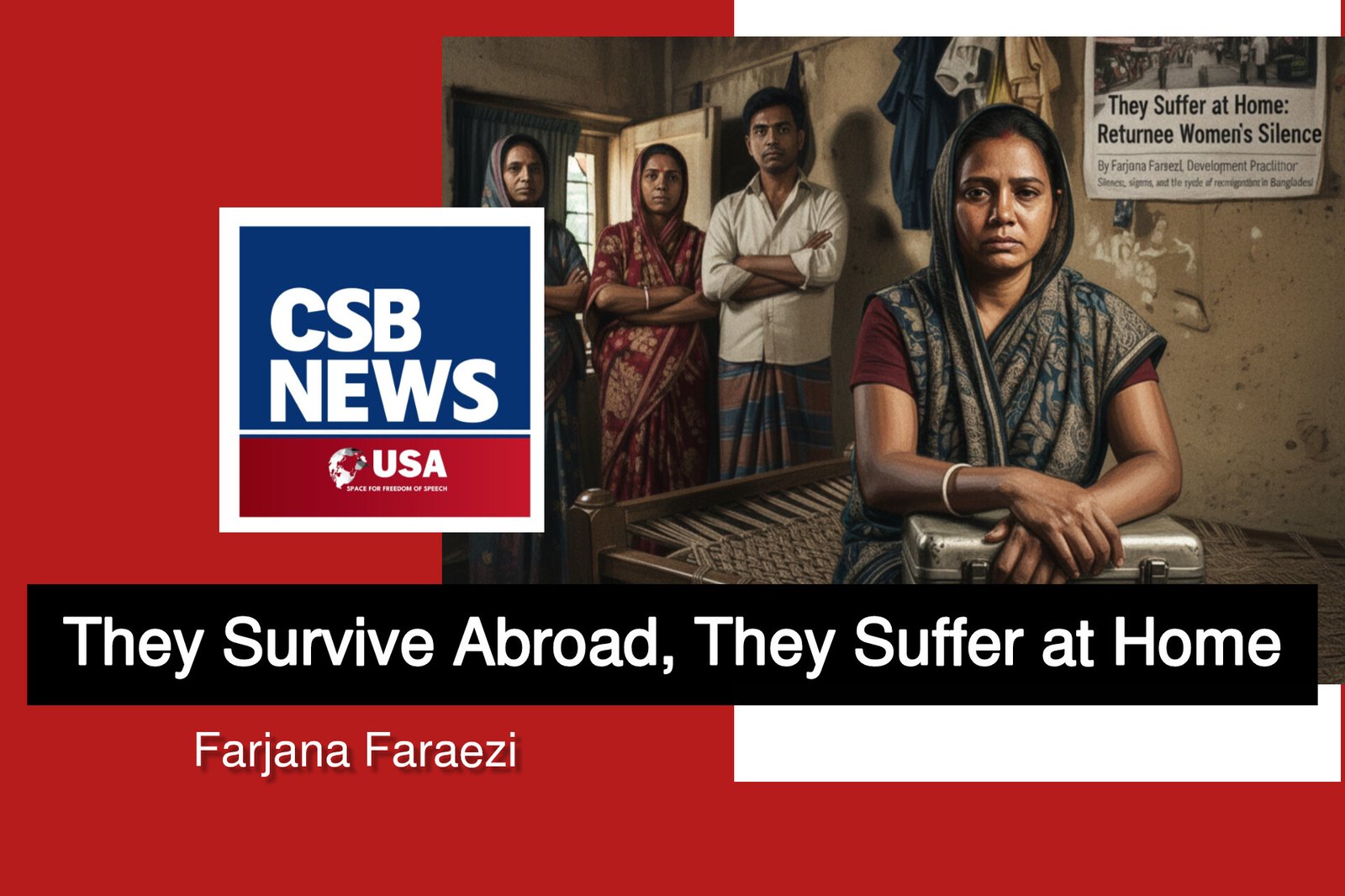
Farjana Faraezi, CSB NEWS USA, Dhaka: Development Practitioner She carried home not just a suitcase but a weight that no one around her could see. Behind her weary eyes were memories of long nights in an unfamiliar land, of harsh words from employers, and of a body pushed beyond its limits. She had left with dreams of securing her family’s future, but returned with scars that went deeper than skin. For her, reintegration was not a moment of healing—it was the beginning of another struggle.
When she stepped through the door, she expected an embrace. Instead, she met silence, suspicion, and whispered questions from neighbors. Her family worried less about what she had endured and more about what she had failed to bring back. What should have been a safe return became another cycle of pain, inflicted not by strangers abroad, but by the people closest to her. Her story is not unusual. Every year, thousands of Bangladeshi women return from abroad carrying similar burdens. According to IOM Bangladesh, between 25 and 35 percent of Bangladeshi women migrants reported experiencing physical abuse abroad during 2023–2024, while BRAC and the Wage Earners’ Welfare Board (WEWB) record that around 1,200 to 1,500 women return annually after facing exploitation (WEWB, 2024). In just the first half of 2025, hundreds of women had already been forced to come back after enduring degrading conditions. These numbers reflect not only the magnitude of the problem but also the persistence of vulnerabilities in the labor migration system. The Double Burden: Abroad and at Home Migration for women is often painted as a story of empowerment—women breaking free of poverty and reshaping their family’s future. But the reality is often far more complex. Women, mostly from lower-middle-income and conservative families, carry with them both the hopes of their households and the risks of isolation in foreign lands.
When things go wrong abroad, the consequences stretch beyond the workplace. Survivors of abuse return to families and communities that may not want to hear their stories. Out of fear of social shame, families sometimes bury the truth. Others go further, rejecting the survivor outright, severing ties as if her trauma were a burden too heavy to acknowledge. Scholars have called this a “double victimization”—where women first suffer exploitation abroad, and then again face stigma, silencing, or rejection at home (Sabban, 2019; Siddiqui, 2020). This is not just silence. It is erasure. It strips women of dignity, reduces their suffering to whispers, and denies them the opportunity to heal. In migration-prone districts across Bangladesh, it is common to hear neighbors speculate on why a woman returned, rarely stopping to ask what she endured. Instead of solidarity, she finds isolation. Instead of empathy, she faces blame. The Psychological Toll The emotional weight of this double burden is immense. Survivors lose confidence in themselves. They question their worth and retreat further into isolation. With no safe spaces to speak, they internalize guilt that does not belong to them.
Research shows that repeated cycles of migration under these conditions not only undermine economic stability but also erode women’s psychological resilience, leaving them less able to cope with the hardships they may face abroad (Rahman & Litchfield, 2021). Depression, anxiety, and post-traumatic stress are common among returnee women, yet mental health remains one of the least addressed areas in reintegration programs. This silence is not only cruel—it is costly. It diminishes the inherent potential of women who, if given the right support, could contribute meaningfully to their families and communities. It erodes social cohesion by embedding cycles of stigma and mistrust.
And it reinforces a broader culture of silence where abuse is hidden, not confronted. The Cycle of Re-Migration Perhaps the most tragic irony is that these very pressures often push women to migrate again. Families, disappointed that their daughters returned “empty-handed,” pressure them to try once more. Communities, quick to label women as failures, drive them to prove themselves again. In this toxic environment, the decision to re-migrate is rarely born out of genuine hope, but out of shame, regret, and social pressure. Women take these risks knowing what they might face because they feel they have no alternative. Yet without addressing the psychological scars of their earlier experiences, re-migration often ends in further disempowerment. Evidence from migration studies highlights that such repeated journeys, when driven by necessity rather than choice, rarely deliver long-term security and instead deepen vulnerability (Rahman & Litchfield, 2021).
Whose Responsibility? The question that lingers is this: who bears responsibility for these outcomes? Is it the woman herself for daring to leave home? Is it her family, who silences or rejects her? Or is it society, which has created a culture where reputation matters more than recovery, and shame weighs heavier than empathy? The reality is that accountability is shared. Families play a critical role in either supporting or silencing survivors. Communities can either perpetuate stigma or stand as allies.
Policymakers can either ignore the problem or take bold steps to reform systems of migration and reintegration. As Siddiqui (2020) notes, Bangladesh’s migration governance has long struggled to adequately address gender-specific vulnerabilities, leaving returnee women caught between silence at home and risk abroad.
Towards Solutions Breaking this cycle requires more than sympathy. It requires systemic change. Mental health and psychosocial support must become a standard part of reintegration programs. Women should not be left to carry their trauma alone. Counseling services for families could help bridge understanding and reduce rejection at home.
Community-level awareness campaigns are vital to shift perceptions from blame to empathy. At the policy level, bilateral labor agreements need stronger gender protections, ensuring that women are not sent abroad without safeguards in place. Reintegration must be reimagined beyond financial packages—it should be about restoring dignity, confidence, and a sense of belonging. Returnee women should be given platforms to share their stories, influence policy, and advocate for the rights of future migrants. Their voices should not be peripheral—they should be central. Beyond Resilience It is often said that Bangladeshi women migrants are resilient. And they are. They endure hardship, survive trauma, and still manage to carry hope.
But resilience should not be demanded endlessly. It should not be used as an excuse to deny them the healing, justice, and dignity they deserve. Bangladeshi women who return from abuse abroad are not failures. They are survivors. Their resilience should not be measured by how much they can endure, but by how much we as a society can support them to thrive. If families, communities, and policymakers continue to choose silence over solidarity, then their suffering is not just their burden. It is ours. The future of migration in Bangladesh will not be measured only by remittance figures or numbers of workers sent abroad. It will be measured by how we treat those who come home hurt, silenced, and forgotten. And in that measure lies the true test of our humanity.