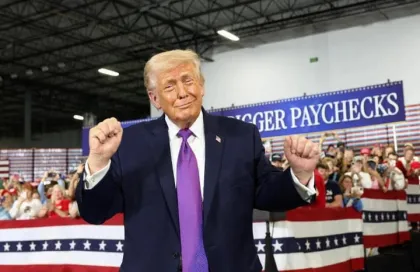

Trump Projects Strength at White House as His Political Battles Continue Today
Trump projects confidence amid political battles, past assassination attempts, and growing election pressure as Americans debate his leadership, policies, and legacy.

Reporter · CSB News USA
6 min read
Listen to this article6 min
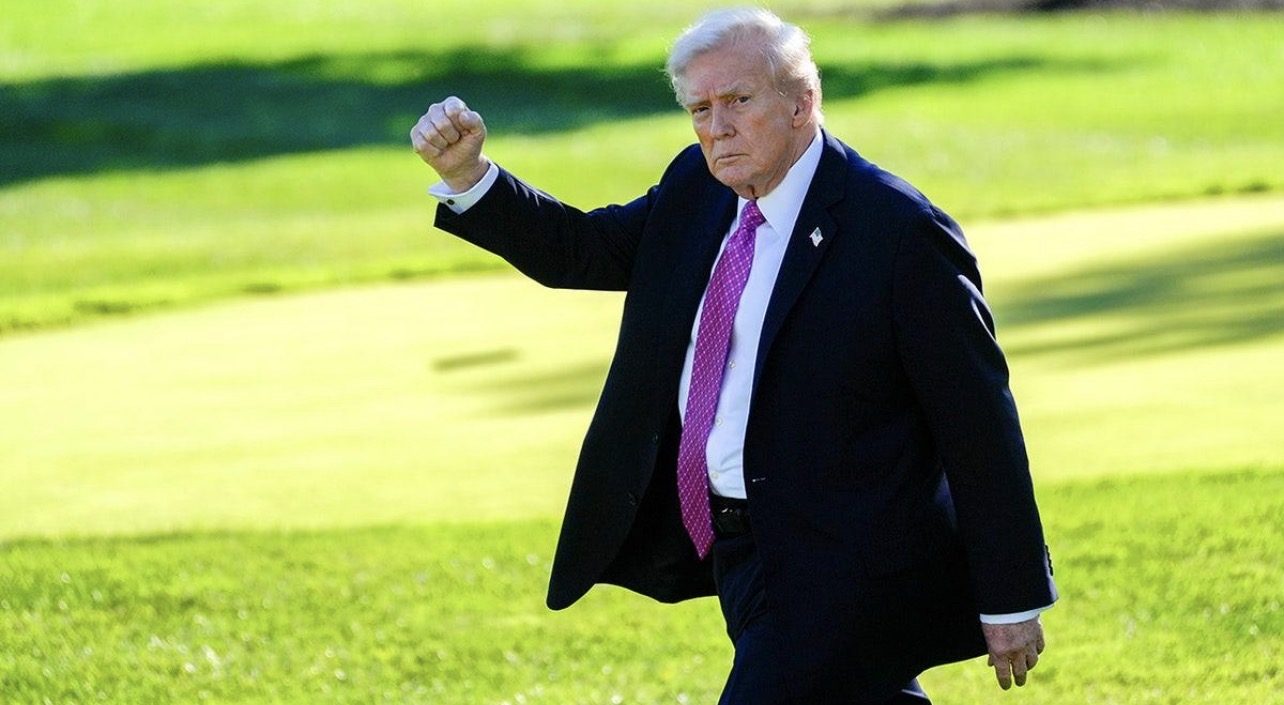
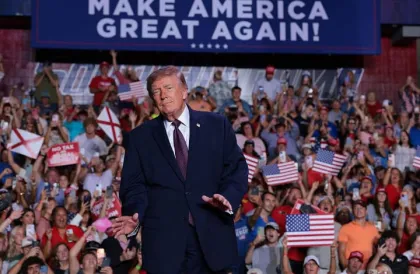
President Donald Trump continues to present himself as a determined political leader who refuses to retreat in the face of criticism, legal challenges, and threats to his safety. A photograph showing Trump raising his fist while walking outside the White House can easily become a powerful political symbol for supporters who see his public appearances as evidence of resilience. However, the wider story involves more than a single image. It includes his turbulent political history, two impeachments during his first presidency, criminal prosecutions, assassination attempts, and the continuing national debate over his leadership and policies.
The message accompanying the image describes Trump as a man who knows where America is headed and claims that the media spent a decade trying to destroy him. Those statements reflect a strongly pro-Trump political viewpoint rather than independently established facts. The historical record confirms that Trump has faced substantial political opposition, legal proceedings, and serious threats to his life. It does not, by itself, establish that all criticism of him was false or that every action taken against him was part of a coordinated effort to undermine him.
Trump's supporters often interpret his refusal to withdraw from political life as a sign of strength. His critics, meanwhile, argue that a president's record should be judged by policies, institutional conduct, economic outcomes, and the consequences of his decisions. The contrast between those views remains central to the country's political debate.
The most dramatic moment in Trump's recent political history came on July 13, 2024, when a gunman opened fire during his campaign rally in Butler, Pennsylvania. Trump suffered an injury to his ear, one rally attendee was killed, and two other attendees were seriously wounded. Law enforcement officers killed the gunman at the scene. Trump was rushed away by Secret Service agents, but he briefly raised his fist and urged supporters to fight as he was escorted from the stage. The image became one of the defining photographs of the 2024 presidential campaign. The Associated Press documented the moment, and subsequent fact-checking confirmed that the widely circulated original photograph was genuine, despite misleading claims that it had been generated by artificial intelligence.
The attack also exposed serious security failures. A U.S. Secret Service investigation released in September 2024 identified communication problems and a lack of diligence among personnel responsible for protecting the former president. The agency acknowledged that failures in planning and coordination contributed to the incident. The attack prompted congressional scrutiny and renewed questions about how a gunman could gain access to a rooftop with a clear line of sight to the rally stage. These findings provide important context for understanding the security challenges surrounding Trump's public appearances.
A second major security incident occurred on September 15, 2024, near Trump's golf course in West Palm Beach, Florida. A Secret Service agent spotted an armed suspect near the property's perimeter before Trump came into view. The suspect fled and was later apprehended. Investigators treated the episode as an apparent assassination attempt. Although Trump was not injured in that incident, it reinforced concerns about the risks associated with political violence in the United States.
The issue of threats to Trump's safety has remained part of the political conversation during his second presidency. In an April 28, 2026, statement, the White House described another incident as a third assassination attempt in less than two years. That is the administration's characterization of the incident; details about any specific case should be checked against law enforcement statements and court records before publication. It is important to distinguish an official administration statement from independently verified investigative findings.
Trump's political resilience also has a complicated legal history. During his first presidency, the House of Representatives impeached him twice. In December 2019, the House approved articles accusing him of abuse of power and obstruction of Congress. In January 2021, it impeached him again on a charge of incitement of insurrection following the January 6 attack on the U.S. Capitol. The Senate acquitted him in both trials. An impeachment is a constitutional and political process, not the same as a criminal conviction.
Trump also faced criminal prosecutions after leaving office. In May 2024, a New York jury found him guilty on 34 felony counts related to falsifying business records. He denied wrongdoing and challenged the proceedings. That verdict is a matter of public record, so describing all legal cases against Trump as fabricated or as proven lies would be inaccurate. Each case must be assessed according to its evidence, legal rulings, and procedural history.
These legal and political battles helped shape Trump's public image. His supporters frequently argue that investigations and prosecutions demonstrate how aggressively the political establishment has opposed him. Critics respond that presidents and former presidents should be subject to the same legal standards as other citizens. Neither political loyalty nor political opposition is a substitute for examining the evidence and the decisions of the courts.
The phrase "America First" remains central to Trump's political identity. It generally refers to his emphasis on national sovereignty, stricter immigration enforcement, domestic economic priorities, and a foreign policy that places greater weight on direct U.S. interests. Supporters view this approach as a commitment to American workers, border security, and national strength. Opponents raise concerns about its economic effects, treatment of migrants, international alliances, and implications for democratic institutions.
Those disagreements matter because the presidency is judged not only through photographs and campaign slogans but also through measurable outcomes. Voters may consider inflation, wages, employment, housing affordability, immigration, public safety, foreign policy, and the performance of federal agencies. They may also weigh Trump's ability to work with Congress and respond to criticism. A fist raised in a photograph can communicate determination, but it cannot establish whether a particular policy has succeeded.
The political context is especially important in October 2026, as the United States approaches its November midterm elections. The contests will determine control of Congress and influence the administration's ability to advance its agenda. A Washington Post report published on October 16 described internal tensions among White House aides and concern among some Republicans about the party's electoral prospects. The report cited interviews with administration staffers, advisers, and people familiar with internal discussions. The White House, for its part, defended the president's team and its commitment to his agenda.
The midterms will offer voters an opportunity to express their views on the administration's record. If Republicans retain control of Congress, Trump could gain additional political room to pursue his priorities. If Democrats win control of one or both chambers, congressional investigations, oversight, budget negotiations, and legislative battles could become more prominent. The results will depend on individual races, turnout, local issues, and the national political climate rather than on any single photograph or campaign appearance.
For Trump's supporters, the image of a fist raised outside the White House may represent perseverance after years of conflict and personal danger. For his opponents, it may be another example of political image-making designed to strengthen his public persona. Both interpretations belong to the political debate, but the underlying events must remain distinct from the emotions they inspire.
The strongest factual conclusion is that Trump has survived serious threats, remained a dominant figure in American politics, and continued to lead a deeply polarizing administration. His political future, however, will depend on more than his ability to project confidence. The November elections, the performance of his policies, the state of the economy, and the decisions of voters will help determine how history judges his leadership.
Related News
Trump’s Approval Under Pressure as Democrats See an Opening in the 2026 Midterms
Trump’s New Press Secretary Faces Possible Exit Just One Week Into the Job
Trump Heads to Georgia as Midterm Campaign Intensifies