U.S. Troops in the Middle East Wait for the “Next Big Moment”
The United States military stationed across the Middle East is now effectively on standby as American officials continue to send contradictory signals about the current state of the war with Iran

U.S. Troops in the Middle East Wait for the “Next Big Moment”
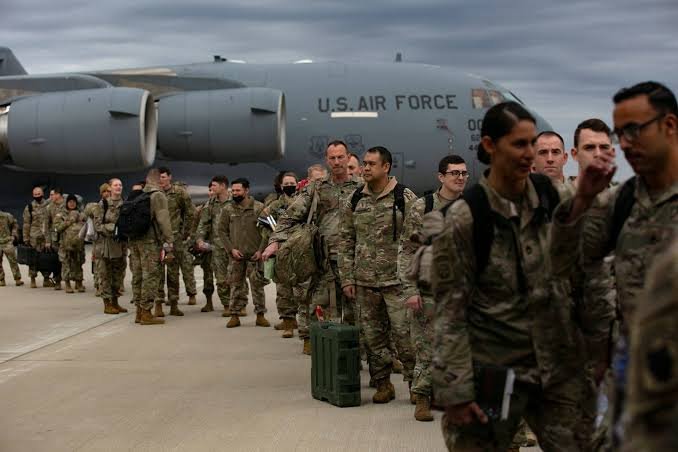
The United States military stationed across the Middle East is now effectively on standby as American officials continue to send contradictory signals about the current state of the war with Iran.
President Donald Trump deployed nearly 50,000 troops for the campaign against Iran, sending aircraft carriers, destroyers, Marine expeditionary units and warplanes into the region.
Equipped with parachutes and survival kits, the troops became part of Trump’s declared mission to “destroy Iran’s missiles and raze its missile industry to the ground.”
However, the White House position on the conflict now appears increasingly unclear. On Tuesday, Secretary of State Marco Rubio announced that “Operation Epic Fury” had ended. Defense Secretary Pete Hegseth, meanwhile, said the primary mission was to ensure safe navigation through the Strait of Hormuz. Later, Trump stated that even that operation had been temporarily paused.
On Wednesday, Trump wrote on social media that he would end the war and guarantee safe passage through the strait if Iran “agrees to give what has been agreed,” though he did not elaborate on the terms. At the same time, he warned that “if they don’t agree, the bombing starts.”
The U.S. Navy is still enforcing a blockade on shipping entering and leaving Iranian ports after Iran effectively shut down the Strait of Hormuz. On Wednesday, a U.S. warplane disabled an Iranian-flagged oil tanker that allegedly attempted to violate the blockade.
Before the conflict escalated, around 40,000 U.S. troops were typically stationed across the Middle East, including bases in Saudi Arabia, Bahrain, Iraq, Syria, Jordan, Qatar, the United Arab Emirates and Kuwait. As the war intensified, that number reportedly rose above 50,000.
Iranian retaliatory strikes also forced the United States to relocate troops from several regional bases to other locations in the Middle East, Europe and even the United States.
82nd Airborne Division
Roughly 2,000 paratroopers from the elite 82nd Airborne Division are currently deployed in the Middle East, though the Pentagon has not disclosed their exact location.
According to U.S. officials, the troops could potentially be used in an operation to seize Kharg Island, a major hub for Iranian oil exports. Military experts also believe they could participate in an effort to capture an airfield inside Iran.
However, analysts warn that holding territory inside a country of more than 90 million people would be extremely difficult and could result in significant U.S. casualties.
31st Marine Expeditionary Unit
The deployment of 2,500 Marines along with another 2,500 sailors helped keep the total number of American personnel in the region above 50,000.
U.S. officials say the 31st Marine Expeditionary Unit could also be used in operations to seize islands or other strategically important territories.
Special Operations Forces
Several hundred U.S. Special Operations troops were deployed to the Middle East in March to provide the Trump administration with additional military options.
These highly trained forces could potentially be involved in missions targeting Iran’s highly enriched uranium stockpile at the Isfahan nuclear facility.
USS Abraham Lincoln and USS George H.W. Bush
The aircraft carriers USS Abraham Lincoln and USS George H.W. Bush are currently positioned in the Arabian Sea, accompanied by multiple warships and more than 10,000 sailors and Marines.
From these carriers, the United States can launch missile strikes and fighter jet attacks against Iran.
According to U.S. officials, the carrier Gerald Ford is now returning toward the Atlantic Ocean after suffering a fire in its laundry facilities earlier in the conflict.