Partnership or Pressure? The Uneasy Ledger of US-Bangladesh Relations
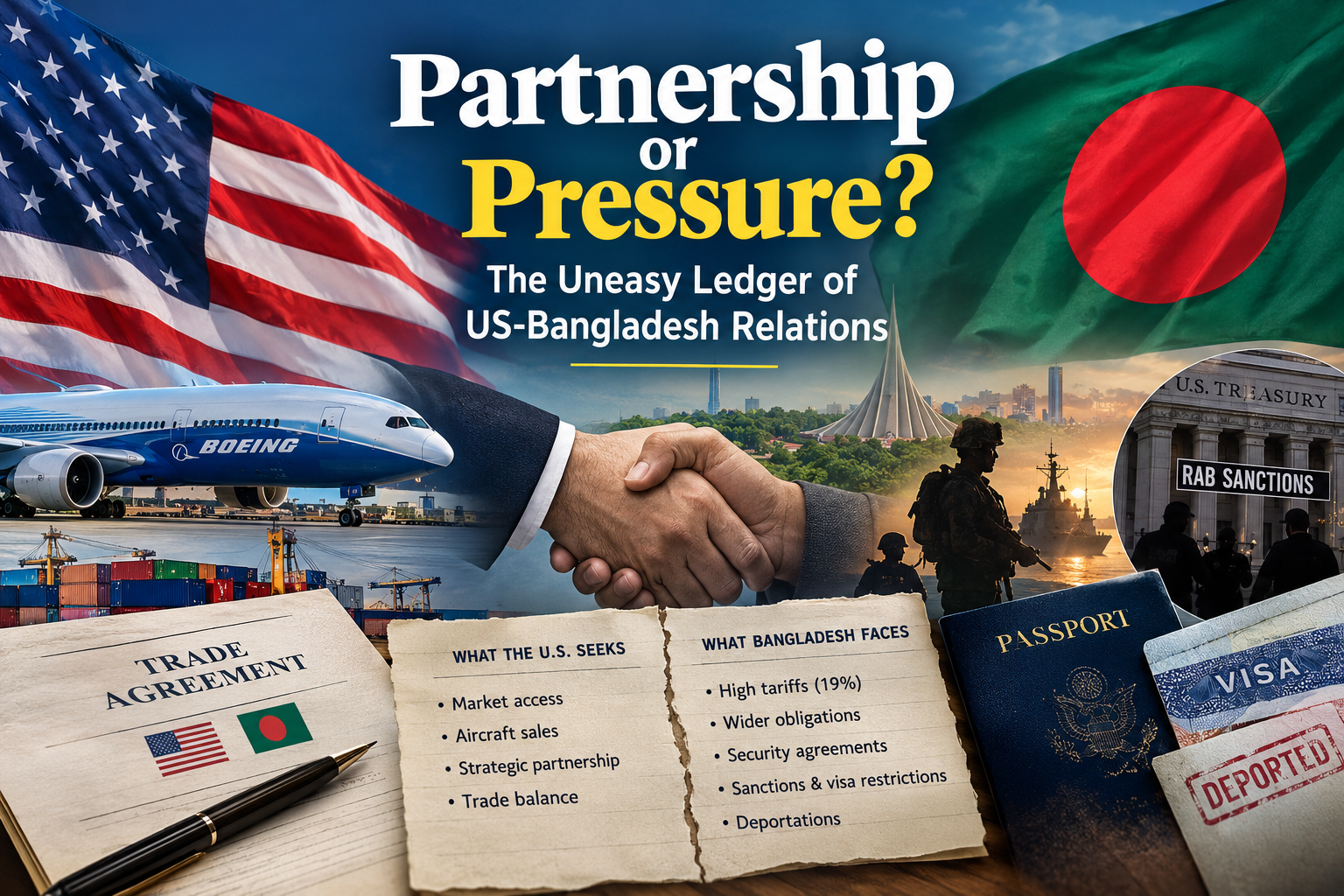
The United States and Bangladesh routinely describe their relationship in the language of partnership, shared prosperity and strategic cooperation. Yet developments in 2026 have fuelled a very different debate in Dhaka: whether the relationship is becoming increasingly asymmetric, with Bangladesh assuming substantial economic and strategic commitments while several contentious U.S. policies toward Bangladesh remain unchanged

Partnership or Pressure? The Uneasy Ledger of US-Bangladesh Relations
The United States and Bangladesh routinely describe their relationship in the language of partnership, shared prosperity and strategic cooperation. Yet developments in 2026 have fuelled a very different debate in Dhaka: whether the relationship is becoming increasingly asymmetric, with Bangladesh assuming substantial economic and strategic commitments while several contentious U.S. policies toward Bangladesh remain unchanged.
The controversy begins with the Agreement on Reciprocal Trade, signed on February 9, 2026, just three days before Bangladesh’s national election on February 12. The agreement was concluded by the interim administration headed by Professor Muhammad Yunus, which formally left office after the newly elected government was formed on February 17.
Timing alone does not prove improper pressure or intent. But it has understandably become part of the political argument surrounding the deal. Bangladeshi economists and policy analysts have questioned whether an outgoing transitional government should have undertaken commitments of such breadth immediately before voters elected a new parliament. Economist Selim Raihan described the agreement as highly unequal and rushed, while the Centre for Policy Dialogue later characterized it as highly discriminatory. A High Court petition has also challenged its legality and alleged disproportionate obligations.
The economic trade-off is substantial. According to the U.S. Trade Representative, Washington agreed to maintain a 19 percent reciprocal tariff on most Bangladeshi imports, while Bangladesh committed to preferential access for a wide range of American industrial and agricultural products and to changes involving regulatory and non-tariff barriers. U.S. officials describe the agreement as expanding market access and producing a more reciprocal commercial relationship. Critics in Bangladesh argue that the obligations extend considerably further than tariff policy and constrain the country's economic room for manoeuvre.
Aircraft procurement has become the most visible symbol of that dispute. During negotiations over U.S. tariffs, Bangladesh had already indicated plans to purchase Boeing aircraft as part of an effort to narrow its trade imbalance with the United States. On April 30, Biman Bangladesh Airlines signed for 14 Boeing aircraft: eight 787-10s, two 787-9s and four 737-8s, with an estimated list value of about $3.7 billion. Deliveries of the initial order are scheduled to begin only in late 2031 and continue through 2035.
Then, on September 23, Biman ordered another 11 aircraft, bringing the 2026 Boeing order book to 25 jets. The second purchase consists of five more 787-10s and six 737-8s.
There is a legitimate commercial case for expanding Biman. The airline and government say Bangladesh needs additional capacity, new international routes and a modernized fleet. Officials have explicitly rejected claims that the Boeing decision resulted from foreign pressure.
But the scale and context warrant scrutiny. Biman currently operates a comparatively modest network, and aviation specialists have cautioned that acquiring aircraft does not itself guarantee profitable expansion. The airline must develop viable routes, management capacity and sufficient passenger demand to use the new fleet effectively. The government is also providing a sovereign guarantee to support financing for the original 14-aircraft purchase.
The choice of manufacturer adds another political dimension. Bangladesh had previously pursued a plan to acquire Airbus aircraft. Following the political change of August 2024, policy shifted toward Boeing, amid the broader tariff negotiations with Washington. That history does not establish that the aircraft were imposed by the United States, but it explains why critics see the procurement decision as intertwined with trade diplomacy rather than purely airline economics.
Security relations raise similar questions. Bangladesh and the United States have been discussing two long-standing defense frameworks: the General Security of Military Information Agreement, or GSOMIA, and the Acquisition and Cross-Servicing Agreement, or ACSA. GSOMIA provides a framework for protecting classified military information, while ACSA facilitates reciprocal logistical support such as supplies and services. Bangladeshi officials said in May that no agreement would be signed unless national interests were protected and relevant government agencies were consulted.
Some Bangladeshi advocacy groups argue that such agreements could gradually deepen U.S. military access and pull Bangladesh further into Washington's Indo-Pacific strategy. Supporters counter that these are standard cooperation mechanisms that could facilitate military modernization, exercises, disaster relief and access to U.S. technology. The important distinction is that negotiations over logistics cooperation are documented; claims that Washington has already secured permanent bases or unrestricted access to Bangladeshi ports and airfields are not established by the available evidence.
Meanwhile, policies that directly affect Bangladeshis remain contentious. The U.S. Treasury sanctioned the Rapid Action Battalion and several current or former officials in December 2021 over allegations of serious human-rights abuses. The RAB designation remains listed by the U.S. Office of Foreign Assets Control.
Bangladeshi nationals applying for B-1/B-2 visas are also currently subject to the U.S. visa-bond programme. Depending on the consular determination, applicants may be required to post $5,000, $10,000 or $15,000. Bangladesh has been covered by the requirement since January 21, 2026.
Deportation flights have continued as well. Twenty-nine Bangladeshis were returned on a U.S.-chartered flight in February, and another 23 arrived in Dhaka in July. Reports indicate that many had entered the United States through irregular migration routes and were removed following immigration proceedings.
None of these measures is formally linked to the trade agreement or the Boeing purchases. Washington would argue that trade policy, human-rights sanctions, immigration enforcement and defense cooperation operate under different legal and policy frameworks.
Yet diplomacy is judged politically as well as bureaucratically. For Bangladesh, the central question is therefore not whether every item belongs in the same legal ledger. It is whether the overall relationship distributes benefits, obligations and strategic freedom in a way that both countries can credibly call reciprocal.
The United States is entitled to pursue market access, aircraft sales and strategic partnerships. Bangladesh is equally entitled to ask what it receives in return—and whether agreements negotiated under economic pressure preserve sufficient autonomy for a smaller state.
That is the debate Washington’s language of “partnership” must ultimately answer.