Iran-US agreement signed, ceasefire on 14 important decisions
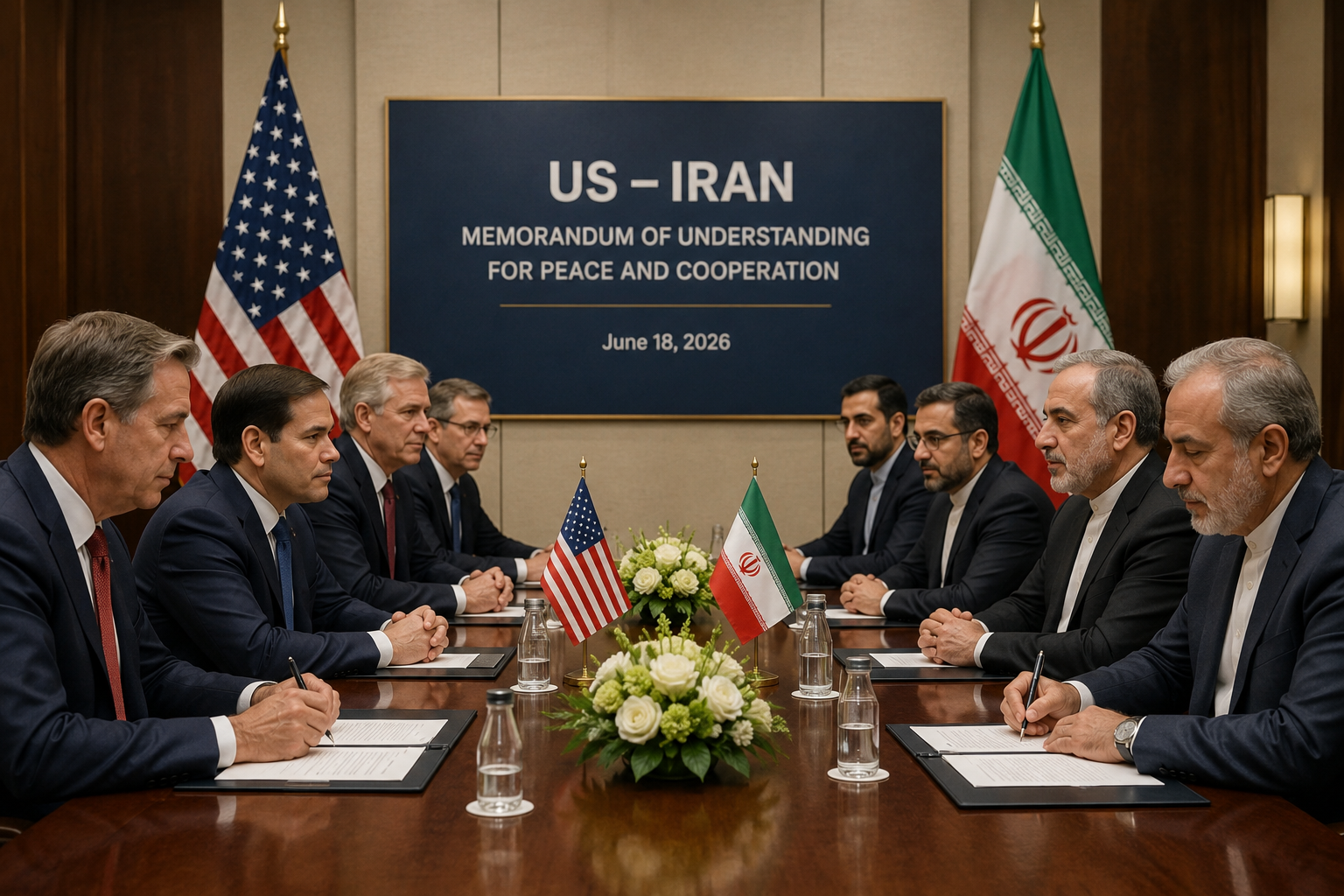
The United States and the Islamic Republic of Iran have reached a significant Memorandum of Understanding (MOU) aimed at ending hostilities and establishing a framework for a broader peace agreement. The document outlines commitments on military de-escalation, sanctions relief, economic reconstruction, maritime security, and nuclear issues, marking a potentially important step toward stabilizing relations between the two countries and reducing tensions in the Middle East

Iran-US agreement signed, ceasefire on 14 important decisions
The United States and the Islamic Republic of Iran have reached a significant Memorandum of Understanding (MOU) aimed at ending hostilities and establishing a framework for a broader peace agreement. The document outlines commitments on military de-escalation, sanctions relief, economic reconstruction, maritime security, and nuclear issues, marking a potentially important step toward stabilizing relations between the two countries and reducing tensions in the Middle East.
Under the agreement, both sides declare the immediate and permanent cessation of military operations on all fronts, including in Lebanon, and pledge not to initiate war or military action against one another in the future. They also commit to refraining from the threat or use of force and to respecting the territorial integrity and sovereignty of Lebanon as part of a broader effort to end the conflict.
The MOU further states that the United States and Iran will respect each other’s sovereignty and territorial integrity and will not interfere in one another’s internal affairs. The two sides have agreed to negotiate a comprehensive final agreement within 60 days, with the possibility of extending the deadline by mutual consent.
One of the key provisions of the memorandum concerns maritime security. The United States has committed to beginning the removal of its naval blockade immediately after the MOU takes effect and to completing the process within 30 days. It also undertakes to withdraw its forces from the vicinity of Iran following the conclusion of the final agreement.
For its part, Iran has agreed to facilitate the safe passage of commercial vessels through the Persian Gulf and the Sea of Oman without charge for a period of 60 days. It will also work to restore normal shipping operations by removing technical and military obstacles, including demining efforts, and will engage with Oman and other Gulf states on the future administration of the Strait of Hormuz in accordance with international law.
The agreement contains major economic commitments. The United States, together with regional partners, undertakes to develop a reconstruction and economic development plan for Iran valued at no less than $300 billion. The implementation mechanism is expected to be finalized during negotiations on the comprehensive agreement.
Another significant element is the commitment by the United States to work toward terminating sanctions imposed on Iran, including United Nations Security Council measures, resolutions of the International Atomic Energy Agency’s Board of Governors, and unilateral U.S. primary and secondary sanctions according to an agreed schedule in the final deal. In the interim, the U.S. Treasury will issue waivers allowing exports of Iranian crude oil, petroleum products, and related financial, insurance, and transportation services.
On the nuclear issue, Iran reaffirms that it will neither procure nor develop nuclear weapons. Both countries have agreed to establish a mutually acceptable mechanism for managing Iran’s stockpile of enriched material under the supervision of the International Atomic Energy Agency (IAEA), with on-site downblending identified as the minimum methodology. Additional discussions on uranium enrichment and Iran’s civilian nuclear needs are expected as part of the final negotiations.
The MOU also provides for the release and use of Iran’s frozen or restricted financial assets. According to the document, the United States will make these funds available for use and issue the necessary licenses and authorizations, while procedures governing their release will be determined through bilateral negotiations.
To oversee compliance, the parties plan to establish an executive mechanism responsible for monitoring implementation of both the MOU and the eventual final agreement. Until a comprehensive accord is concluded, Iran will maintain the current status of its nuclear program, while the United States will refrain from imposing new sanctions or deploying additional military forces in the region.
Finally, the memorandum states that the eventual comprehensive agreement is intended to be endorsed through a binding resolution of the United Nations Security Council, providing an international legal framework for its implementation.
If fully implemented, the MOU could pave the way for a lasting reduction in tensions between Washington and Tehran, improve regional security, reopen commercial and energy flows, and create conditions for significant economic recovery in Iran. However, its long-term impact will depend on the successful negotiation and execution of the final agreement in the coming weeks.