Journalist, Thinker, Minister: Swapan Dasgupta Emerges as a Strategic Bridge Between Public Opinion and Governance
Having secured a resounding victory from the prestigious Rashbehari constituency, Dasgupta’s induction into the cabinet as a Full Minister is being hailed as a masterstroke. His inclusion is set to profoundly reshape the governance, image, and strategic roadmap of the newly formed BJP government.

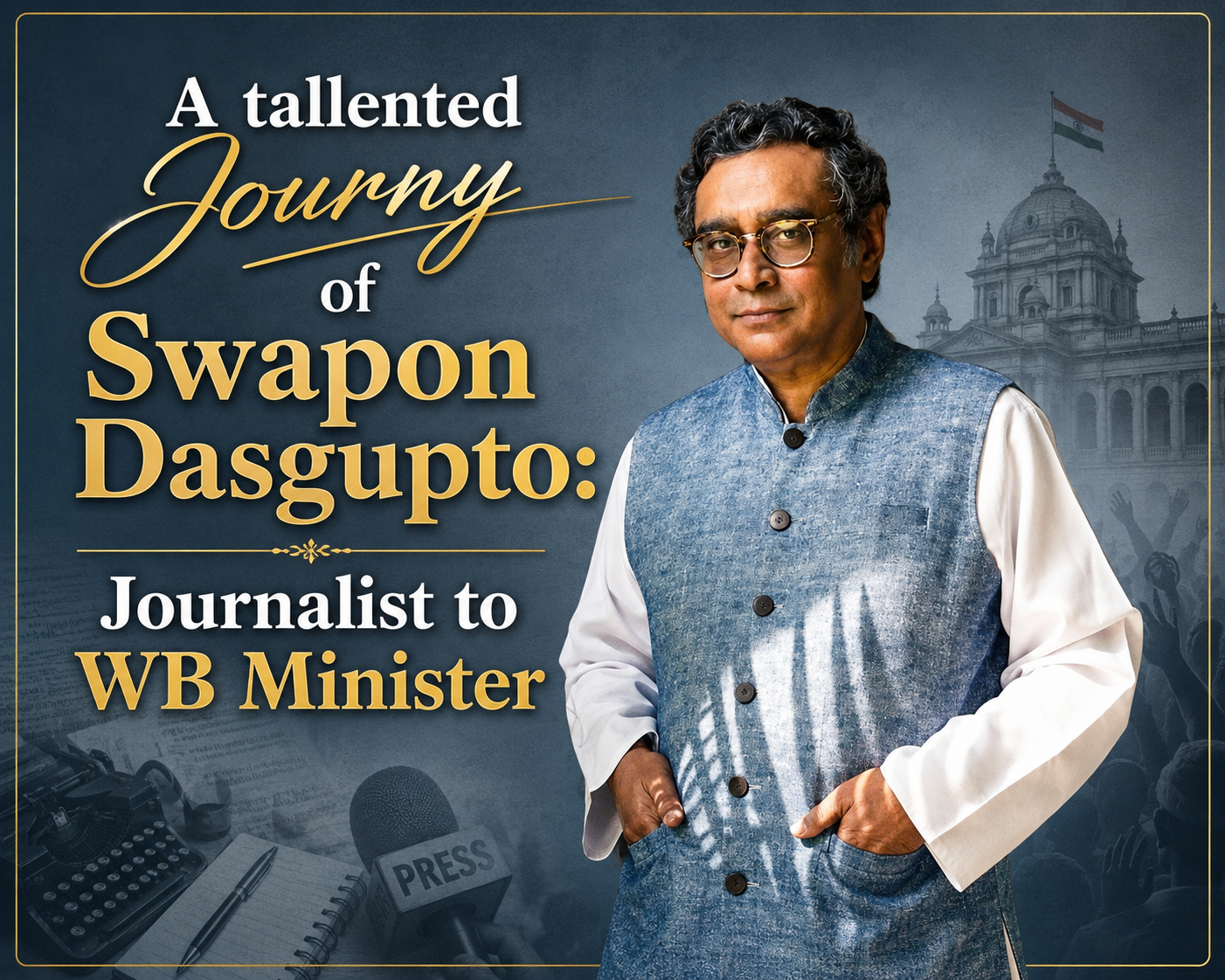
Journalist, Thinker, Minister: Swapan Dasgupta Emerges as a Strategic Bridge Between Public Opinion and Governance
Following a historic shift in the May 2026 West Bengal Assembly elections, the Bharatiya Janata Party (BJP) has formed its maiden government in the state. Amid the formation of the new cabinet under Chief Minister Suvendu Adhikari, one name has taken center stage in both political and intellectual circles—eminent journalist, columnist, and former Rajya Sabha MP, Swapan Dasgupta.
Having secured a resounding victory from the prestigious Rashbehari constituency, Dasgupta’s induction into the cabinet as a Full Minister is being hailed as a masterstroke. His inclusion is set to profoundly reshape the governance, image, and strategic roadmap of the newly formed BJP government. Below is an in-depth analysis of his background, his role in the BJP's rise in Bengal, and the strategic dividends his ministership brings to the table.
Swapan Dasgupta: Professional and Academic Background
Long before his active foray into mainstream politics, Swapan Dasgupta spent over four decades shaping India’s English journalism.
- Academic Excellence: He graduated from St. Stephen's College, Delhi, pursued his Master's from Jawaharlal Nehru University (JNU), and earned his PhD in History from the School of Oriental and African Studies (SOAS), University of London. He was also a Junior Research Fellow at Nuffield College, Oxford.
- Editorial Leadership: Dasgupta has held top editorial positions across India's premier media houses, serving as Managing Editor of The Times of India, Deputy Editor of The Indian Express, Editor-in-Chief of The Pioneer, and Executive Editor of India Today.
- National Recognition: In 2015, the Government of India honored him with the Padma Bhushan, the country’s third-highest civilian award, for his outstanding contributions to literature and journalism. His 2019 book, 'Awakening Bharat Mata: The Political Beliefs of the Indian Right', remains a definitive text on modern Indian conservative philosophy.
Formulating the Narrative: Dasgupta's Role in BJP's Rise in Bengal
The BJP's journey from a marginal player to the ruling party in West Bengal required a massive ideological shift, and Swapan Dasgupta was the chief architect of this narrative. He successfully challenged the long-standing left-liberal intellectual hegemony in the state through several key initiatives:
- Countering the Leftist Hegemony: For decades, Bengal’s socio-political discourse was dominated by Left and liberal intellectuals. Dasgupta used his columns and public debates to critique the systemic failures of the 34-year Left front rule, providing a formidable right-of-center alternative.
- Mainstreaming Nationalism Among the 'Bhadralok': Historically, Bengal's urban middle class (the Bhadralok) resisted aggressive political rhetoric. Dasgupta, with his sophisticated language and profound erudition, gave cultural nationalism and Hindutva a polished, respectable face that resonated deeply with Kolkata’s elite and middle-class intelligentsia.
- Bridging Culture and Politics via 'Khola Hawa': To counter the narrative that the BJP was an outsider to Bengali culture, he founded the socio-cultural organization 'Khola Hawa' (Open Air). Through this platform, he aligned the core philosophy of national revival with the teachings of icons like Rabindranath Tagore, Rishi Aurobindo, and Swami Vivekananda.
- Architect of Election Manifestos: The visionary blueprints and manifestos for the BJP's campaigns, including the detailed roadmap for building a 'Sonar Bangla' (Golden Bengal), were largely brainstormed under his intellectual guidance.
How the Adhikari Government Benefits from Minister Swapan Dasgupta
By appointing Swapan Dasgupta to a full cabinet rank, the Suvendu Adhikari administration secures five distinct political and administrative advantages:
A) Deepening Trust Within the Bengali Middle Class
Detractors have frequently labeled the BJP as a party primarily rooted in the Hindi-heartland. By placing a globally educated scholar like Dasgupta in a position of power, the party sends a crystal-clear signal to Bengal's educated electorate: the government values refined Bengali leadership capable of world-class governance.
B) Unmatched Administrative and Policy-Making Expertise
As the BJP forms government in West Bengal for the very first time, a large section of its legislators consists of grassroots leaders with limited administrative experience. Dasgupta's extensive experience as a parliamentarian in the Rajya Sabha and his association with national think-tanks will provide steady guidance. His oversight will be invaluable for sensitive portfolios such as Education, Higher Education, or Information and Cultural Affairs.
C) A Strong Liaison with New Delhi
Dasgupta is a highly trusted and influential figure within the power corridors of New Delhi. He shares a long-standing rapport with Prime Minister Narendra Modi, the Union Home Minister, and top-tier central bureaucrats. As a state minister, he can seamlessly bridge the gap between Kolkata and New Delhi, ensuring swift clearances for central funds, welfare schemes, and mega infrastructure projects.
D) Global Image Building and Media Management
With his four-decade-long media career, Dasgupta commands immense respect across national and international press circles. Faced with intellectual criticism from opposition benches, the state government now has an eloquent defender who can articulate complex policy decisions rationally and gracefully on national television.
E) Balancing Assertiveness with Moderation
While aggressive politics is often necessary to win elections, sustainable governance requires a touch of moderation. Dasgupta’s calm demeanor, intellectual depth, and non-confrontational personality offer the perfect counterweight, softening the party's image and making the government appear inclusive, balanced, and accessible to all citizens.
The mandate to rebuild West Bengal requires an effective combination of grassroots political acumen and deep intellectual foresight. The synergy between Chief Minister Suvendu Adhikari’s dynamic, people-centric leadership and Cabinet Minister Swapan Dasgupta’s elite policymaking skills promises to steer West Bengal into a highly efficient, modern, and progressive era of governance.
Written By S. Goswami, CSB News USA