
Dengue threat unlikely to ease before December

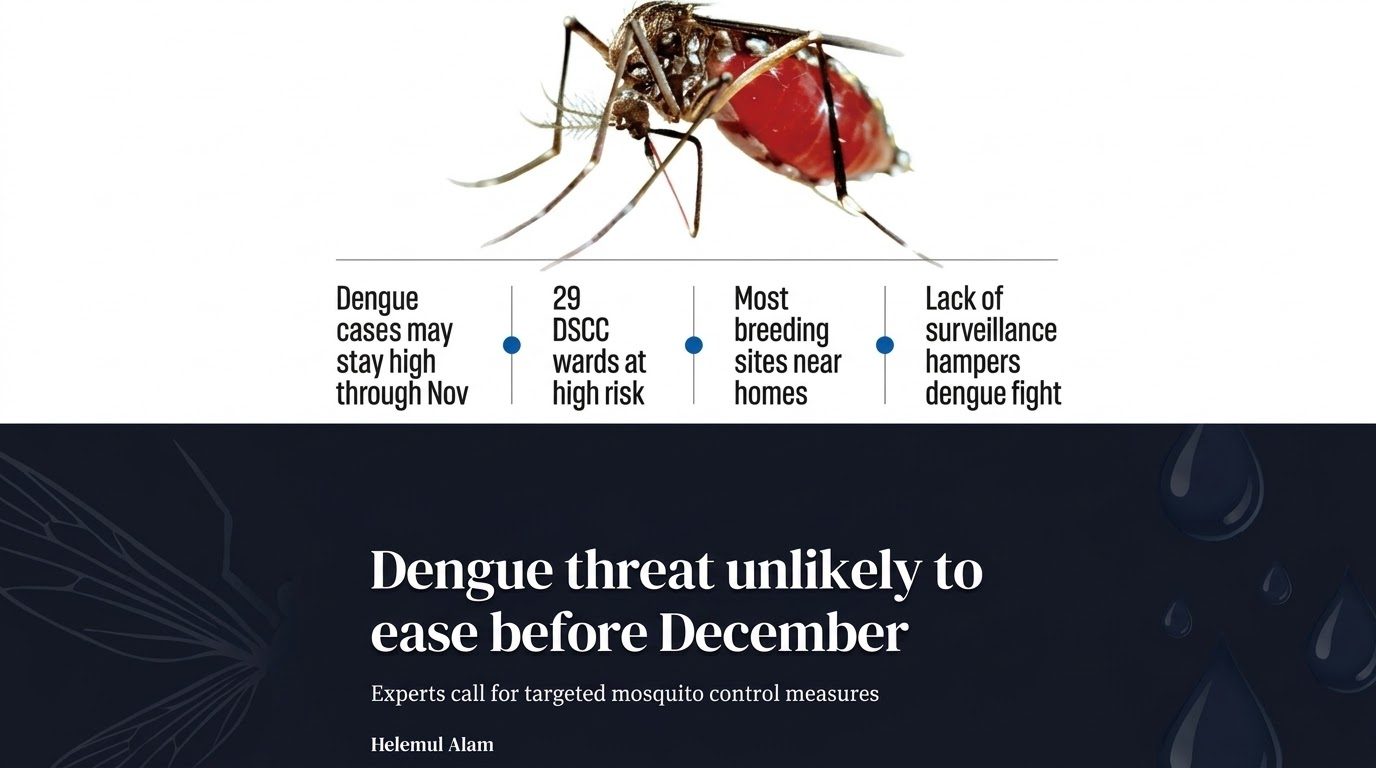
Dengue infections are likely to remain relatively high in November, with no significant decline expected until December, entomology experts have warned.
A recent survey by Dhaka South City Corporation (DSCC) identified 29 of its 75 wards as high-risk areas for Aedes mosquito breeding, while 28 were classified as moderately risky and 18 as low-risk. The survey, conducted from September 27 to October 8, found Aedes mosquito larvae and pupae in 322 of the 2,250 houses inspected.
Of the identified breeding sites, 31.06 percent were in multi-storey buildings, 31.37 percent in independent houses, 17.39 percent in semi-permanent houses and 13.04 percent in buildings under construction.
Stagnant water on floors accounted for 12.26 percent of breeding sources, while plastic buckets accounted for 10.34 percent. Vacant plots were also identified as potential breeding grounds.
Prof Kabirul Bashar of Jahangirnagar University said dengue cases might decline slightly this month, but a significant reduction was more likely in December.
He said nearly 27 years of unsuccessful efforts to control dengue in Bangladesh showed the need for targeted, evidence-based mosquito control, particularly in residential areas.
The Insect Rearing and Experimental Station (IRES) of Jahangirnagar University, led by Bashar, conducts regular mosquito surveillance in Dhaka North City Corporation areas under an agreement between the two institutions. It submits weekly reports to DNCC to support mosquito control activities.
According to the surveillance findings, nearly 70 percent of Aedes breeding sites are concentrated in a limited number of locations, including household drums and buckets, building basements, spaces between buildings, car parking areas, water meter facilities and water tanks.
“The key recommendation is community engagement. These containers are mostly located around people’s homes. Therefore, effective Aedes mosquito control will not be possible without active community involvement,” Bashar said.
Bashar identified the absence of targeted control measures and comprehensive, regular surveillance as major reasons behind Bangladesh’s continued failure to contain dengue.
He said surveillance findings should guide dengue control policies and action plans for the coming year.
He also called for regular surveillance nationwide, saying breeding patterns and risk factors differed between localities such as Barguna and Bandarban.
“Every locality needs a regular surveillance system. Based on surveillance data and scientific evidence, we must develop specific action plans for each locality, city corporation and municipality,” he said.
He suggested that the Ministry of Local Government coordinate surveillance and targeted interventions through local government institutions and specialised expert teams.
Bashar said around 20 percent of Aedes mosquitoes breed in household water containers such as drums and buckets. A regular water supply could reduce dependence on such storage.
He also questioned the need to install WASA meters inside water reservoirs, which can accumulate water and become breeding sites.
Other neglected sites include basement parking areas, stagnant water left after vehicle washing and spaces beneath buildings under construction.
“Through surveillance, we are identifying these breeding sites and making recommendations. But the problem is that the necessary action is not being taken. If effective action were taken based on these findings, mosquito breeding would decline,” he said.
He warned that routine spraying and awareness campaigns alone would not contain dengue unless authorities acted on surveillance findings and eliminated specific breeding sources.
Citizen posts are written by readers and checked by CSB News editors before publishing. They are not CSB News reporting.
Is something happening in your area? Report it to the world. Earn the CSB News Contributor badge.
Post from your area